Morning Pages
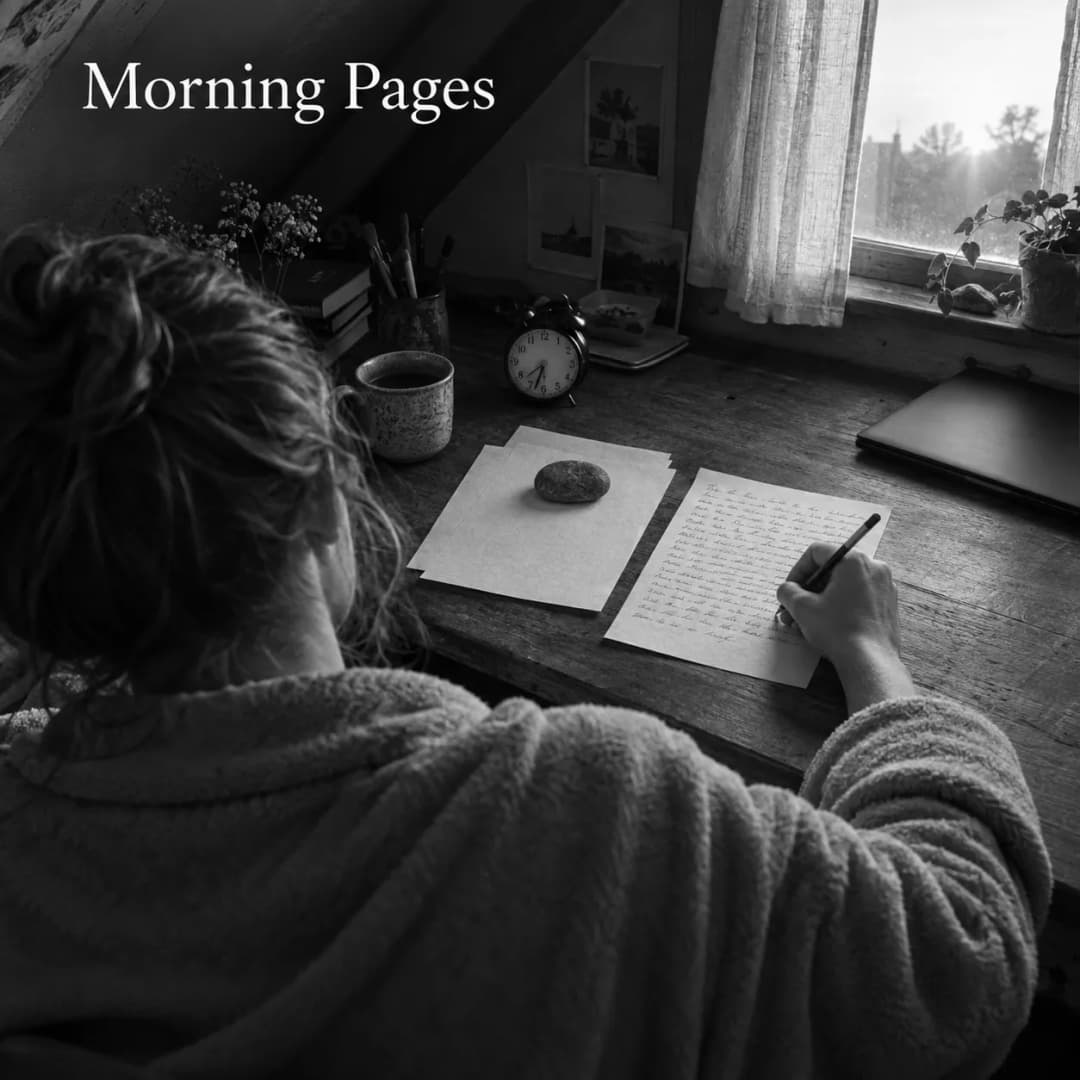
Morning pages are a writing practice, not a research finding: three pages of stream-of-consciousness longhand writing done on waking, before anything else. The practice is Julia Cameron's, from The Artist's Way. No controlled evidence is offered for it in the sources this publication holds, and nobody involved claims otherwise, so there is nothing to mark down. The one caution is that the expressive-writing literature is not about this and its findings do not transfer.
What it is
There is no subject and no standard. You are not writing anything, on Cameron's account. You are clearing what is in the way, and the pages are not meant to be reread or shown to anyone.
Three specifications carry the practice and are usually the first things people drop. Longhand, because it is slow enough to outrun editing. Three pages, because the interesting material arrives after the obvious material has been used up. First thing, because the point is to catch the mind before the day has organised it.
The practice is correctly credited wherever this publication has met it, to Cameron and to The Artist's Way. No publication year is given in the source read here and the primary text has not been opened, so the year is not stated on this page.
In effect
One writer reports doing it for nearly a decade and treats it as the practice underneath everything else in her book, the place where an anxious internal voice gets written out where it can be looked at. That is a plausible use and it is also a modification. Cameron's instruction is that the pages have no purpose. Putting them to work gives them one, and a practice defined by having no goal behaves differently once it acquires one.
The mechanisms people reach for are worth naming as speculation rather than explanation. Producing words yourself may do something that reading them would not, which is the generation effect's territory. The handwriting specification has a neighbouring case in the reading research on screens against paper, and that case is suggestive rather than settled. A daily practice sustained for years is doing identity work whatever else it is doing, and the instruction to do it first thing, before anything else, is what makes it survive as a habit at all.
There is a failure mode neither source addresses. Unstructured daily writing about how you feel can rehearse a loop as easily as it drains one, which is the rumination literature's concern, and nothing in the practice as described guards against it.
What it does not say
It does not say this has been tested. No controlled evidence is offered in the sources this publication holds.
It does not inherit the expressive-writing findings. Those protocols are structured, time-limited and directed at a specified difficult experience, and their results do not transfer to an unstructured daily three-page habit. Any evidence claim near this concept must come from a named study of this practice.
It does not make a health or mood claim. It is a creative practice and this page treats it as one.
And it does not survive its own modification unchanged. Used as a thought record it is a different instrument from the one Cameron described.
Sources
- Cameron, J. The Artist's Way. Named in the secondary source as the origin of the practice. The primary text has not been read here, and no year, publisher or exact wording of the original instruction is recorded.
- Rae, A. Choose Wonder Over Worry. Credits Cameron and the book by name, and reports nearly a decade of the author's own practice.
- Evidence grade: not a research claim. A writing practice with a long history of reported personal benefit and no controlled evidence offered in either source.