Motivational Research
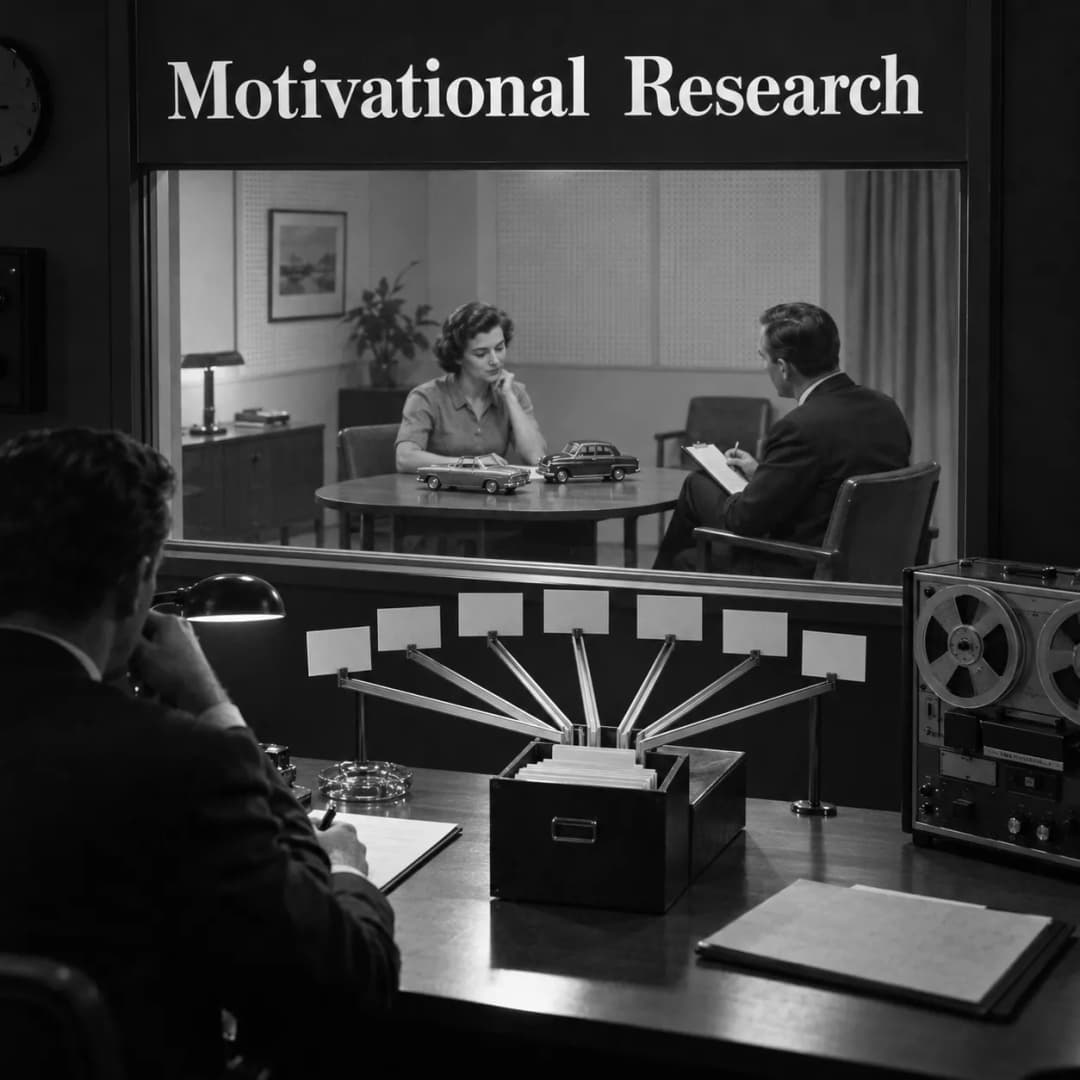
Motivational research is Ernest Dichter's method of digging past what people say they want and into the unconscious associations he believed were driving a purchase. It is a historical market-research technique rather than a testable effect, its interpretations were largely unfalsifiable, and its main legacy is a reputation it did not quite earn: most mid-century advertising ran on behaviourism, not on Freud.
What it is
Dichter brought psychoanalytic depth interviewing into commercial research, beginning in the United States with a study of the Plymouth convertible for Chrysler in 1939, and institutionalised it when he founded the Institute for Motivational Research in 1946. The method was to sit people down and probe them the way an analyst would probe a patient, rather than asking what they would buy.
The Chrysler study is the emblematic case. Dichter read the convertible as a symbolic mistress and the sedan as the reliable wife, reframing a whole product line around a private fantasy rather than a specification sheet. His own line summarises the method: tell him how a man drives, he said, and he would tell you what kind of man he is. The car is not the product being sold. The self-image is.
The obvious problem is the one the method never solved. An interpretation of that kind fits whatever the data does, and there is no result that would count against it.
In effect
The commercial descendants are real. Depth interviewing survives in qualitative consumer research, and the strategy of attaching an unconscious emotional association to a product rather than stating a claim about it is the working logic of brand mythology.
Two credit corrections belong here. The claim that motivational research is where the modern focus group comes from is overstated: the focused interview is usually credited to Robert Merton and colleagues in the 1940s. And the reason Dichter looms so large in the popular story is publicity rather than dominance. Tim Wu's correction is worth carrying: mainstream mid-century advertising ran on John Watson's behaviourism, on stimulus, repetition and conditioned response, and Dichter was the glamorous exception. He was vivid and press-friendly enough that Vance Packard's The Hidden Persuaders, published in 1957, made him the public face of hidden manipulation in advertising generally, which is why the Freudian version of the story stuck even though it was never the dominant one.
The useful thing to notice about the method is its structure rather than its content. It is the 1950s ancestor of a failure mode the field repeated much later with better statistics, where an unfalsifiable account of an unconscious cause is offered for an observed behaviour. The instruments changed. The shape of the argument did not.
What it does not say
It does not say the interpretations were correct. They were largely unfalsifiable, which is a different and worse problem than being wrong.
It does not say mid-century advertising was Freudian. It mostly was not.
It does not say Dichter invented the focus group. That lineage runs through Merton's focused interview.
And it does not carry a finding. This is a method and a piece of commercial history, and it has no effect to replicate.
Sources
- Dichter, E. The Plymouth convertible study for Chrysler, 1939; the Institute for Motivational Research, founded 1946.
- Packard, V. (1957). The Hidden Persuaders. Made Dichter the public face of the method.
- Wu, T. (2016). The Attention Merchants, pp. 133-134 for the Chrysler study and the driving line, p. 147 for the correction that mainstream mid-century advertising leaned behaviourist with Dichter as the publicised exception.
- The vault's evidence review of 2026-09-25 grades this not a research claim, from secondary sources, corrects the originator from the historian to Dichter, and records the focus-group lineage as better credited to Robert Merton's focused interview of the 1940s.