Myelination
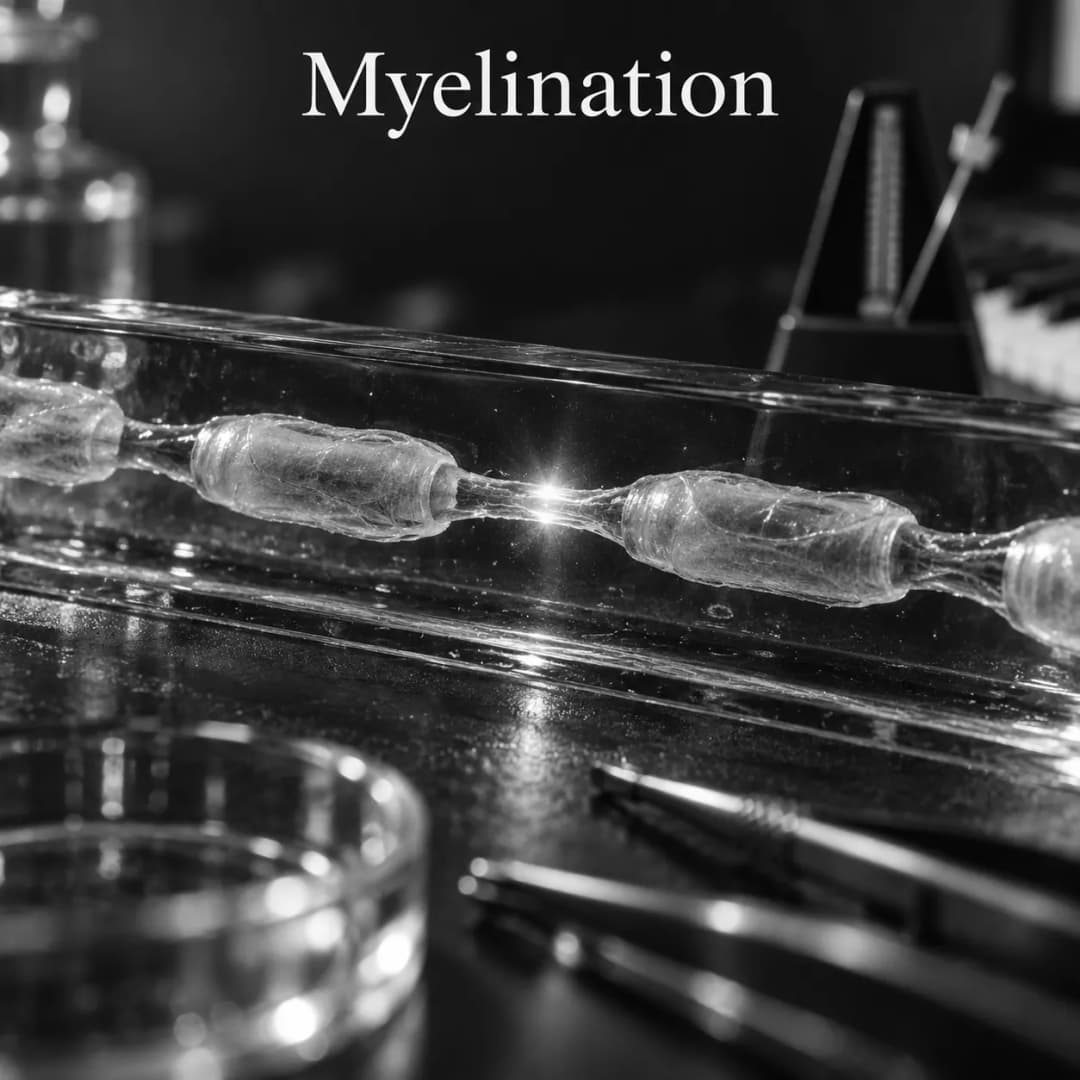
Myelination is the growth of a fatty insulating sheath around nerve fibres, which speeds and sharpens the signal they carry. In the deliberate-practice literature it is offered as the neural mechanism under skill: practise a circuit hard enough and the body insulates it. The research area is real and has primary evidence behind it. The popular claim built on it overreaches, and the version that reaches most readers arrives through a trade book rather than through any measurement.
What it is
Myelin was described in the nineteenth century and named by Rudolf Virchow in 1854. The idea relevant here is much newer: that myelination responds to activity, and that this is part of how learning is consolidated. R. Douglas Fields set out that account in Trends in Neurosciences in 2008.
There is a primary literature, and it is worth naming because the popular treatments do not. Ian McKenzie and colleagues showed in Science in 2014 that mice could not learn a new motor skill well when the formation of new oligodendrocytes was blocked, which is the closest thing to a causal test. Sara Bengtsson and colleagues reported in Nature Neuroscience in 2005 that childhood piano practice was related to white-matter structure.
The limits of that evidence matter. The human work is largely correlational, and the imaging measures used are indirect proxies for myelin rather than measurements of it.
In effect
The route by which this reaches readers of productivity writing is the problem. The claim that to be great at something is to be well myelinated comes from a trade book by a journalist surveying scientists, and the chapter that borrows it for an argument about the intensity of focus cites that trade book and a slideshow by the same author, with no primary neuroscience in the endnotes at all.
A further step is then added with nothing behind it: that isolating one circuit through intense concentration is the only way to trigger useful myelination. That is not a finding from anywhere. It is a gloss on a popularisation.
The honest handling is to keep the behavioural claim and drop the neural story. The advice it supports, concentrate hard on one thing at a time, does not need a mechanism to stand up, and it stands up better without one. This is the same shape as other pieces of unearned brain language in the same genre, where neuroscience vocabulary is attached to a behavioural recommendation to make it feel settled.
What it does not say
It does not say that skill simply is myelination. Nothing in the primary literature supports that equivalence.
It does not say intense focus is the only way to produce it. That claim carries no source.
It does not establish direction in humans. The human evidence is mostly correlational, and imaging proxies are not direct measures.
And it does not licence citing a popular book as a neurobiological source. The primary literature exists, and the popular accounts simply do not cite it.
Sources
- Fields, R. D. (2008). "White matter in learning, cognition and psychiatric disorders." Trends in Neurosciences, 31(7), 361-370. Abstract only.
- McKenzie, I. A., et al. (2014). Science, 346(6207), 318-322. Mice learn a new motor skill poorly when new oligodendrocyte formation is blocked. Abstract only.
- Bengtsson, S. L., et al. (2005). Nature Neuroscience, 8(9), 1148-1150. Childhood piano practice linked to white-matter structure. Abstract only.
- Coyle, D. (2009). The Talent Code. The trade book that is the source of the popular claim.
- Newport, C. Deep Work, ch. 1, pp. 36-37, sourced to Coyle and a slideshow. The claim at p. 37 that intense concentration is the only way to trigger useful myelination carries no source.
- Evidence grade: mixed. A live research area with real support, carrying a popular claim that overreaches it.