Nanotargeting
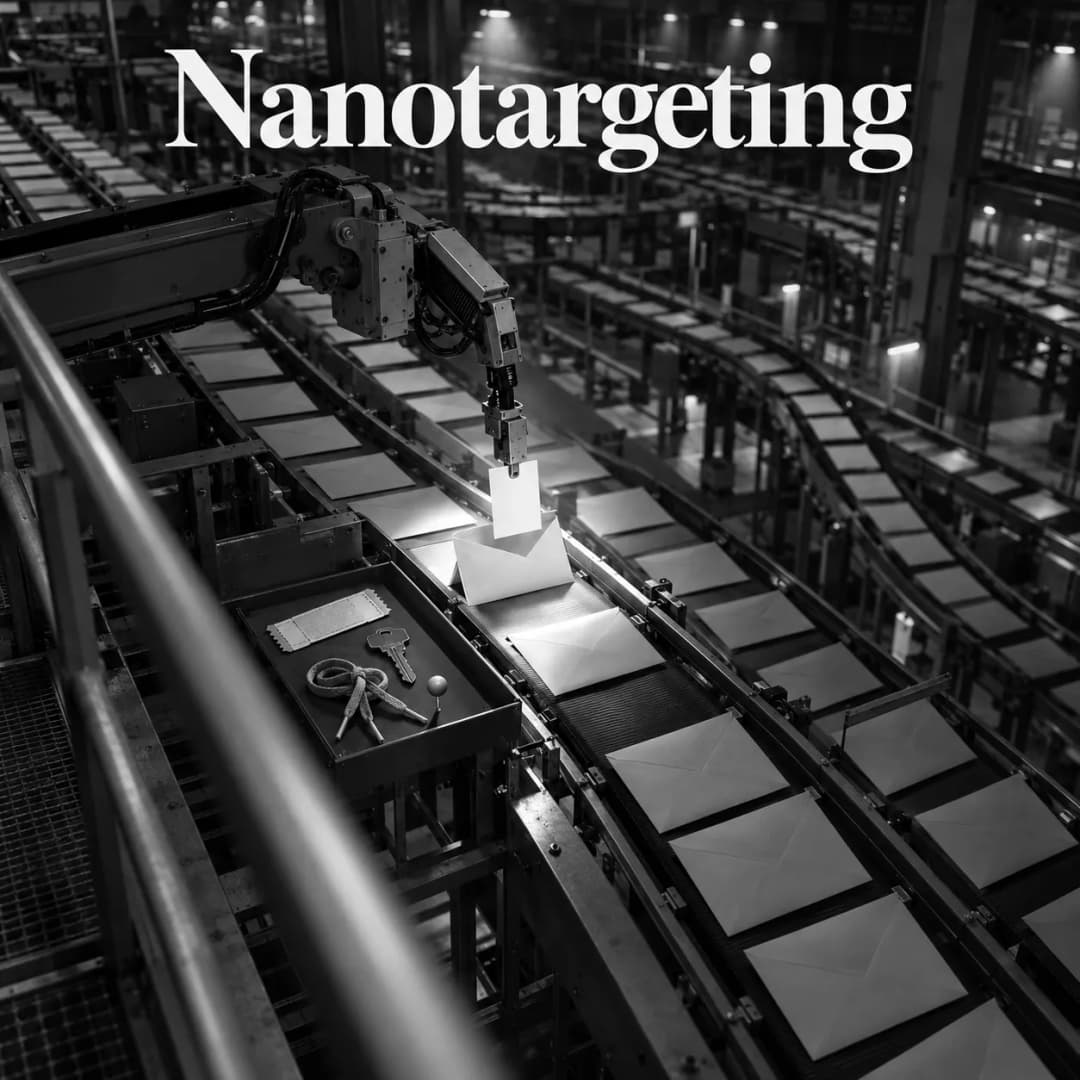
Nanotargeting is advertising aimed at individuals rather than at markets: not women aged twenty-five to forty, but a specific person defined by age, location, stated interests and behaviour. It is a descriptive term rather than a testable effect. It is also not merely theoretical: a 2021 measurement study demonstrated that advertisers could reach a single identified user on a large platform using interest categories alone, without any personally identifying information.
What it is
The shift the term names is from segments to individuals. Geodemographic clustering, the predecessor, sorted people by postcode into types. Nanotargeting sorts them one at a time.
The instrument that made it possible at scale is the like button, which looks like a harmless social gesture and functions as a continuous feed of brand-affinity data. The infrastructure behind it is quiet and largely invisible: a single visit to a mainstream news site can trigger a substantial number of separate tracking calls, none of which the reader sees.
Tim Wu's illustration in The Attention Merchants is an advertiser targeting suburban men in a specific age band in one American state who like two named rock bands, a slice of audience no mass-market buy could ever isolate. He notes that the like button is socially useful on its face while generating exactly this affinity data underneath.
The term itself is industry and research usage that Wu employs. This publication has not confirmed that he coined it and does not credit him with doing so.
In effect
The feasibility question has since been answered empirically. José González-Cabañas and colleagues published a measurement study at the ACM Internet Measurement Conference in 2021 showing that advertisers could reach a unique individual on a major platform using non-identifying interest data alone. That is the citation to use for the claim that the practice is possible, rather than any of the popular accounts.
The commercial logic is straightforward and the privacy consequence is the point. A platform that knows enough about a person to reach only them has, by construction, accumulated a profile nobody agreed to in those terms. Wu argues that the tracking apparatus is more invasive than any disclosed state surveillance programme, which is his comparison and this publication has not traced it. Eric Schmidt's widely reported remark about getting right up to the creepy line and not crossing it is the industry's own statement of how thin the line is, and it is a 2010 interview quote rather than a finding.
The reason the like button is used so freely, despite being the collection instrument, is that liking things is itself a public identity signal. The gesture the user wants to make and the data the platform wants to collect are the same gesture.
What it does not say
It does not say that nanotargeting changes behaviour. The demonstrated claim is about reach, not about persuasion, and effectiveness is a separate and much less settled question.
It does not supply a verified tracking count. The figure quoted for tracking calls on a news site is one author's claim and was not traced.
It does not name a coiner. The term is in general industry and research use.
And it is not a research finding in itself. It is a description of a practice, and the evidence attaching to it concerns whether the practice is technically possible.
Sources
- González-Cabañas, J., et al. (2021). "Unique on Facebook: Formulation and evidence of (nano)targeting individual users with non-PII data." Proceedings of the ACM Internet Measurement Conference. Abstract only. Demonstrated that advertisers could reach a single user using interests alone.
- Wu, T. (2016). The Attention Merchants. The targeting example at pp. 297-299; the like button as data instrument at p. 300; the tracking-call count, the surveillance comparison and the Schmidt quote at p. 323. The tracking count and the comparison are Wu's own claims and were not traced.
- Evidence grade: not a research claim. The vault's review of 2026-09-25 records that the term was not confirmed as Wu's coinage.