Neuroadaptation
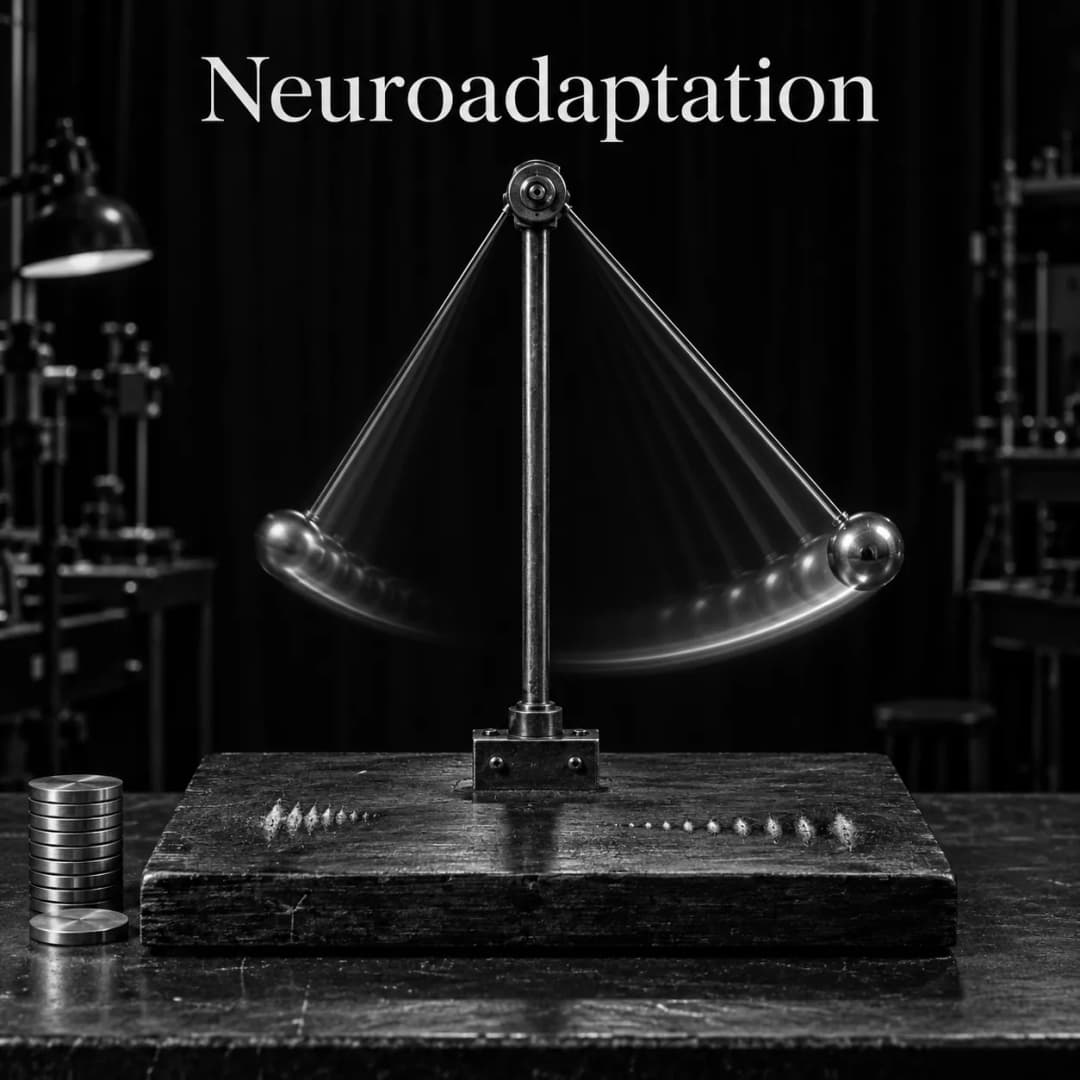
Neuroadaptation is the process by which repeated exposure to a stimulus reshapes the response to it, so that the pleasure side weakens and gets shorter while the opposing response after it strengthens and gets longer. The net result is tolerance. The term itself is general in addiction science and has no single coiner, which is fair enough. The specific claim inside it, that the opposing response both strengthens and lengthens, is not a definition but a finding, and it belongs to Richard Solomon and John Corbit. It is well supported for drug tolerance and withdrawal. Its extension to reading, running, gaming and pornography is not.
What it is
Described at the level of a single response the process is neuroadaptation. Described at the level of the regulated baseline it is allostasis, and the two names describe the same machinery at different scales.
The mechanism people usually mean when they say neuroadaptation is opponent-process theory, set out by Richard Solomon and John Corbit in Psychological Review in 1974. On their account every affective response recruits an opposing response, the a-process and the b-process. With repetition the first weakens and the second grows and outlasts it, so the same dose delivers less of what it used to and more of what follows it. George Koob and Michel Le Moal extended this into an allostatic account of addiction in 2001, in which the regulated set point itself moves.
For drugs, counter-adaptation driving tolerance and withdrawal is well supported. Opponent-process theory's predictions for affective experience outside drugs have had uneven support, and that boundary is where most popular writing goes wrong.
In effect
Anna Lembke uses neuroadaptation in Dopamine Nation as the mechanism sitting under her pleasure-pain balance, and it is what makes a shift in the hedonic set point a claim with a process behind it rather than an assertion. Her clearest instance is her own: a romance novel that gripped her the first time, then needed more of the same to do anything, then stopped working at all while the wanting stayed. The pleasure got smaller and shorter each time and the flatness afterwards got bigger and lasted longer. She runs the same shape for the runner's high, for gaming and for pornography.
Two things about that use are worth recording. The text introduces the term with the phrase "a process scientists call" and then names no originator, no year, no laboratory and no study, so a reader who wants to follow it upstream has nowhere to go. And the reading case is a patient case in all but name, with no cited study in the book covering reading at all. It is a good illustration and it is not evidence.
One qualifier travels with the whole idea. If wanting and liking are separate systems, a weakening pleasure response does not entail a weakening pull, which is precisely why people persist past enjoyment.
What it does not say
It does not say that the behavioural generalisation is established. Tolerance to a drug and habituation to a novel is not the same claim, and the evidence behind the second here is clinical anecdote.
It does not say that the term belongs to anyone in particular. Neuroadaptation is general vocabulary in addiction science, and demanding a single originator for it would be a category error. The strengthens-and-lengthens claim inside it is the part that wants a citation.
It does not say that the pleasure is gone. What the process describes is a smaller and shorter positive response with a larger and longer negative one after it, not the disappearance of the first.
It does not supply any dose, threshold or recovery period, and nothing here bears on any individual's care.
Sources
- Solomon, R. L., & Corbit, J. D. (1974). "An opponent-process theory of motivation." Psychological Review, 81(2), 119-145. The source of the strengthens-and-lengthens prediction.
- Koob, G. F., & Le Moal, M. (2001). Neuropsychopharmacology. The allostatic extension.
- Lembke, A. Dopamine Nation. Introduces the term as "a process scientists call", with no originator in the text or the apparatus. The reading, running, gaming and pornography cases are the author's interpretation, not established findings.
- Evidence review, 2026-09-25. Verdict: mixed.