Neuroarts
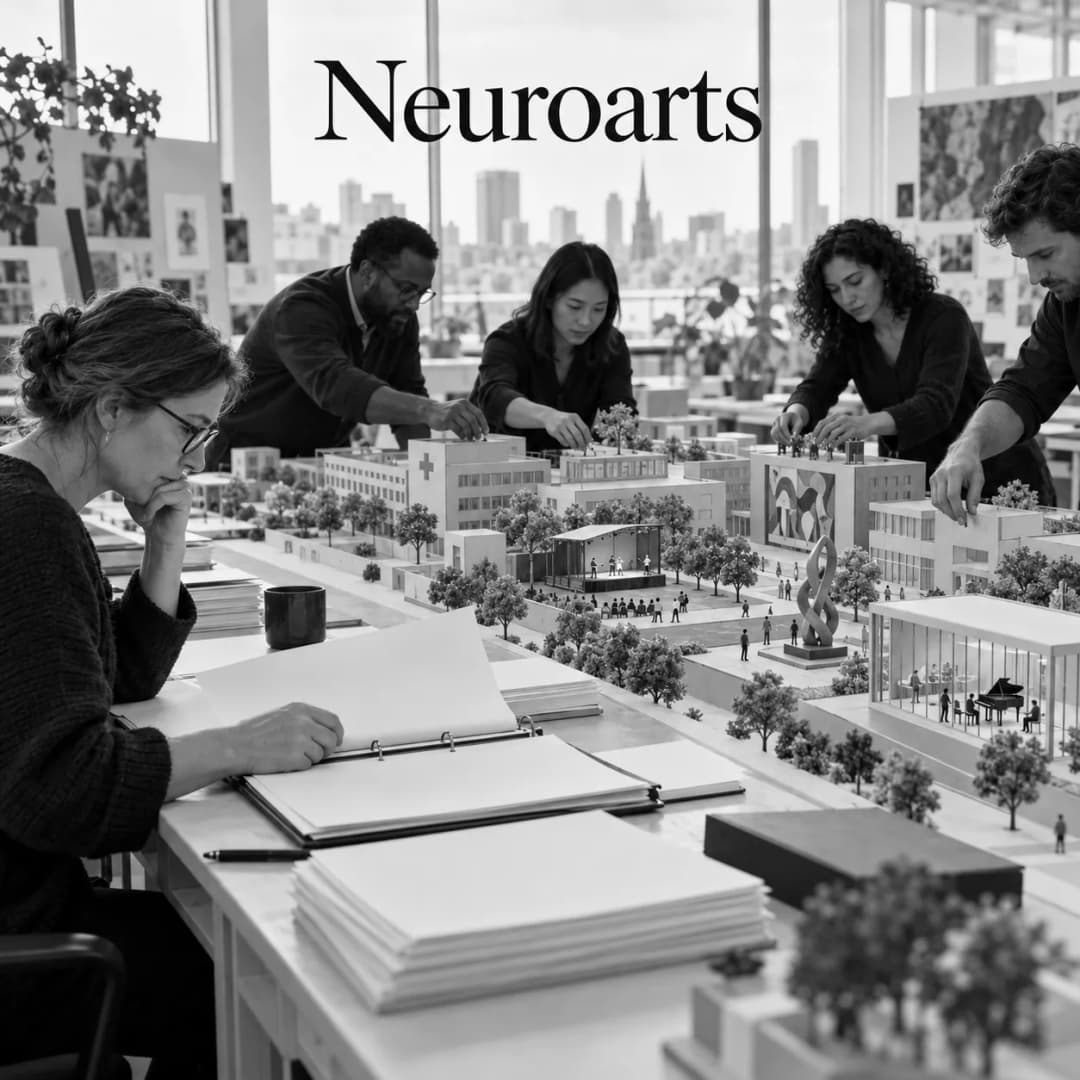
Neuroarts is the applied and advocacy arm built on top of neuroaesthetics: the effort to get arts and aesthetic experience into medicine, education, architecture, urban design and workplaces, supported by institutions, blueprints, funders and practitioners rather than by a single research programme. It is a programme rather than a proposition, so there is nothing in it to replicate. This publication keeps it apart from the research field on purpose, and treats none of its health claims as established.
What it is
Neuroaesthetics asks what the brain does. Neuroarts argues what should therefore be built, funded and prescribed. Holding the two apart is the whole point of having a separate entry, because the second can be right or wrong independently of the first.
No originator is named for the term in this library's source. What the field has instead is an institutional centre of gravity. Its central artefact is the NeuroArts Blueprint, a five-year initiative released in 2021, co-directed by Susan Magsamen through the International Arts and Mind Lab at Johns Hopkins and by Ruth Katz of the Aspen Institute, with a twenty-five-person global advisory board co-chaired by Renée Fleming and Eric Nestler, on which Ivy Ross serves. Every one of those relationships is a matter of public record, and several are stated in the source's own parentheses.
In effect
This library's only source on neuroarts is Your Brain on Art, which is written by two of the field's architects, reports on the institutions they direct and serve on, and carries no disclosure statement of any kind. That is recorded here as public record and never as an allegation. It is still a reason to hold the field's self-description loosely.
What can be assessed is the evidence the programme cites, and it is uneven. The arts-and-health epidemiology is real and observational. The arts-education transfer literature has been repeatedly deflated. The brain-mechanism claims are the weakest part, and are frequently sourced to press coverage rather than to studies.
One number the field uses has no paper behind it. The conclusion of Your Brain on Art rests at page 231 on a claim that neuroaesthetic research has already identified more than six hundred mechanisms by which the arts affect us. The verification pass could locate no source, dataset, review or database corresponding to any such count. It is untraced, and this publication repeats it in no form.
Both sides are worth stating. Building an applied field before the mechanisms are settled is ordinary and sometimes necessary, medicine has done it repeatedly, and arts programmes in hospitals and schools are cheap, low risk and often valued by the people in them. Against that, an advocacy field that supplies its own evidence review, its own blueprint and its own popular book has no adversarial reading built into it. The programme is defensible, its self-report is not evidence, and every health claim it makes needs an independent primary source.
What it does not say
It does not say that the programme is illegitimate or that anyone in it has behaved improperly. No allegation of misconduct is made or implied here.
It does not say that arts provision produces any particular health outcome. This publication carries no outcome claim on the field's authority.
It does not say that the six-hundred-mechanisms figure means anything. It was searched for and not found, and it should be named as untraced wherever it turns up rather than repeated as data.
It does not inherit authority from neuroaesthetics. A research field's findings do not transfer to a programme built on top of them without the programme earning its own evidence.
Sources
- Magsamen, S., & Ross, I. Your Brain on Art. Canongate, 2023. Blueprint material at pp. 239 and 242; the six-hundred-mechanisms claim at p. 231; the institutional positions throughout. The book is this library's only source on the field and is written from inside it.
- Verification pass, 2026-09-20. The six-hundred-mechanisms figure: searched for and not found, recorded as checked and not found. Magsamen's founding and directing role at the International Arts and Mind Lab, her co-directorship of the NeuroArts Blueprint with the Aspen Institute, and Ross's role at Google all confirmed as public record.