Outcome Bias
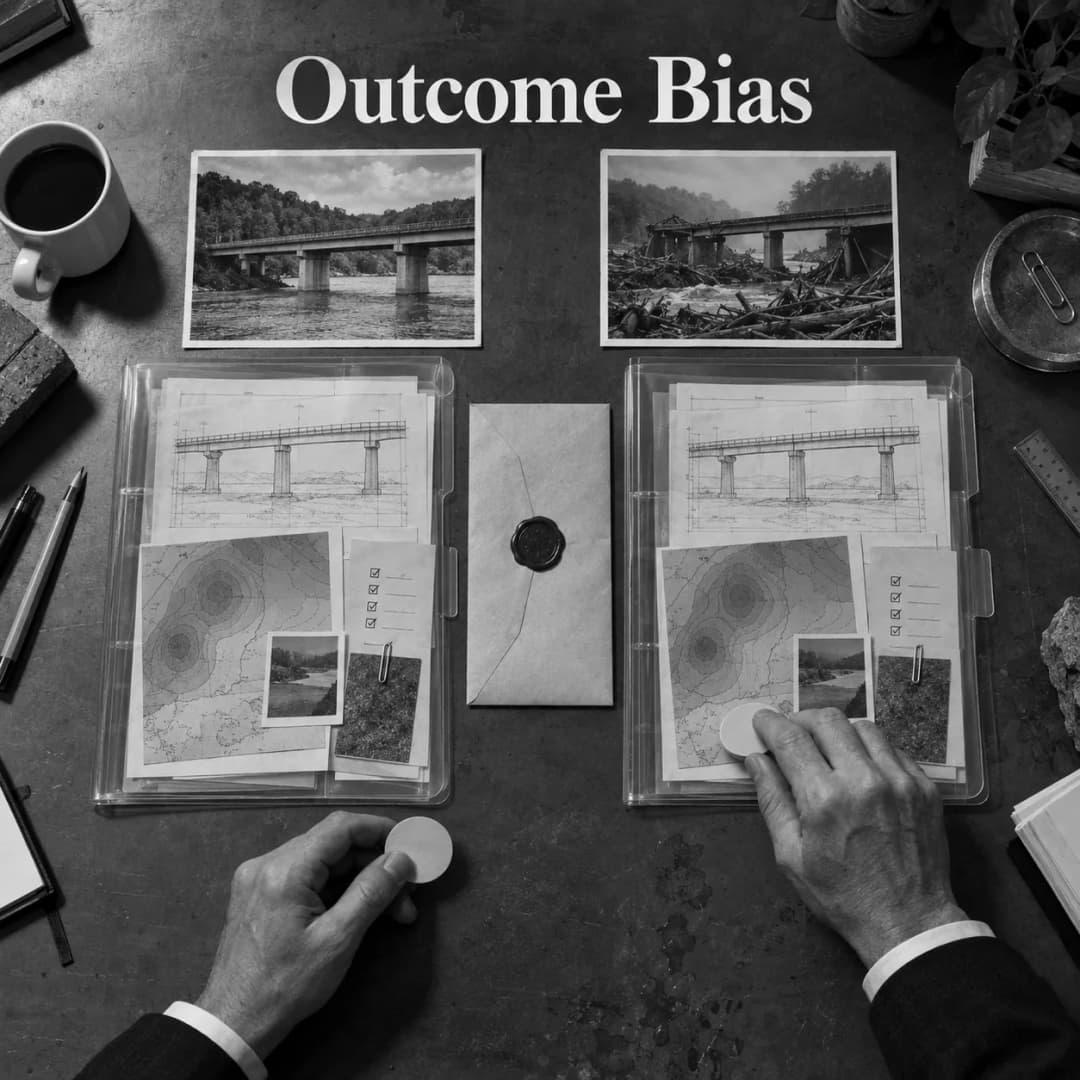
Outcome bias is judging the quality of a decision by how it turned out rather than by whether the process behind it was sound. A good decision that ends badly gets punished; a reckless one that ends well gets promoted. It was named and demonstrated by Jonathan Baron and John Hershey in 1988 and has been reproduced many times since. The point is not that outcomes are irrelevant. It is that nobody can hold the process and the result apart once the result is known, and whole professions are appraised on the wrong one of the two.
What it is
Baron and Hershey published the effect in the Journal of Personality and Social Psychology in 1988. Their participants rated identical decisions as better when told they had turned out well, which is the whole finding in one sentence.
The bias is parasitic on hindsight bias. Because you can no longer recover what was knowable at the time, the outcome feels like something the decision-maker should have seen coming, so blaming them feels fair rather than unfair. Hindsight bias itself has meta-analytic support, and the two effects travel together closely enough that studies of one routinely measure the other.
Daniel Kahneman's list of who this punishes, from chapter 19 of Thinking, Fast and Slow, is worth keeping: physicians, financial advisers, third-base coaches, chief executives, social workers, diplomats and politicians. What they have in common is that the work is decision-making under uncertainty and the audit happens afterwards, when the uncertainty has resolved and looks as though it never existed.
In effect
The illustration usually given is the Duluth bridge-monitor case, and the book that popularised it names no researcher, no year and no sample. The study is Kim Kamin and Jeffrey Rachlinski, published in Law and Human Behavior in 1995.
Participants judged whether the city should have paid for a full-time bridge monitor. Shown only the evidence available at the time of the decision, twenty-four per cent said yes. Told in addition that debris had blocked the river and caused major flood damage, fifty-six per cent said yes, and they had been explicitly instructed not to let hindsight distort their judgment. That instruction is the point. The bias more than doubled the judgment of negligence in people who had been warned about it and were trying to discount it, which makes it something other than a failure of effort or goodwill. Strictly the design measures hindsight bias in negligence judgements, the sibling effect, and it is best cited as hindsight feeding outcome-based blame rather than as a direct demonstration of outcome bias.
Kahneman's generalisation on the same page is that the worse the consequence, the greater the hindsight bias, which is why officials who failed to anticipate a catastrophe are so readily judged negligent or blind. The practical cost is the part worth writing about. Increased accountability is a mixed blessing: it pushes decision-makers toward bureaucratic solutions and extreme risk aversion, with defensive medicine as the worked case, and the same machinery hands undeserved rewards to reckless risk seekers who happen to get lucky.
What it does not say
It does not say that outcomes carry no information. Over enough decisions, results are the only feedback there is. The claim is about single cases judged after the fact, where the result swamps everything that was knowable before it.
It does not say that warning people works. The Kamin and Rachlinski participants were warned, tried to comply, and produced the effect anyway.
It does not say that accountability is a mistake. It says that auditing results while leaving reasoning unexamined selects for defensiveness, and that the remedy is to put the reasoning on the record before the outcome can contaminate it.
It does not license the phrase "a study found" with no study attached. The figures above belong to a named paper, and the popular account that made them famous supplies neither the paper nor the authors.
Sources
- Baron, J., & Hershey, J. C. (1988). "Outcome bias in decision evaluation." Journal of Personality and Social Psychology, 54(4), 569-579.
- Kamin, K. A., & Rachlinski, J. J. (1995). "Ex post does not equal ex ante: Determining liability in hindsight." Law and Human Behavior, 19(1), 89-104. Foresight group 24 per cent, hindsight group 56 per cent, the latter instructed to ignore what they knew.
- Guilbault, R. L., et al. (2004). Basic and Applied Social Psychology, 26(2-3), 103-117. Meta-analytic support for hindsight bias.
- Kahneman, D. Thinking, Fast and Slow, ch. 19, for the exposition, the professions list and the accountability argument. The book names no researcher for the bridge-monitor study.
- Evidence review, 2026-09-25. Verdict: robust.