Overconfidence
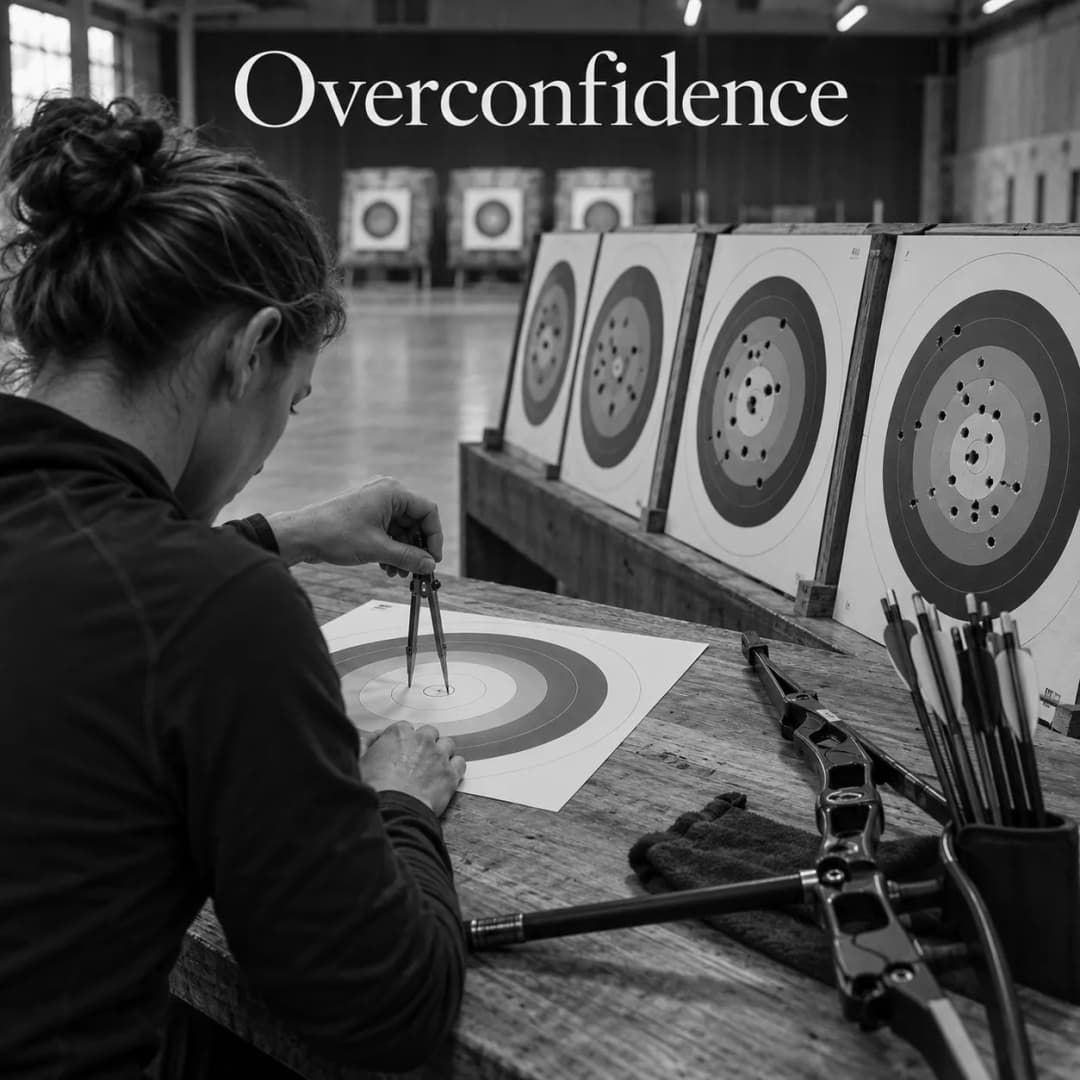
Overconfidence is believing you are better, more able or more right than you actually are. The useful move is to stop treating it as one thing. Don Moore and Paul Healy split it in 2008 into three separable facets, and they do not behave alike. Over-precision, exaggerated confidence in the accuracy of your own beliefs, is close to universal and is the one that does the most professional damage. The other two reverse direction depending on how hard the task is, which is why the flat sentence that people are overconfident is only unconditionally true of precision.
What it is
Moore and Healy set out the decomposition in Psychological Review in 2008, and it has been standard since.
Over-placement is a positively biased view of yourself relative to other people, the better-than-average effect. Over-estimation is an inflated view of your own absolute ability or performance, independent of anyone else. Over-precision is exaggerated confidence in the accuracy of your beliefs, so that your confidence intervals are too narrow.
The qualification is central to their paper rather than a footnote to it. On hard tasks people tend to underestimate and under-place; on easy tasks the pattern reverses. Moore and Healy's model was built to explain exactly that reversal, which is the hard-easy effect. Over-precision is the facet that persists across forecasting and interval-estimation studies without that sign change.
In effect
The three come apart in ordinary settings. A driver who thinks they are safer than average is over-placing. A forecaster who says a project will take six weeks when it takes twelve is over-estimating. An analyst whose ninety per cent confidence range contains the true answer half the time is over-precise, and that is the version that does the most damage in professional work, because it is the least visible to the person doing it.
Richard Shotton takes the idea into marketing in The Choice Factory, and the applications are the usable part. A team that assumes its next campaign will beat the competition is tempted to spend less, when the base rate says the work will be average, so resist cutting the budget. Campaigns that still outperform rivals are often dropped because they have lost some early lustre to the people who commissioned them. And more information raises forecasters' confidence without raising their accuracy, which is over-precision in a marketing setting.
The sourcing around those applications needs stating. Shotton frames the chapter through the Dunning-Kruger effect, and the strong popular version of that effect is not supported, so nothing here should say that a lack of skill causes confidence. His over-placement examples and the handicappers study he attributes to Paul Slovic are given with name and year only and are recorded in this library as not confirmed, with no samples. The Moore and Healy decomposition fits his own material better than the framing he uses.
What it does not say
It does not say that people are overconfident in every direction at once. On difficult tasks the bias runs the other way, and a claim that ignores task difficulty is overstating the finding.
It does not support the self-estimated intelligence figures that circulate with it, including the reported sex difference in points and the correlation between self-estimated and tested intelligence. Those were not traced to a primary source and are not printed here.
It does not say that confidence is a defect. The construct is about calibration, and being well calibrated includes being confident when confidence is warranted.
It does not say that knowing about the bias fixes it. The tested corrections are procedural: take the outside view, and force yourself to state what would make your estimate wrong.
Sources
- Moore, D. A., & Healy, P. J. (2008). "The trouble with overconfidence." Psychological Review, 115(2), 502-517. The three-facet decomposition and the hard-easy reversal.
- Furnham, A., & Grover, S. (2020). "Correlates of self-estimated intelligence." Journal of Intelligence, 8(1), 6. Confirmed on Crossref. The printed sex-difference and correlation figures in the popular account were not traced and are not cited.
- Furnham, A. The New Psychology, ch. 35. Five references listed, none cited in the prose; Moore and Healy appear in the bibliography and are unnamed in the text.
- Shotton, R. The Choice Factory, Bias 13, pp. 89 to 93. The Dunning-Kruger framing is quarantined in this library; the Svenson, Cross and Slovic citations are recorded as not confirmed and carry no samples.
- Evidence review, 2026-09-25. Verdict: robust, with the hard-easy qualification attached.