Personified Emotion
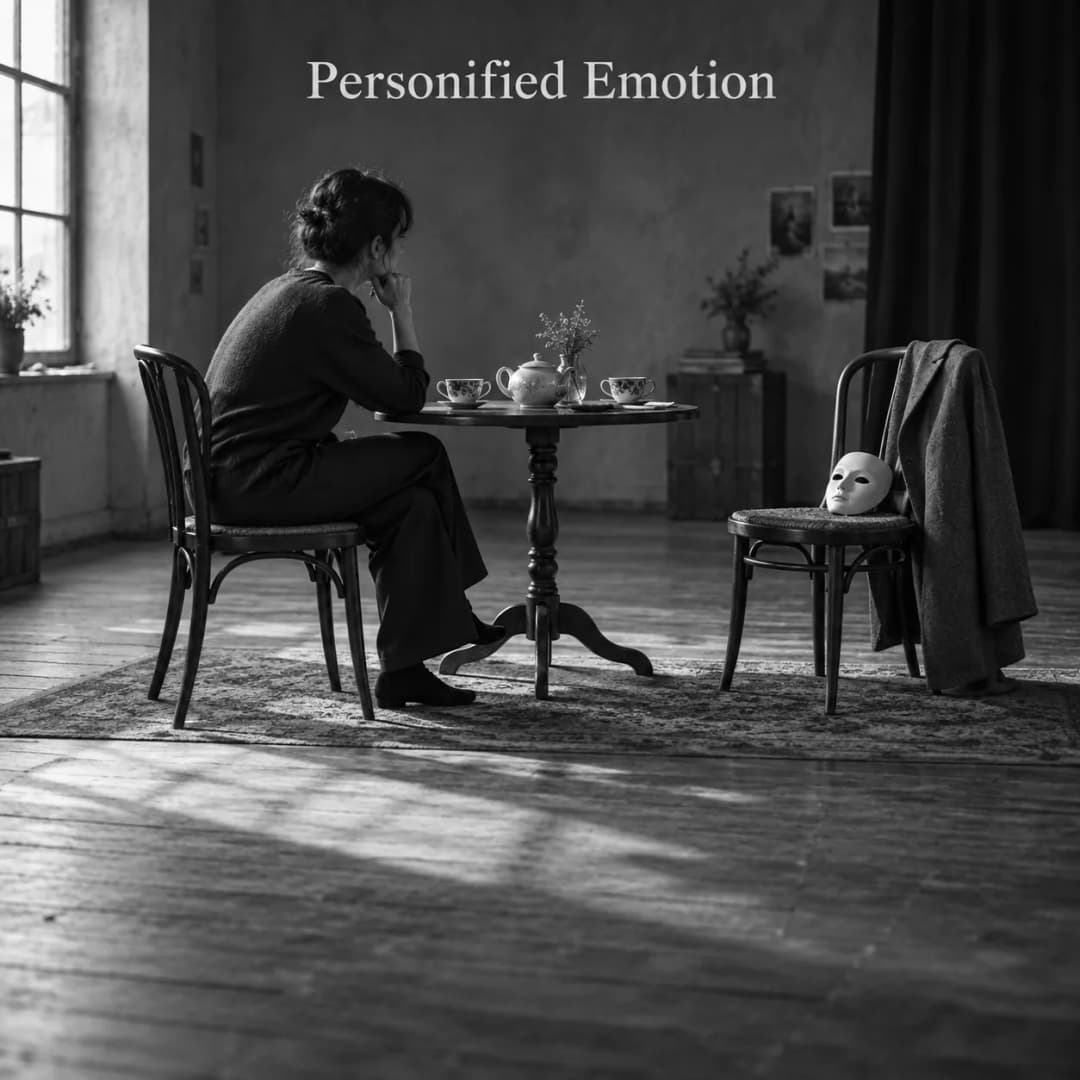
Personified emotion is the practice of addressing a feeling as a character rather than as a state. The feeling is given a name, a capital letter, a voice and something it wants, and then it is asked what it is here to tell you. It is a practice, not a testable effect, and grading it against an evidence standard it never entered would produce a meaningless verdict. The move has two halves and they do different work: naming is the cheap and defensible half, and personifying is the half that carries the risk.
What it is
Naming separates the person from the state, so that "I am anxious" becomes "Anxiety is here", which is a smaller claim about the self. That half overlaps with a real literature on affect labelling. Personifying then gives the state intentions, so that it can be negotiated with instead of endured, and that half has no literature behind it.
Externalising a state so that it can be addressed is not new and is not fringe. Narrative therapy has used the move for decades, with a clinician in the room. In popular form its best-credited antecedent is Tara Brach's Inviting Mara to Tea, in which a difficult state arrives as a guest and is welcomed rather than expelled, and Amber Rae credits Brach by name, credential and title. She also quotes Cheryl Strayed's advice that the inner terrible someone is better taken out for a glass of wine than killed off, which is the same instruction in a different register.
In effect
In Choose Wonder Over Worry the device is not a technique inside the book but its structural spine. Part Two is twenty-two chapters, each titled as a meeting with an emotion, and the reader is introduced in turn to Worry, Fear, Shame, Envy, Anxiety, Addiction, Procrastination, Comparison, Doubt and the rest. Each chapter closes with the same hand-lettered worksheet asking the reader to write down what the character said.
That format has a consequence worth stating carefully. A character who always has something to tell you cannot be wrong: whatever the reader writes down is treated as the message, and the exercise is identical whether the underlying state is a passing irritation or a symptom. That is a property of the device rather than a criticism of any one chapter.
The sharpest observation about the architecture is that clinical terms appear in the same series as ordinary moods. Anxiety and Addiction sit in the same list as Envy and Procrastination, at the same length, in the same voice, with the same closing exercise, and the book never marks a line between a mood and a diagnosis. The anxiety chapter's own examples run from social-media comparison to a full panic attack and all of it receives the same answer. The addiction chapter narrates a severe case at length and names no clinician, treatment or programme. Stated neutrally, the device is doing what it was designed to do, which is to make a state feel approachable, and that is a virtue for envy and a hazard for a disorder.
What it does not say
It does not say that the practice works or that it does not. No study is offered here, none is implied, and the author claims no scientific standing for it anywhere.
It does not carry the evidence for affect labelling across to the personifying half. The naming step has a literature; giving the state a voice and a wish does not.
It does not make a clinical term a disposition that can be talked to. Personifying a diagnosis as a friendly character converts a category with criteria into something the reader is invited to negotiate with, and that is a formatting decision with consequences rather than a claim about the condition.
It does not supply guidance for anyone dealing with a diagnosed condition, and nothing in this entry should be read as any.
Sources
- Rae, A. Choose Wonder Over Worry. Part Two, twenty-two chapters, each closing with a journalling worksheet. The device is the book's organising structure.
- Brach, T. Radical Acceptance, credited by Rae with name, credential and title. Primary text not read for this entry.
- Strayed, C., credited by Rae and quoted on the inner terrible someone. No book or column named in the passage.
- Narrative-therapy externalisation is recorded here as an adjacent tradition. It is not named in the book and no primary source has been read for it.