Placebo Effect
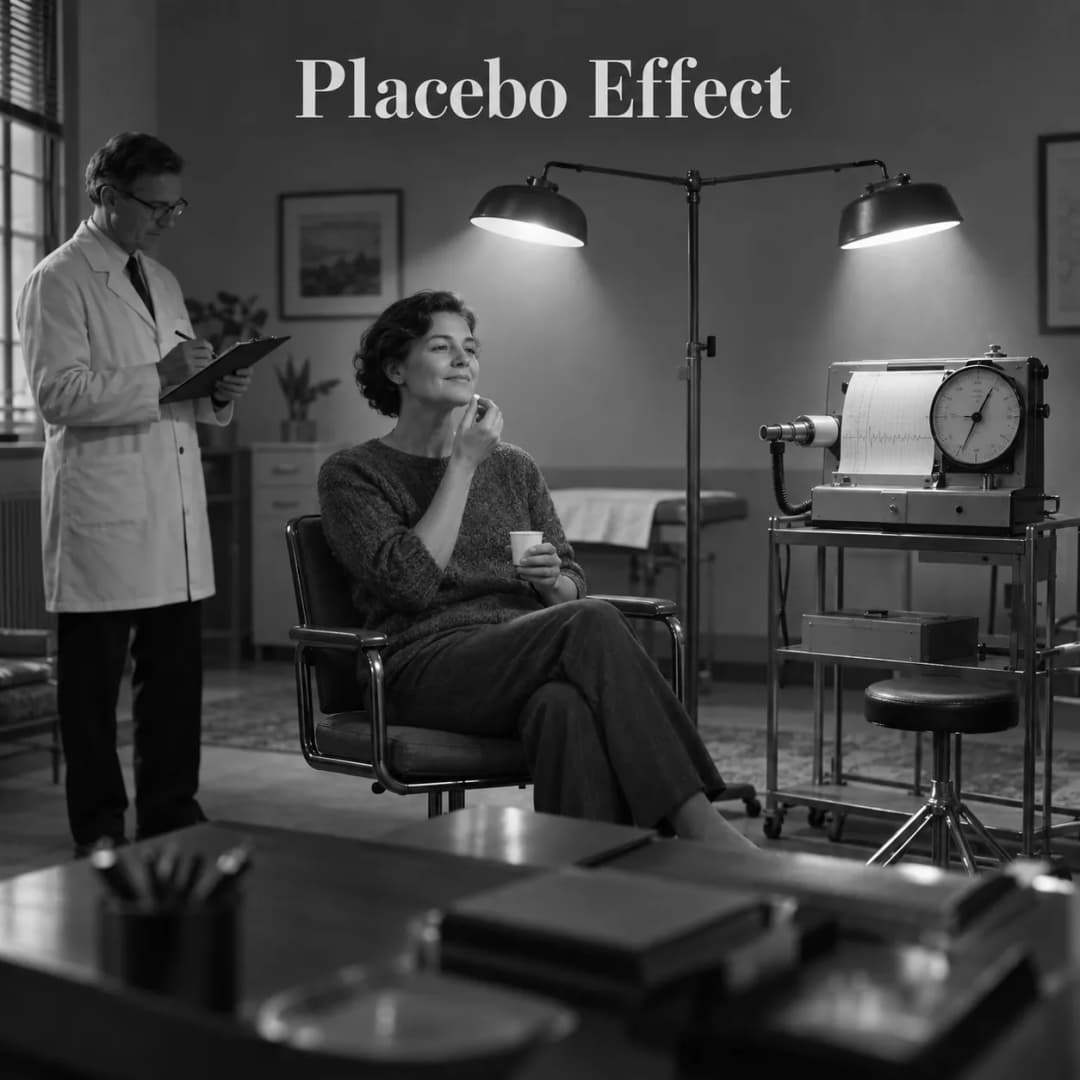
The placebo effect is an improvement that follows a treatment because of what the patient expects from it rather than because of what the treatment does. The single most useful thing to know about it is the split by endpoint. Placebo reliably moves how people say they feel, it has real physiology behind it in opioid and dopaminergic pathways, and it does not reliably move disease: objective and biological endpoints do not follow the subjective ones. The historical anchor everybody quotes, Henry Beecher's one-third figure from 1955, does not hold, although Beecher himself founded the modern study of the subject. Nothing here tells anybody what to take, start or stop, and where a reader needs guidance the answer is a clinician.
What it is
Henry Beecher published "The Powerful Placebo" in the Journal of the American Medical Association in 1955, pooling fifteen trials covering just over a thousand patients and reporting an average placebo effectiveness of about thirty-five per cent. That is where the one-third figure entered medical teaching, and it is the number the mind-power genre still reaches for seventy years later.
The defect is structural and it is fatal to the number. None of the fifteen trials had a no-treatment arm. Without one there is no way to separate a placebo response from spontaneous remission, the natural history of the illness, regression to the mean, symptom fluctuation, rating-scale artefacts and observer effects. Beecher was measuring everything that happens to a patient who gets better while taking an inert pill and calling all of it placebo. Gunver Kienle and Helmut Kiene reanalysed his fifteen source studies in the Journal of Clinical Epidemiology in 1997 and found no evidence of a placebo effect in any of them, attributing the improvements to exactly those confounds. The current position in the placebo literature is that the one-third figure should be abandoned.
Beecher should be credited properly in the same breath, and that is not a courtesy. He founded the modern study of placebo, and his wartime pain work of 1946 is a genuine observation about context and meaning modulating reported pain. The founding is his and stands. The headline number is not and does not.
The evidence that replaced it comes from trials containing both a placebo arm and a no-treatment arm, which is the comparison Beecher lacked. Asbjørn Hróbjartsson and Peter Gøtzsche assembled them, first in the New England Journal of Medicine in 2001 and then in a Cochrane review updated in 2010 covering roughly two hundred trials. Subjective continuous outcomes such as pain, fatigue and quality of life showed a small to moderate effect, amounting in the pain trials to a few millimetres on a hundred-millimetre rating scale. Objective continuous outcomes, meaning biomarkers and physiological measures, showed a very small effect that did not reach significance. Binary outcomes, including survival and whether an event occurred, showed no significant effect. In plain terms, placebo reliably moves how people say they feel and does not reliably move disease, and that sentence is the ceiling on every mechanistic story beneath it.
In effect
The physiology is real, and it is bounded. Jon Levine, Newton Gordon and Howard Fields showed in The Lancet in 1978 that placebo analgesia in dental postoperative pain was reduced by naloxone under double-blind conditions, which was the first evidence for opioid mediation of a placebo response. Martina Amanzio and Fabrizio Benedetti later separated expectation-activated opioid systems from conditioning-activated subsystems. Jon-Kar Zubieta and colleagues showed placebo-induced endogenous opioid activity at mu-opioid receptors directly by positron emission tomography rather than by pharmacological inference. Falk Eippert and colleagues combined naloxone with imaging and found placebo-related changes in prefrontal and cingulate activity and in the descending pain control system, reversed by naloxone. Petrovic, Kalso, Petersson and Ingvar showed in Science in 2002 that opioid analgesia and placebo analgesia share a rostral anterior cingulate and brainstem network. On the dopaminergic side, de la Fuente-Fernández and colleagues showed in Science in 2001 that placebo releases striatal dopamine in Parkinson's disease.
The limits of that literature are routinely omitted. Naloxone attenuates placebo analgesia rather than abolishing it, even at high doses, and in several studies, including work from Benedetti's own group and from Lene Vase and colleagues, it had no effect at all. A non-opioid route exists with a different pharmacology, mediated by cannabinoid receptors in Benedetti's 2011 work. Samples across this literature are small, often a few dozen people, and most use experimentally induced or dental pain in healthy adults. Endogenous opioid involvement in one route to placebo analgesia is well supported. Placebo analgesia as a single settled opioid mechanism is not.
The cleanest illustration of the endpoint split in the literature is the asthma work of Wechsler and colleagues in 2011, a double-blind crossover trial in which a placebo inhaler made patients feel about as well as an active bronchodilator and left lung function essentially unchanged. The drug moved the disease; the placebo moved the patient. Open-label placebo, where the patient is told the pill is inert, still improves symptom scores in irritable bowel syndrome and chronic low back pain, with a three-year follow-up of a separate trial finding no lasting difference.
The antidepressant question is genuinely contested and both sides belong together. The figure usually quoted as three quarters or more descends from Irving Kirsch and Guy Sapirstein's 1998 paper, which reported that as a proportion of the drug response the placebo response was about three quarters and was constant across medication types; anyone tracing it goes to the 1998 paper, not to Kirsch's later analysis of trials submitted to the Food and Drug Administration, which is a different analysis and does not contain that number. Kirsch's position is that the drug-placebo difference is small, that most of what a patient experiences on an antidepressant would have happened on a placebo, and that unblinding by side effects may inflate even the small remaining difference; his arithmetic was challenged and then recalculated and found correct, so the numbers themselves are not in dispute. Against that, Andrea Cipriani and colleagues pooled over five hundred trials and more than a hundred thousand participants in The Lancet in 2018 and found all twenty-one antidepressants studied more effective than placebo, and critics of Kirsch argue that a proportion-of-response framing is the wrong statistic, because the placebo arm contains spontaneous remission, regression to the mean and the effects of clinical contact, none of which are placebo effects properly speaking. The verdict that travels is this: the drug-placebo difference in antidepressant trials is real and statistically robust, and whether it is clinically meaningful in mild to moderate depression is genuinely disputed among serious researchers on both sides. Both halves travel together or neither does.
What it does not say
It does not say that belief defeats disease. The mind and illness boundary is where this concept sits, and the boundary is drawn by the endpoint split: symptom report moves, organic disease does not follow. Claims that belief changes disease through gene expression are barred here in any form, including as paraphrase and including as an illustration of what some people believe, and the best available evidence on that question points the other way.
It does not support the one-third figure. Beecher's fifteen trials had no no-treatment arm, and the reanalysis of them found no evidence of a placebo effect in any. Anyone who meets that number downstream should be sent back to the reanalysis.
It does not say that placebo analgesia is settled opioid blockade. Naloxone attenuates rather than abolishes it, sometimes does nothing, and at least one non-opioid route with different pharmacology exists. Any formulation in which pain signals are simply prevented from reaching the brain is a simplification the literature does not license.
It does not say anything about what care anyone should consume or skip. Nobody should reduce their own medical treatment on the strength of any of this, and a subjective improvement discounted as placebo because it arrived early is an interpretation rather than a finding.
Sources
- Beecher, H. K. (1955). "The Powerful Placebo." JAMA. Fifteen trials, 1,082 patients, reported average placebo effectiveness 35.2 per cent plus or minus 2.2. No trial in the set had a no-treatment arm.
- Kienle, G. S., & Kiene, H. (1997). Journal of Clinical Epidemiology. Reanalysis of Beecher's fifteen source studies, finding no evidence of a placebo effect in any of them.
- Hróbjartsson, A., & Gøtzsche, P. C. New England Journal of Medicine (2001) and Cochrane review updated 2010, 202 trials. Standardised mean difference about 0.23 overall, about 0.36 for subjective continuous outcomes, about 0.12 and not significant for objective continuous outcomes, relative risk about 0.95 for binary outcomes.
- Levine, J., Gordon, N., & Fields, H. (1978). The Lancet. Amanzio, M., & Benedetti, F. (1999). Zubieta, J.-K., et al. (2005). Journal of Neuroscience. Eippert, F., et al. (2009). Neuron. Petrovic, P., Kalso, E., Petersson, K. M., & Ingvar, M. (2002). Science, 295, 1737-1740; sample size not settled by the verification pass and no figure is carried. de la Fuente-Fernández, R., et al. (2001). Science.
- Wechsler, M. E., et al. (2011), the asthma crossover trial separating symptom report from lung function.
- Kirsch, I., & Sapirstein, G. (1998). Prevention and Treatment, the source of the proportion figure. Kirsch, I., et al. (2008). PLoS Medicine, 35 trials, a different analysis that does not contain it.
- Cipriani, A., et al. (2018). The Lancet, 522 trials, more than 116,000 participants, odds ratios for response mostly between about 1.4 and 1.9.
- Two claims are quarantined and are not repeated from their sources in any form: that placebo accounts for up to eighty per cent of improvement in most patients, endnoted in Bizarre to a paper that does not contain the number; and that belief defeats disease through gene expression, asserted in Mind Magic on the authority of a trade book.
- Shotton, R. The Choice Factory, Bias 11, pp. 76 to 81, for the marketing version. His two academic anchors are Wansink studies and are quarantined; his own tests with branded and plain glassware and with standard and eco labelling are practitioner evidence only, with no samples given.