Political Abuse of Psychiatry
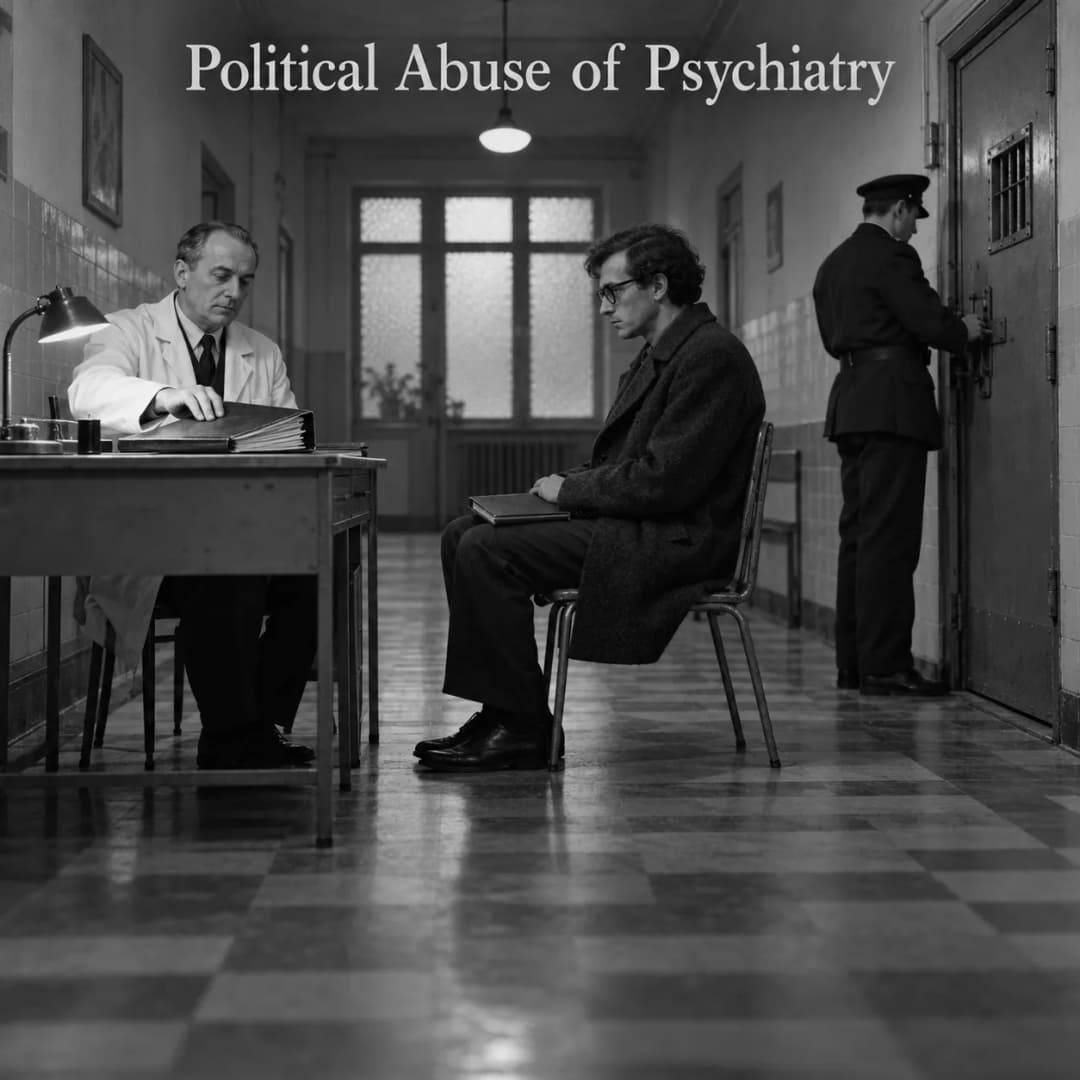
Political abuse of psychiatry is the use of psychiatric diagnosis and compulsory hospitalisation to detain political dissidents. It is a documented historical pattern rather than an effect to be replicated, and the Soviet case between the 1960s and the 1970s is the one the record is built on. The earliest detailed account published in the West is Valery Tarsis's Ward 7, in 1965. Every claim below is attributed, and where the sources disagree with each other this entry says so rather than choosing.
What it is
The mechanism is diagnostic rather than procedural. Where a diagnostic category's criteria include social maladaptation and reformist ideas, no doctor has to lie in order for dissent to be classified as illness. The category most often identified by historians as the one that made the abuse operable is sluggish schizophrenia, associated with Andrei Snezhnevsky's school; that identification is standard historiography and is supplied here from outside the popular accounts, which generally omit it. Without the category the episodes read as individual corruption rather than as a design.
The clinical language recorded in the best-documented case is the substance of the matter. The phrases preserved in the record, including heightened nervousness, deviation from the norm, poor adaptation to the environment, and an exaggerated opinion of oneself, together with the claim that only experienced doctors could detect the early stages of mental illness, are unfalsifiable by design. That is the mechanism, not an incidental feature of it.
In effect
The canonical documented case is that of the geneticist Zhores Medvedev, admitted to the Kaluga psychiatric hospital on the evening of 29 May 1970 and released on 17 June 1970, following public protest by Pyotr Kapitsa, Andrei Sakharov and Aleksandr Solzhenitsyn. He was subsequently reinstated in his post. The dates are confirmed against the contemporaneous samizdat record, A Chronicle of Current Events, number 14 of 1970. The account written by Zhores and Roy Medvedev themselves, A Question of Madness, is the primary source.
The composition of the examining commissions is not settled and should not be repeated as though it were. Peter Watson's intellectual history names a commission of Snezhnevsky, Daniel Lunts and Georgy Morozov of the Serbsky Institute of Forensic Psychiatry. The Chronicle names the examiners differently: a first commission chaired by B. V. Shostakovich of the Serbsky Institute, and a second comprising G. Morozov, V. Morozov and R. Nadzharov. It does not name Snezhnevsky or Lunts. Anyone citing a line-up should check it first.
The most interesting argument inside the case is a genetic one used in defence against a psychiatric diagnosis. Roy Medvedev was Zhores's identical twin. Schizophrenia is partly heritable, so if Zhores had it, Roy should show signs of it, and he did not. That is the substantive psychiatric content of the episode.
On scale, the figure of about 210 authenticated cases that circulates traces to Sidney Bloch and Peter Reddaway's Russia's Political Hospitals of 1977. They catalogue about 210 people interned for their beliefs since 1962, and some fifteen or so special hospitals. Watson's version gives a different date range and a different institution count, so cite Bloch and Reddaway directly. Watson's own caveat is worth keeping: chilling as they were, the Soviet special psychiatric hospitals dealt with at most hundreds of people.
What it does not say
It does not say that psychiatric diagnosis is inherently political. The finding concerns particular categories, in a particular state, whose criteria were loose enough that no falsification was required.
It does not settle who sat on the examining commissions. Two sources disagree, one of them contemporaneous, and this entry carries both rather than picking.
It does not support the frequently quoted counts of cases and institutions in the form they usually travel. The underlying catalogue gives a different date range and a different number of hospitals.
It does not extend beyond what the historical record documents. This entry makes no claim about any present-day institution or any living person.
Sources
- Tarsis, V. Ward 7 (1965). The earliest detailed account of the practice published in the West.
- Medvedev, Z., & Medvedev, R. A Question of Madness (1971). The primary account of the 1970 case.
- A Chronicle of Current Events, no. 14 (1970). Confirms the admission of 29 May 1970 and the release of 17 June 1970, and names a first commission chaired by B. V. Shostakovich and a second of G. Morozov, V. Morozov and R. Nadzharov.
- Bloch, S., & Reddaway, P. Russia's Political Hospitals (1977). About 210 people interned for their beliefs since 1962; some fifteen or so special hospitals.
- Watson, P. The Modern Mind. Perennial, 2002, pp. 540 to 541. An intellectual history rather than a research source, cited here only for the fact that the episode mattered and for the commission line-up this entry declines to confirm. Its apparatus carries no bibliography.
- Evidence review, 2026-09-25. Verdict: not-a-research-claim.