Post-Traumatic Stress Disorder
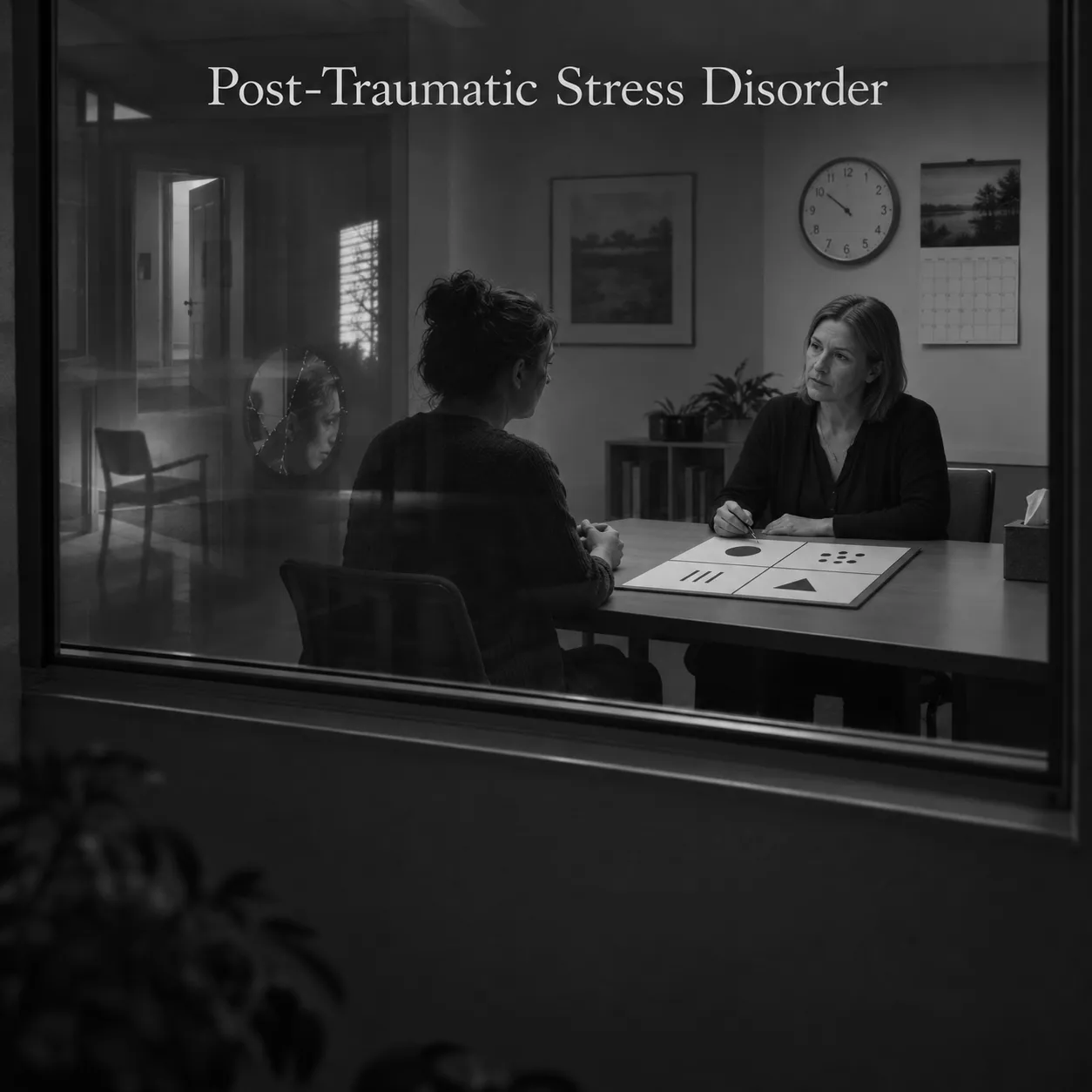
Post-traumatic stress disorder is a psychiatric disorder that can develop after exposure to actual or threatened death, serious injury or sexual violence, whether experienced directly, witnessed, learned of as having happened to someone close, or encountered through repeated exposure to aversive details in the course of work. It is a diagnosis with criteria, not a description of feeling upset. This entry is deliberately short and deliberately clinical. It records what the diagnosis is so that this publication has somewhere to point when a popular account blurs the category, and nothing in it is guidance for anyone about themselves.
What it is
The recognised symptom clusters are intrusion, including involuntary memories, nightmares and flashbacks; persistent avoidance of reminders; negative alterations in cognition and mood; and marked alterations in arousal and reactivity, including hypervigilance and startle. Duration and functional impairment are part of the criteria, and that is what separates the disorder from the ordinary and usually self-limiting distress that follows a serious event.
Assessment uses structured instruments rather than impression, the clinician-administered scale and the self-report checklist being the standard pair. The international classification adds a separate complex presentation as its own category.
The disorder has a large epidemiological, neurobiological and treatment literature, and several trauma-focused psychotherapies are supported by randomised trials and endorsed in clinical guidelines. No therapy is named or described here, because naming one would be advice, and this entry does not give any.
In effect
The reason this entry exists is what happens when the category is dissolved into a colloquial one. Benjamin Hardy's Personality Isn't Permanent names the disorder exactly once, at page 113, and only to set it aside: most people, he writes, imagine trauma only in its extreme manifestations such as a diagnosed disorder. His own definition then takes over and covers any negative experience that shapes a person. From that point the chapter addresses a reader with the diagnosis and a reader with a fifty-year-old embarrassment in the same voice and with the same prompts. No therapy is named anywhere in the chapter, and the only clinical signpost is a single sentence at page 136.
One sentence from that chapter has to be marked and never repeated. At page 115 the book states that research has shown that individuals suffering from the disorder often score zero on imagination. The verification pass searched for a standardised imagination measure on which such populations score zero, for any study reporting such a result, and for the claim in the secondary literature, and found nothing. None of the standard assessment instruments contains an imagination subscale. The endnote for the page routes the claim to a four-hundred-page trade book with no chapter and no page, and to no primary paper at all.
What exists nearby says something materially different and weaker. There is a real literature on impoverished and overgeneral future thinking, reduced imagery specificity and impaired scene construction in this population, including work on scene construction published in Frontiers in Behavioral Neuroscience in 2022. Those findings are about reduced specificity and richness, not about zero. A claim in this area comes from one of those named studies with its design attached, and it says specificity.
What it does not say
It does not say that distress after a serious event is a disorder. Most of it is self-limiting, and duration and impairment are part of what the criteria are for.
It does not say that a colloquial use of the word trauma refers to the same thing. A definition that covers any negative experience that shaped a person is a different object, and the two should not borrow authority from each other.
It does not support the claim that people with the diagnosis score zero on imagination. That claim could not be traced, and it must not be repeated with a hedge, with "reportedly", or as something one book says. A quantitative claim about a diagnosed clinical population does not become citable by being framed carefully.
It does not contain guidance. Nothing here bears on any individual's care, and a reader who needs an answer about their own situation needs a clinician rather than an encyclopaedia entry.
Sources
- The diagnostic description above follows the standard criteria as used in clinical assessment. No single manual edition was consulted for this entry, so none is cited, and one should be attached before the description is used in published work.
- Hardy, B. Personality Isn't Permanent. p. 113, the diagnosis named once and set aside; p. 115, the imagination claim; p. 136, the single clinical sentence; p. 111, the epigraph from Bessel van der Kolk.
- Verification pass, 2026-09-11, item 10. The imagination claim: could not confirm, no basis found. Includes the search record and the nearby literature.
- Scene construction and spatial processing in this population, Frontiers in Behavioral Neuroscience, 2022, for the adjacent finding about specificity rather than absence.
- Evidence review. Verdict: robust for the disorder itself. Nothing in the popular source above bears on that standing in either direction.