Propaganda vs Advertising
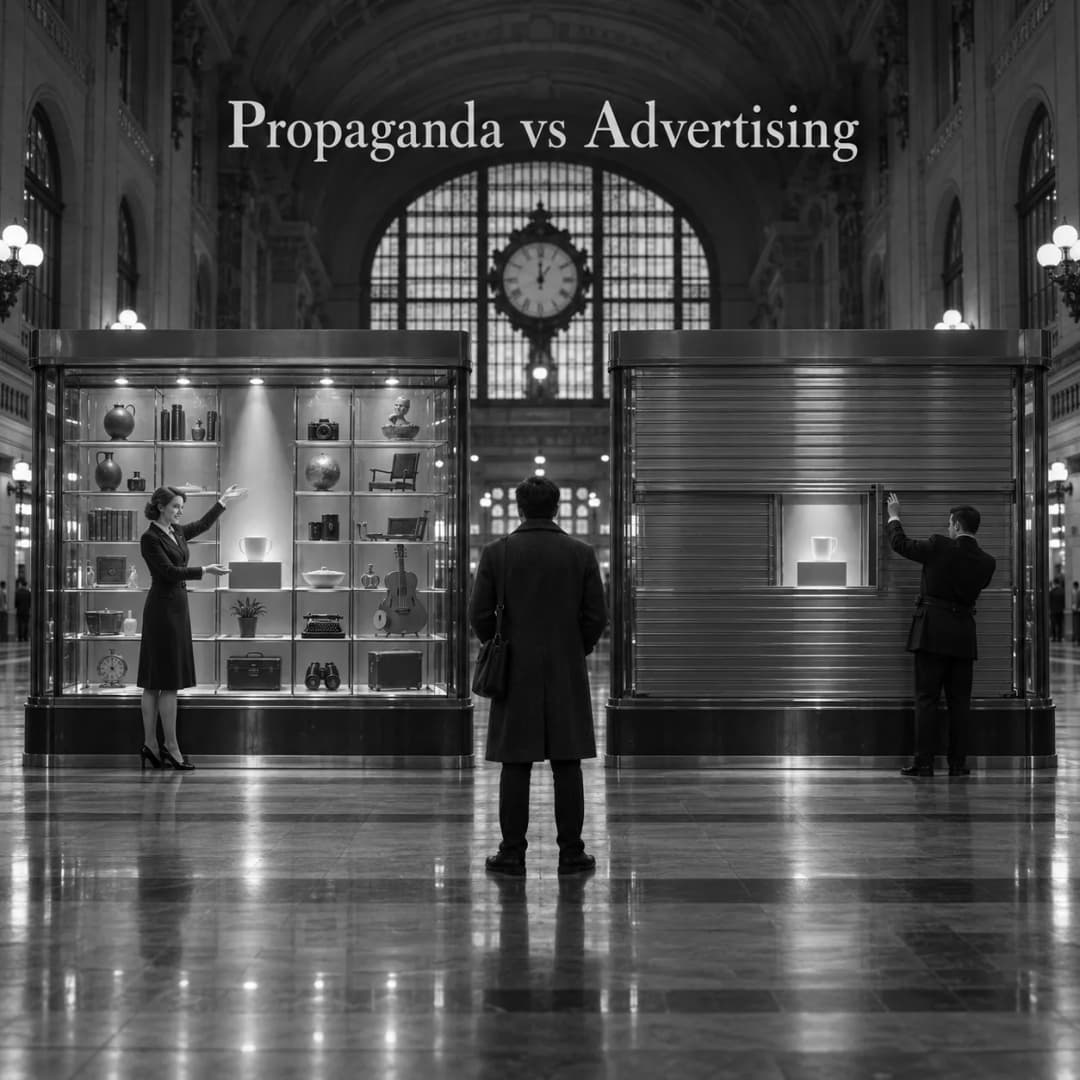
The distinction is Tim Wu's, from The Attention Merchants in 2016. Advertising persuades within an existing marketplace of options: it wants you to pick this one, and it leaves the menu intact. Propaganda works on the option set itself, making alternatives unthinkable or invisible rather than arguing you out of preferring them. It is a conceptual distinction rather than an empirical claim, and it is probably the single most useful idea in that book for telling a manipulative pitch apart from an ordinary one.
What it is
Wu grounds it in a two-part account of freedom at pages 119 to 120. How free you are depends on the size of your option set, and separately on two layers of awareness: knowing an option exists at all, conceptually, and registering it as actually real and available for you. Advertising works on the second layer without touching the first. Propaganda erases the first layer outright.
Walter Lippmann supplies the precondition underneath, and his version is more mechanical. In Public Opinion, in the chapter on censorship and privacy, he argues that without some form of censorship propaganda in the strict sense is impossible, because there must be a barrier between the public and the event: access to the real environment has to be limited before anyone can build a pseudo-environment in its place. People with direct access can still misconceive what they see, but nobody else can decide how they will misconceive it unless he can decide where they shall look and at what.
The two accounts are compatible and answer different questions. Wu tells you what the move is. Lippmann tells you what has to be true for the move to be available.
In effect
Wu's own examples run along the boundary. Chocolate against vanilla is advertising's normal terrain, pure preference across a visible and intact menu. Commercial spaceflight is a case of expanding awareness of something that already existed conceptually but was not real for you until someone put it in front of you. Switching computing platforms sits right on the line, because the option always existed and making it feel real and thinkable is most of the persuasive work being done. What separates propaganda from all of this is the move that removes an option from the menu, not the move that argues for one already on it.
Lippmann's refinement is the more useful half for anyone writing about the modern attention economy. He argues that official censorship is the weakest barrier of the set, because it is known to exist and is therefore in some measure agreed to and discounted. The barriers that do the work are the unnoticed ones: the shifting convention of what counts as private, the cost of travel and communication, the compression of an event into a few lines, and the limits of a social set. Nobody censors anything, and the barriers are all of the second kind.
This publication credits the option-set distinction to Wu. Jacques Ellul's argument that propaganda must be total is an adjacent idea and a fair connection, and it is not this distinction.
What it does not say
It does not say that advertising is harmless. It says that advertising operates on preference within a visible menu, which is a claim about the kind of work it does rather than about how much damage it causes.
It does not say that the distinction is empirical. Both Wu's account and Lippmann's are philosophical and historical arguments, and neither is a tested effect.
It does not say that Wu originated the underlying analysis. Lippmann set out the censorship precondition in 1922, and Ellul's totality requirement is a separate and older account of the same territory.
It does not give a test you can apply from the outside. Whether an option has been removed from someone's menu or merely made unattractive is a judgement about what they could have considered, and nothing here measures that.
Sources
- Wu, T. The Attention Merchants (2016), pp. 119 to 120. The option-set distinction and the two-part freedom argument, illustrated with chocolate against vanilla, commercial spaceflight, and switching computing platforms.
- Lippmann, W. Public Opinion (1922), Part II, Chapter II, section 3, for the censorship precondition and the ranking of barriers. Read in full for this entry. No page numbers exist in the edition used; cite by part, chapter and section.
- Ellul, J. Propagandes (1962; English 1965), for the totality requirement. An adjacent argument, not this one.
- Evidence review, 2026-09-25. Verdict: not-a-research-claim. The originator is Wu, not Ellul.