Regression to the Mean
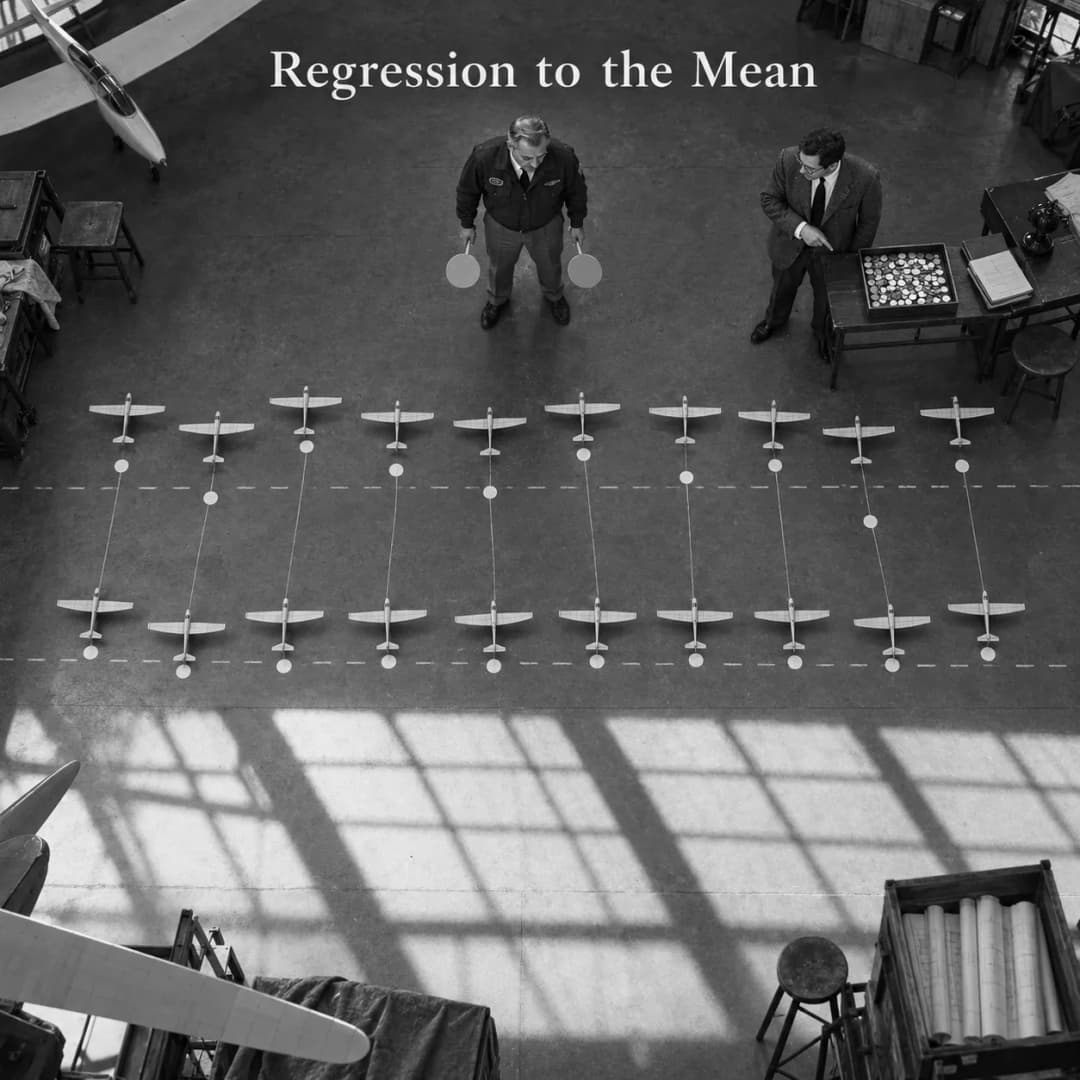
Regression to the mean is the fact that on any measure less than perfectly correlated with whatever it is being compared to, an extreme score will on average be followed by a less extreme one. It is arithmetic rather than a force, and nothing acts on the second measurement to pull it back. Francis Galton named it in 1886. It matters far beyond statistics because the mind supplies a cause for a pattern that has none, and this publication treats it as the explanation sitting behind several apparent training effects.
What it is
Wherever the correlation between two measures is imperfect, extremes at one end will be followed by scores nearer the average at the other, and the weaker the correlation the stronger the regression. That is the whole mechanism, and it holds by arithmetic rather than by evidence, which is why it cannot fail to replicate.
Galton gave it its name in "Regression towards Mediocrity in Hereditary Stature" in 1886, following a Royal Institution lecture of 9 February 1877. The word regression in this sense starts there.
The half that matters for anyone writing about behaviour is the second one. A pattern produced entirely by imperfect correlation invites a causal story, and the story usually feels better supported than the arithmetic. That is where regression stops being a statistics topic and becomes a judgment topic.
In effect
The cleanest demonstration is Daniel Kahneman's account of an instructor in the Israeli Air Force who told him that praise makes cadets worse and criticism makes them better: after an unusually good manoeuvre and warm praise, the next attempt was typically worse, and after a bad one and a rebuke, the next was typically better. The observation was accurate. The inference was not. Performance on a manoeuvre is imperfectly correlated from attempt to attempt, so an unusually good one is followed on average by a worse one whatever anyone says.
Kahneman then reproduced the pattern in the room using coin throws, where no instruction, feedback or skill was present at all, and the same praise-then-decline and criticism-then-improvement shape appeared in pure noise. That demonstration is the argument, because the pattern survives the removal of every candidate cause.
The consequence is uncomfortable and worth stating plainly. Because performance regresses either way, anyone who intervenes after an extreme result will be rewarded for punishing and punished for rewarding, purely by the arithmetic. This publication treats regression as the standing explanation behind several illusory training effects: any writing about coaching, management, medicine or self-improvement that draws its evidence from what happened after an intervention at an extreme point is exposed to it. A substantial part of the famous chart behind the Dunning-Kruger effect is what a noisy self-assessment measure produces on its own, and expectancy studies that intervene on a labelled group share the same design weakness.
What it does not say
It does not say that nothing works. It says that a change following an extreme measurement is not evidence on its own, and that the test is a comparison group selected the same way.
It does not have a cause to find. The arithmetic is the explanation, which is precisely why the intuition to look for one leads people astray.
It does not license the correlation coefficients usually printed to illustrate it. The figures given in the best-known popular exposition, for height and weight, admissions test and later grades, income and education, and parent and child height, carry no source, no study, no sample and no year. The admissions-test figure needs a further flag, because it depends on which institutions are in the sample, which students were admitted in the first place, and whether it has been corrected for range restriction, and corrected and uncorrected estimates differ substantially. Treat those as orders of magnitude, never as numbers to publish.
It does not apply only to noisy measures. It applies wherever correlation is less than perfect, which in practice is everywhere.
Sources
- Galton, F. (1886). "Regression towards Mediocrity in Hereditary Stature." The originating paper and the origin of the word in this sense. It follows Galton's Royal Institution lecture of 9 February 1877.
- Kahneman, D. Thinking, Fast and Slow, ch. 17, for the exposition, the flight-instructor anecdote and the coin-throwing demonstration. The four correlation coefficients printed in that chapter are unattributed and are not cited here.
- Evidence review. Verdict: robust, for an unusual reason. This is not an empirical finding that could fail to replicate but a property of imperfectly correlated measures. What is contestable is never the phenomenon, only the specific numbers used to illustrate it.