Self-Regulation vs Self-Control
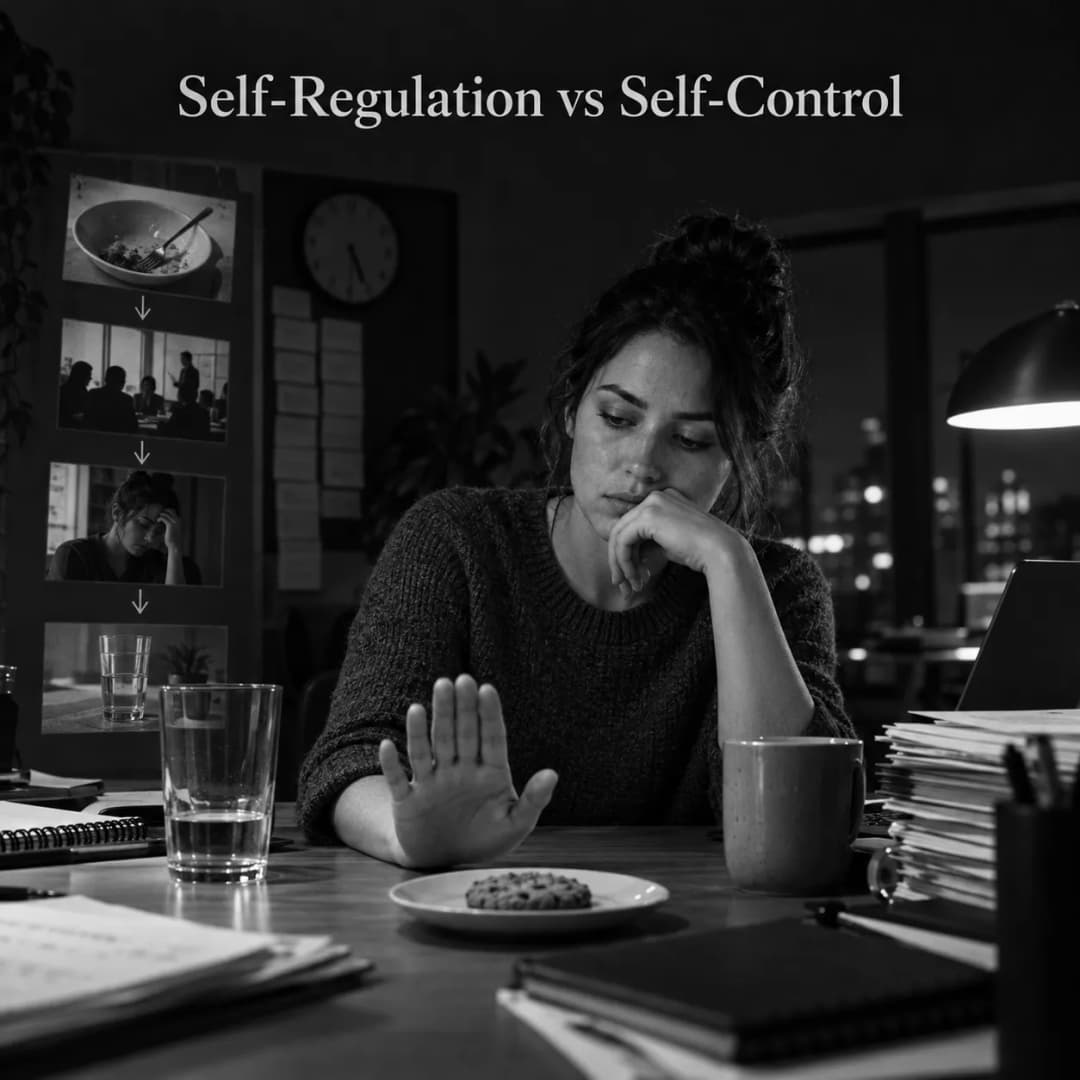
Self-control is what you do at the moment of temptation: an impulse arrives and you inhibit it. Self-regulation is upstream of that, the management of stress load, arousal and recovery so that fewer impulses arrive and the ones that do arrive are weaker. The distinction matters because the two prescribe opposite things. It reaches this publication through Zelana Montminy's Finding Focus, which takes it from Stuart Shanker's trade book Self-Reg of 2016, and the broader self-regulation literature long predates him.
What it is
Self-control tells you to try harder at the point of failure. Self-regulation tells you that the point of failure is the wrong place to intervene, and asks what put you in a state where the impulse was that strong.
The everyday version: refusing the biscuit at four in the afternoon is self-control. Noticing that you always want the biscuit at four because you skipped lunch and have been in back-to-back meetings since nine, and changing that, is self-regulation. The biscuit was never the problem, it was the last link in a chain.
Angela Duckworth's two-process framing is the sharper analytic version of the same split. Volitional processes are the conscious plans, rules and commitments that support self-control. Impulsigenic processes are the reward-seeking, temptation-sensitive machinery that undermines it. The pairing is useful because it stops self-control being treated as one quantity a person has more or less of: two systems are in play, and interventions that raise the first do nothing to the second. The terminology comes from Duckworth and Laurence Steinberg's 2015 paper in Child Development Perspectives.
In effect
The reason to hold on to the distinction is that it is the constructive alternative to the depletable-resource model of willpower. If self-control is a fuel tank, the advice is to ration it. If impulse strength is a function of load and recovery, the advice is to change the load. The second survives the replication record and the first does not: multi-laboratory tests of ego depletion put the effect between zero and about a sixth of a standard deviation against an original estimate around six tenths.
The tension sits inside the book that supplied the distinction here. Finding Focus relies on the depletion metaphor throughout without ever naming it, in language about concentration being depleted, about operating on an empty tank, about recharging the brain's batteries. So the same book carries the model that failed and the frame that replaces it, a few chapters apart, and never notices they are competitors. Two points in the author's favour: she explicitly rejects the willpower explanation of distraction in the prologue, and by chapter 13 she prefers environment design to willpower outright. This publication sides with the self-regulation framing and records that she does too, in her better passages, without saying so.
On sourcing, this is one of the passages where she names her source in the prose, which she mostly does not: Shanker is named and credited to Self-Reg and to a magazine piece, and both are cited honestly as what they are. The Duckworth material has a real journal reference behind it in the endnotes, which the reader is never shown. Both halves are correct in the back of the book; only the first is visible in the front.
What it does not say
It does not say that self-control does not exist. It says that intervening at the moment of temptation is the least favourable place to intervene, which is a claim about where effort pays.
It does not inherit the evidence for the constructs it replaces. One trade-book framing and one journal citation is what supports this pairing here, and the self-regulation literature has not been independently assessed by this publication.
It does not originate with Shanker. He is credited because he is who the book credits and because his is the version that travelled to this source; the field is much older.
It does not license any figure from the Duckworth paper. The full text has not been read here.
Sources
- Shanker, S. Self-Reg. Penguin, 2016, and an accompanying magazine piece. A trade source, cited honestly as one.
- Duckworth, A. L., & Steinberg, L. (2015). Child Development Perspectives, 9, pp. 271-289 as printed in the endnote. The source of the volitional and impulsigenic terminology. Full text not read for this entry, so no figure from it is carried.
- Montminy, Z. Finding Focus, for the distinction as it reaches this publication, and for the depletion language running alongside it.
- Evidence status: mixed. One real journal citation, one trade-book framing with no research offered.