Shell Shock
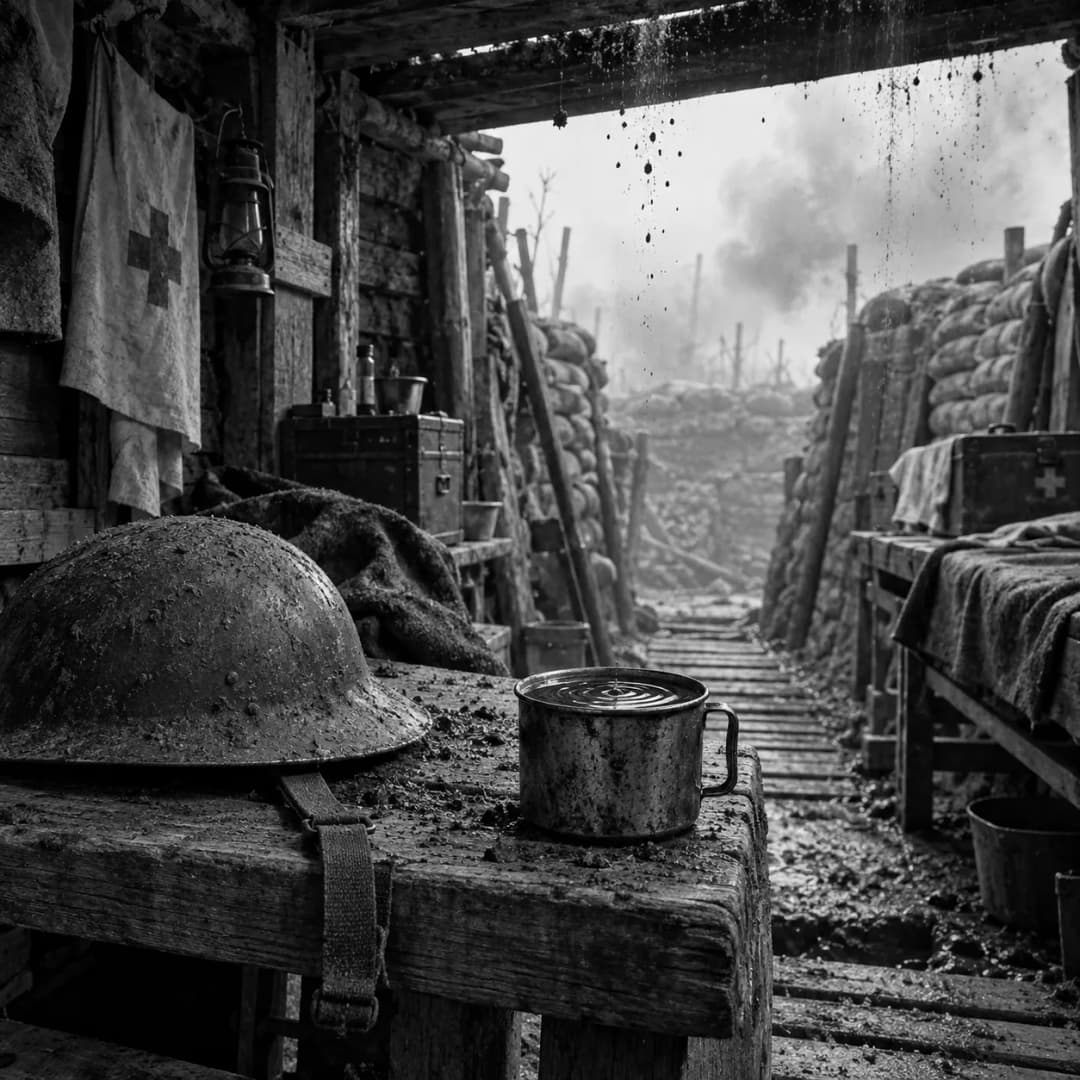
Shell shock was the First World War name for the breakdown of soldiers under bombardment. In Peter Watson's account, the sheer number of cases did more than argument to make psychological explanation respectable in British medicine. The historical scale of the phenomenon is not in doubt; its mechanism, its relation to later trauma diagnoses and the figures attached to it remain contested.
What it is
This library's records state that the term entered print in The Lancet in 1915 under Charles Samuel Myers, who later argued against it because it implied a physical cause in blast injury that most cases did not have. That attribution comes from outside Watson's book and is held with medium confidence.
Watson, in chapter 9 of The Modern Mind (around p. 155), describes British medical hostility to Freud before the war and argues that the volume of shell-shock cases, rather than argument, changed that opinion. He attributes the claim to nobody. He also offers the hypothesis that mass conscript armies contained men who would not normally have soldiered and whose civilian difficulties surfaced under fire. He credits W. H. Rivers with early studies and cures of shell shock, and gives Ernst Simmel for the German side, using hypnosis on so-called malingerers.
Watson also records a 1920 Austrian government commission into Julius von Wagner-Jauregg, professor of psychiatry in Vienna, after troops complained about his wartime treatment of battle casualties, which included electric-shock therapy. Freud gave evidence, and the commission found no case against Wagner-Jauregg.
In effect
For a reader, shell shock is an early example of a pattern this site returns to: when many people present with symptoms that do not fit the expected cause, the explanation that wins may be the one with the most cases behind it rather than the best-tested one. It also shows how the name given to a condition can carry an assumption about its cause. This page is history, not medical advice.
What it does not say
It does not give a rate. Watson prints a precise incidence figure for British casualties, but with no analyst, no date and no definition of what counted, so this page does not carry it.
It does not settle the link between shell shock and later trauma diagnoses. Watson's causal claim about British opinion is unsourced, his account of Rivers gives no method, date or publication, and he does not record what Freud's evidence to the 1920 commission said. Nor does he note that the view of shell shock as constitutional weakness was already contested in the 1920s, notably by the 1922 War Office Committee of Enquiry into Shell-Shock.
Sources
- Watson, P. (2001). The Modern Mind: An Intellectual History of the 20th Century. HarperCollins (Perennial edition 2002), ch. 9 and the opening of ch. 10, around p. 155.
- The Myers attribution and the 1922 War Office Committee of Enquiry are recorded in this library's concept note from outside Watson's book; neither was read on a primary source for this page.