Should and Could
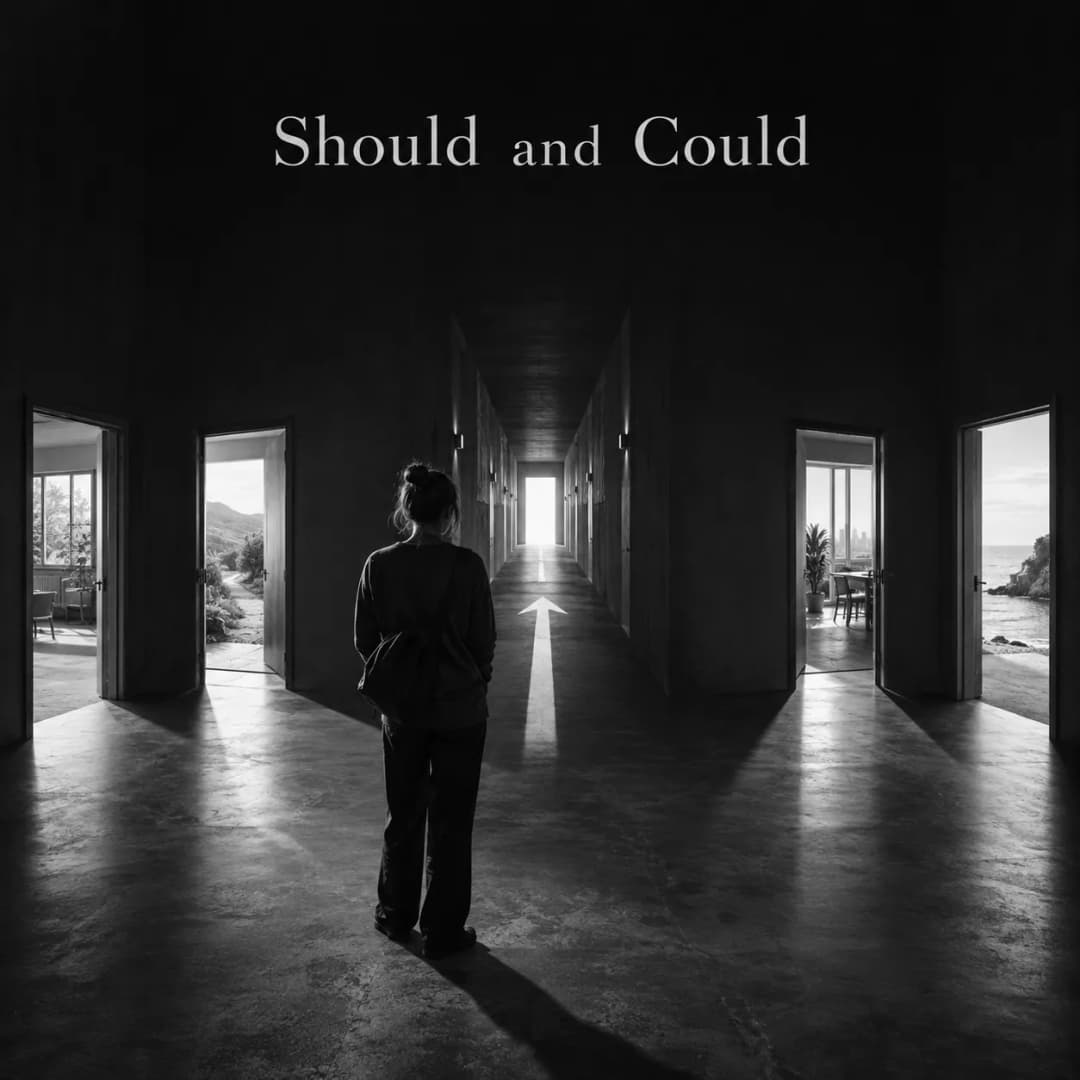
Should and could is a two-word distinction about where the terms of your life are being set. Should is how other people want you to live: it speaks in right and wrong, it arrives already decided, and it presents exactly one option. Could says there are several and asks which one you would prefer. It is a framing device and a piece of vocabulary, not a testable effect, and it is not offered as one. Amber Rae credits it to Elle Luna, naming her as an author and naming no book.
What it is
The move is not from duty to indulgence. It is from a single imposed path to a visible set of alternatives with you as the one choosing.
The useful part is the diagnostic rather than the advice. If you can only see one option, you are probably in should, whoever you think put you there. That makes the distinction a test you can run on a sentence: count the options the sentence allows.
On attribution, Rae credits Elle Luna by name and identifies her as an author. She names no book in the passage, so this publication carries no title, no year and no publisher on the strength of it, and the primary text has not been read here.
In effect
The application is to a decision framed as an obligation. A sentence like "I should stay" collapses on inspection into somebody else's expectation that had never been examined. Rewriting it as "I could stay, and I could also do these three other things" does not make the decision; it restores the fact that there is a decision to make.
The same closed-to-open operation runs through Rae's other substitution move, in which a verdict question becomes an action question, so the two are the same device applied to different sentences.
Where the distinction touches something evidenced is at the edges. The observation that a course of action framed as externally imposed is experienced differently from the same action framed as chosen is not a fringe idea: self-determination theory has an actual literature on autonomy as a psychological need, and reactance describes what happens when a single-option frame is pushed hard. Luna's contribution is a memorable pair of words for a distinction those literatures already draw. That is worth something and it is not evidence.
What it does not say
It does not say that obligations are illusory. It says that an obligation presented as the only option should be checked, and the check is whether alternatives exist rather than whether the obligation is real.
It does not carry the self-determination evidence. That literature is named here as the adjacent evidenced account, not as support for this device.
It does not detect the case where the chosen option is itself the trap. A person can survey the alternatives freely and still pick the one that will cost them, and nothing in the distinction catches that.
It does not come with a source that can be traced further. No book, year or publisher is named by the account that credits it.
Sources
- Rae, A. Choose Wonder Over Worry. Credits Elle Luna, named as an author. No book named in the passage, no year, no publisher.
- Luna, E. Primary text not read for this entry. Title and year not given.
- Evidence status: not-a-research-claim. A framing device and a piece of vocabulary.