Social Loafing
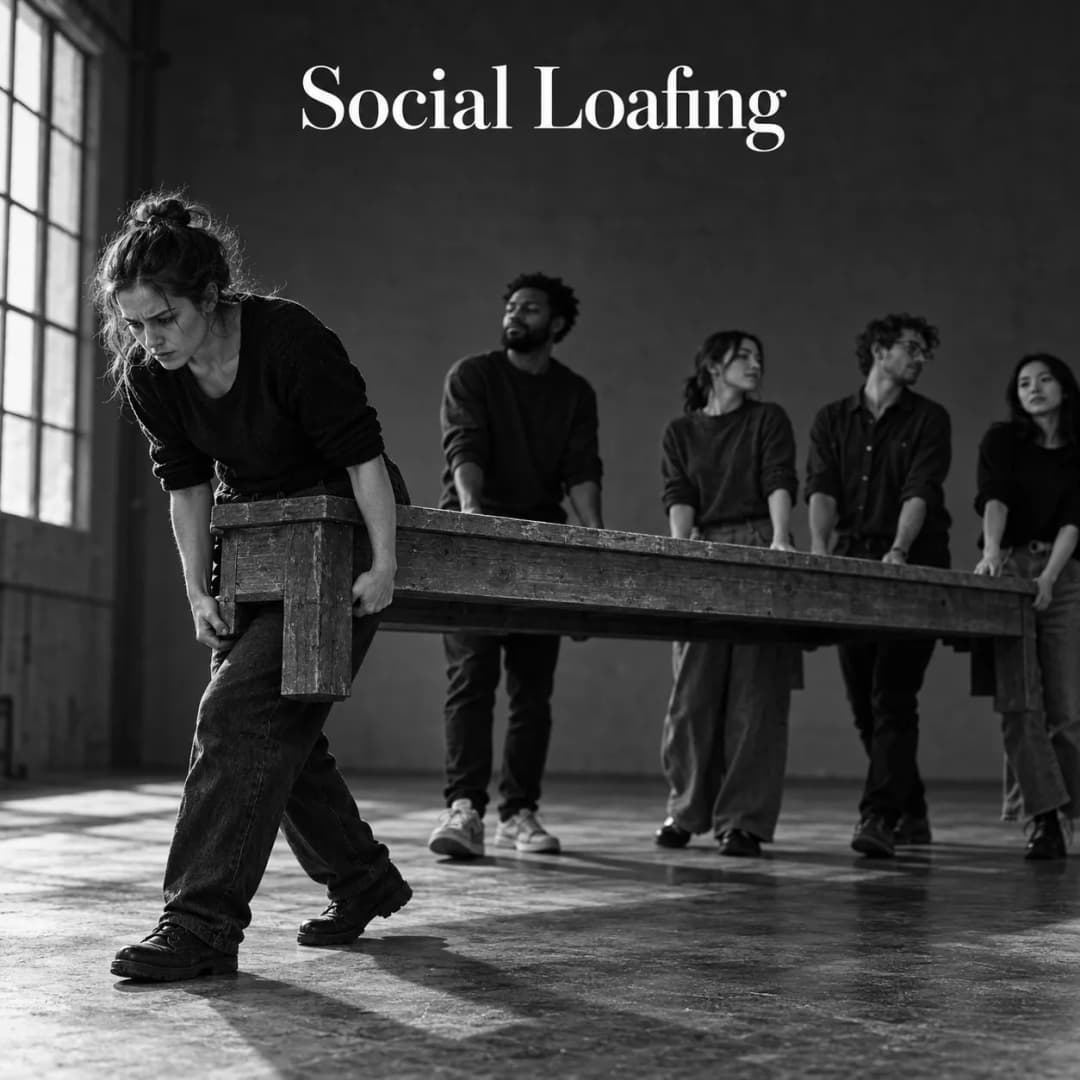
Social loafing is the finding that people put in less effort on a shared task than they do on the same task alone, and that the shortfall grows as the group grows. The size effect is named after Maximilien Ringelmann, a French agricultural engineer who measured it first. It replicates in modern designs and it has a testable mechanism, but the founding data are thin and the size of the effect depends so heavily on the kind of task and on whether anyone can see who did what that a flat statement about groups loafing is not a finding.
What it is
Ringelmann worked at the agricultural institute at Grand-Jouan, and what he measured was rope. Men pulled on a rope, draught animals pulled loads, and he recorded what each individual contributed as the number pulling rose. Individual contribution fell. The dates matter and are routinely reported wrongly: the experiments ran between about 1882 and 1887, and they were not published until 1913. Both dates are defensible depending on which is meant, and an account giving only one of them will mislead somebody.
The modern name and the modern experiments came from Bibb Latané and colleagues in the 1970s, who used cheering tasks and pseudogroup designs in which participants believed others were working alongside them when they were not. The proposed mechanism is loss of identifiability. When a contribution cannot be traced back to the person who made it, effort falls, and interventions that restore identifiability reduce the loss.
The correct source for the caveat is David Kravitz and Barbara Martin, whose 1986 paper in the Journal of Personality and Social Psychology reconstructed what Ringelmann actually did and reported. It is the reconstruction that established the original data are thin. Anyone citing Ringelmann without it is citing a story rather than a study, and it is worth noticing that the standard correction arrives more than sixty years after the thing it corrects.
In effect
The practical reading is narrower than the popular one. Effort loss is not a property of groups, it is a property of certain arrangements of work: tasks where contributions pool into one output, where nobody can see who supplied what, and where members do not much care about the result. Change any of those and the effect changes with it.
That is why the useful interventions are structural rather than motivational. Make individual contributions visible. Make the task divisible where it can be divided. Make the outcome something members have a stake in. None of that requires a theory of laziness, and all of it follows from identifiability being the mechanism.
The effect also has siblings that should not be collapsed into it. Diffusion of responsibility is the same structural move in a different setting, where what dilutes is obligation rather than effort. Steiner's task taxonomy says which tasks are vulnerable in the first place, and it is the more precise tool when the question is about a specific piece of work.
What it does not say
It does not say that people in groups are lazy. The finding is about arrangements and visibility, not character, and the same people show no loss when their contribution can be identified.
It does not say the effect has a fixed size. Task type, observability and how much members care about the outcome all move it, which is why a single quoted percentage for effort lost per additional member should be treated as an illustration rather than a measurement.
It does not say Ringelmann proved it. He measured something, the record of what he measured was not available in its original form for seventy years, and what survives is thinner than the confident retellings suggest. The modern paradigm carries the evidential weight, not the rope.
Sources
- Ringelmann, M. (1913). "Recherches sur les moteurs animés: Travail de l'homme." Annales de l'Institut National Agronomique, 2nd series, 12, 1-40. Experiments conducted c. 1882-1887, published 1913.
- Kravitz, D. A., & Martin, B. (1986). "Ringelmann rediscovered: The original article." Journal of Personality and Social Psychology, 50(5), 936-941. The reconstruction establishing that the original data are thin, and the correct citation for that caveat.
- Latané, B., Williams, K., & Harkins, S. (1979). "Many hands make light the work: The causes and consequences of social loafing." Journal of Personality and Social Psychology, 37(6), 822-832.
- Fisher, C. M. The Collective Edge. Ringelmann at pp. 22-23, Latané at pp. 23-25. A supporting meta-analysis is cited at p. 25 with no author and no year; this publication has not traced it and does not repeat its figures.