Social Prescribing
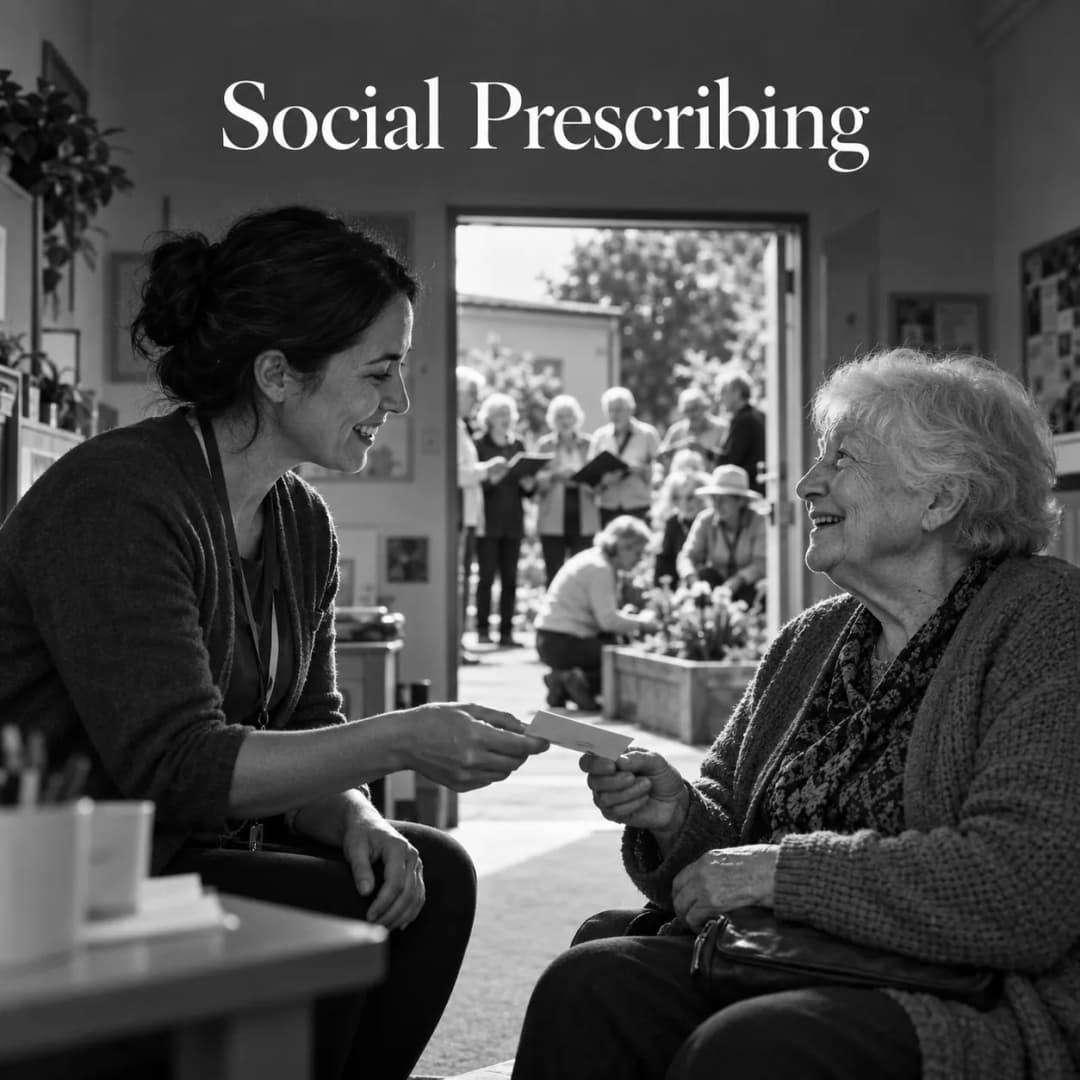
Social prescribing is a referral route in which a clinician sends a patient not to a pharmacy but to something else: a choir, a museum pass, a gardening group, a dance class, a walking club. It is a service-design idea first and an evidence claim second, and the two get conflated constantly. The honest summary of the research is that the strongest evidence is for the outcome people care about least, and the weakest for the outcomes that justify funding it.
What it is
The prescription is social and cultural rather than pharmacological, and delivery usually runs through a link worker or a community organisation rather than through the health service itself. No originator, date or founding programme is named in the source through which this reaches the vault, so no originator is claimed here.
Two programmes are usually cited as the working examples. CultureRx in Massachusetts put museum passes into a prescribing pathway. SHAPER in the United Kingdom took arts interventions that had shown promise and tried to implement them at scale inside the health system. The World Health Organization has framed arts engagement as belonging in health policy rather than beside it.
A disclosure fact belongs on this page, stated as public record. In Your Brain on Art, a research director at an arts and neuroscience laboratory is quoted evaluating CultureRx and calling it a model for enhancing community care. The page does not note that an author of the book founded and directs that laboratory. Both facts are public. Neither is on the page. That is recorded here as a disclosure gap and never as an allegation about anyone's honesty.
In effect
What is well supported is that people who take part generally like it, report better mood and feel less isolated. Those are real outcomes and they matter. Implementation studies also show the referral pathway can be built and used, which is not nothing.
What is not well supported is everything downstream. Hard clinical endpoints, reductions in service use and cost savings are much weaker. The design problem is structural rather than a criticism of anyone: a person who accepts a referral to a choir is systematically different from a person who does not, most of the literature is observational or uncontrolled, and the comparator where there is one is often no treatment rather than an active alternative.
The strongest argument for taking the field seriously is Daisy Fancourt's, and it is an argument about evidence rather than about outcomes. She defends the messiness of arts and health research against a pharmacological standard of proof: an arts intervention is multi-component, context dependent and impossible to blind, so demanding that it look like a drug trial is demanding that it be a different intervention. That is a fair point. It is also not a finding, and it does not convert a weak evidence base into a strong one.
What it does not say
It does not say the arts help you live longer. Fancourt and Andrew Steptoe followed several thousand community-dwelling adults aged fifty and over in the English Longitudinal Study of Ageing, with mortality linked to the central register over fourteen years, and found receptive arts engagement associated with a lower hazard of dying during follow-up, with the larger association for more frequent attendance. A Swedish precursor by Lars Olov Bygren and colleagues found the same direction in the 1990s. Nobody was randomised to the opera. The adjustment list is long and the association survives it, which is a real strength, and it still cannot exclude residual confounding by the things that make a person able to go out at all: mobility, cognition, wealth, sensory function and social connection. Fancourt and Steptoe are explicit about this in the paper. Associated with lower mortality holds. Helps you live longer does not.
It does not support the ten-year figure that circulates. The rear jacket of Your Brain on Art carries a line that one art experience a month can extend your life by ten years. It appears nowhere in the book's body text, and this publication's verification pass could find no study reporting such a figure. Hazard ratios over a fixed follow-up window are not convertible into added years of life without a life-table calculation nobody in this literature has published. The chain runs claim, press, book, not claim, paper, book. This publication repeats the figure in no form and in no context.
It does not support social prescribing as a substitute for treatment. The better passages in the source frame the arts as adjunctive, working alongside clinical staff, and nothing on this page is advice about anyone's care.
It does not rest on primary evaluations this publication has read. The evaluation literature on CultureRx and on SHAPER was not covered in the verification pass, and nothing here should be cited as an outcome finding until it has been.
Sources
- Fancourt, D., & Steptoe, A. (2019). "The art of life and death: 14 year follow-up analyses of associations between arts engagement and mortality in the English Longitudinal Study of Ageing." BMJ, 367, l6377. 6,710 community-dwelling adults aged 50 and over, baseline 2004-2005, mortality linked to the NHS central register. Attending once or twice a year associated with a 14 per cent lower hazard; attending every few months or more with a 31 per cent lower hazard, after adjustment. Confirmed at the vault's verification pass, 2026-09-20; full text not read.
- Bygren, L. O., Konlaan, B. B., & Johansson, S.-E. (1996). BMJ. 12,982 adults interviewed 1982-1983 and followed to 1991; extended to fourteen years by Konlaan, Bygren and Johansson in 2000. Confirmed at the same pass.
- Magsamen, S., & Ross, I. Your Brain on Art, 2026-09-20. CultureRx, SHAPER and the World Health Organization framing. The two mortality percentages appear at p. 109 with no study, cohort, journal or follow-up period named, followed by a line stating that the arts literally help you live longer. Fancourt's defence of complexity is at p. 100. The disclosure gap is at p. 219.
- Checked and not found: any study reporting a ten-year life-extension figure. Recorded as checked and not found, not as refuted.
- Not yet checked: the primary evaluation literature on CultureRx and SHAPER.
- Evidence status: mixed.