Stand-Ups
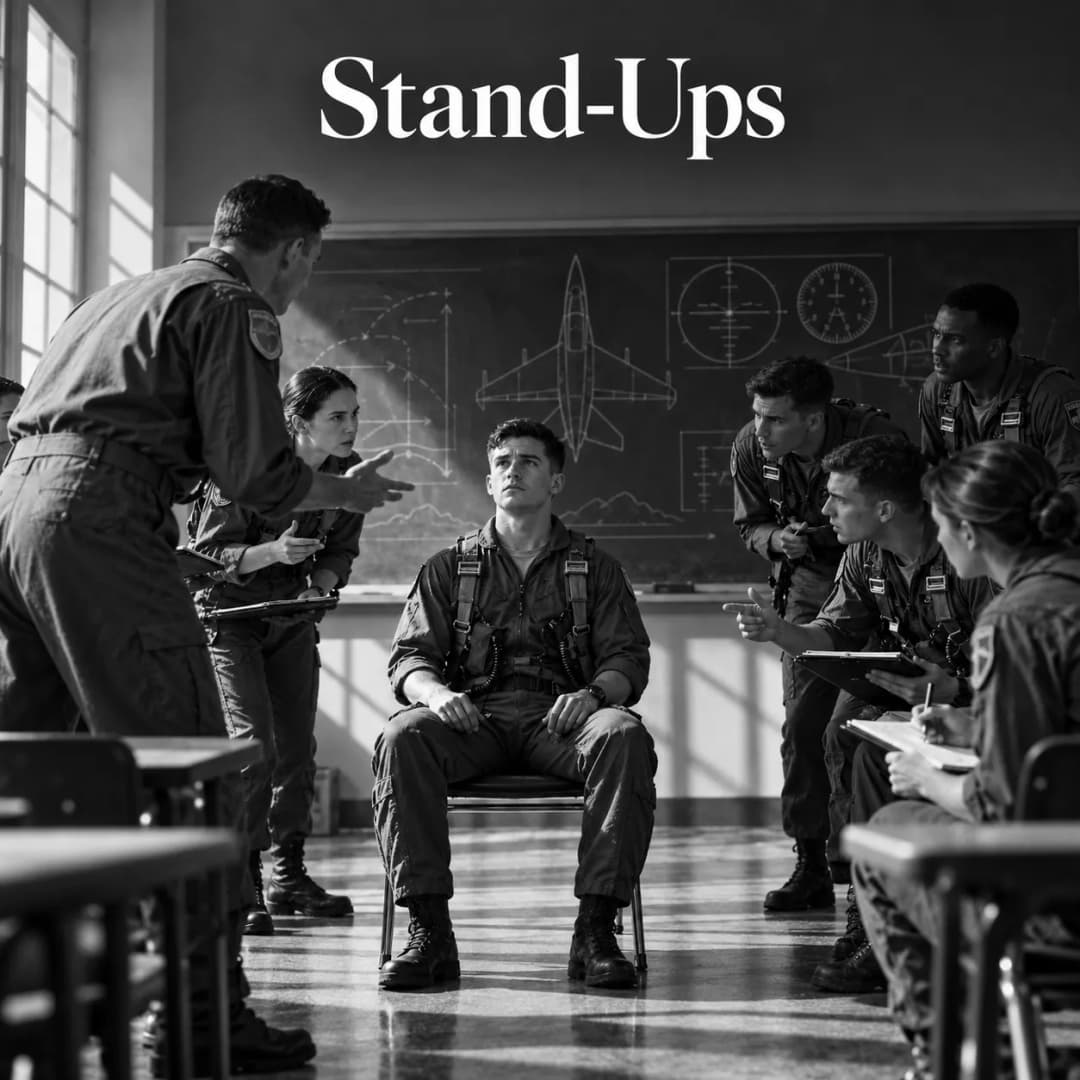
A stand-up is the morning ritual of United States Air Force pilot training, described by Hasard Lee in The Art of Clear Thinking. A randomly chosen student stands in the middle of the classroom and is handed a theoretical emergency in a deliberately tense atmosphere built to imitate the fear and adrenaline of a real one. It is a training and selection practice with real consequences attached rather than an experiment, and nothing about it has been tested as a research claim.
What it is
Performance in a stand-up is documented, it affects which aircraft a student is assigned, poor performance means sitting down for the next student, and the whole class can be punished. The stakes are the point: the ritual exists to put a trainee under something resembling operational pressure while the cost of failure is still only a career rather than an aircraft.
Every stand-up opens with the same recited phrase. I will maintain aircraft control, analyse the situation, take proper action, and land as soon as conditions permit. Lee's reading, at pages 23 to 25, is that the answer was in the phrase all along, in the order of its first two verbs. Analyse comes before take proper action, and the instinct the whole ritual exists to break is the instinct to skip the first and start doing the second.
In effect
Lee reads the same failure into Air France 447 across pages 30 to 38, and the same ordering is what Wind the Clock enforces physically rather than verbally. The transferable part of the practice is not the classroom or the punishment, it is the insistence that a diagnosis precedes an action under conditions that make skipping the diagnosis feel natural.
Two observations Lee draws from his own cohort are worth recording as his observations rather than as findings. At page 24 he says students who had graduated top of their class often struggled most, their minds honed for problems with one well defined answer. At pages 24 to 25 he describes a student who wrote every conceivable problem and its solution into notebooks, succeeded early, could not adapt when a problem diverged from his expectations, and washed out. One remembered student is carrying an argument there, and it should not be repeated as more than that.
What it does not say
It does not say that stand-ups are deliberate practice. At page 24 Lee writes that they develop deliberate practice at solving complex problems under pressure. That term is Anders Ericsson's and it arrives in the book with no name attached, and nothing in the account checks whether stand-ups meet Ericsson's definition, which requires an individualised task at the edge of current ability with immediate feedback. The dispute over deliberate practice belongs on its own page and is not settled here.
It does not say the practice has been shown to improve decisions. There is no trial, no comparison group and no outcome measure in the record. What exists is a described institutional method and one practitioner's account of it.
It does not say the design transfers. The pressure in a stand-up comes from consequences a workplace usually cannot and should not reproduce, and a version stripped of those consequences is a different thing wearing the same name.
Sources
- Lee, H. The Art of Clear Thinking. p. 23 for the ritual, p. 24 for the recited phrase and the deliberate-practice label, pp. 24-25 for the top-of-class observation and the notebook student, pp. 23-25 for the ordering of the first two verbs, pp. 30-38 for the Air France 447 reading.
- Ericsson's definition of deliberate practice is discussed on its own page. Lee uses the term without attribution and without testing stand-ups against it.