The Broken Home
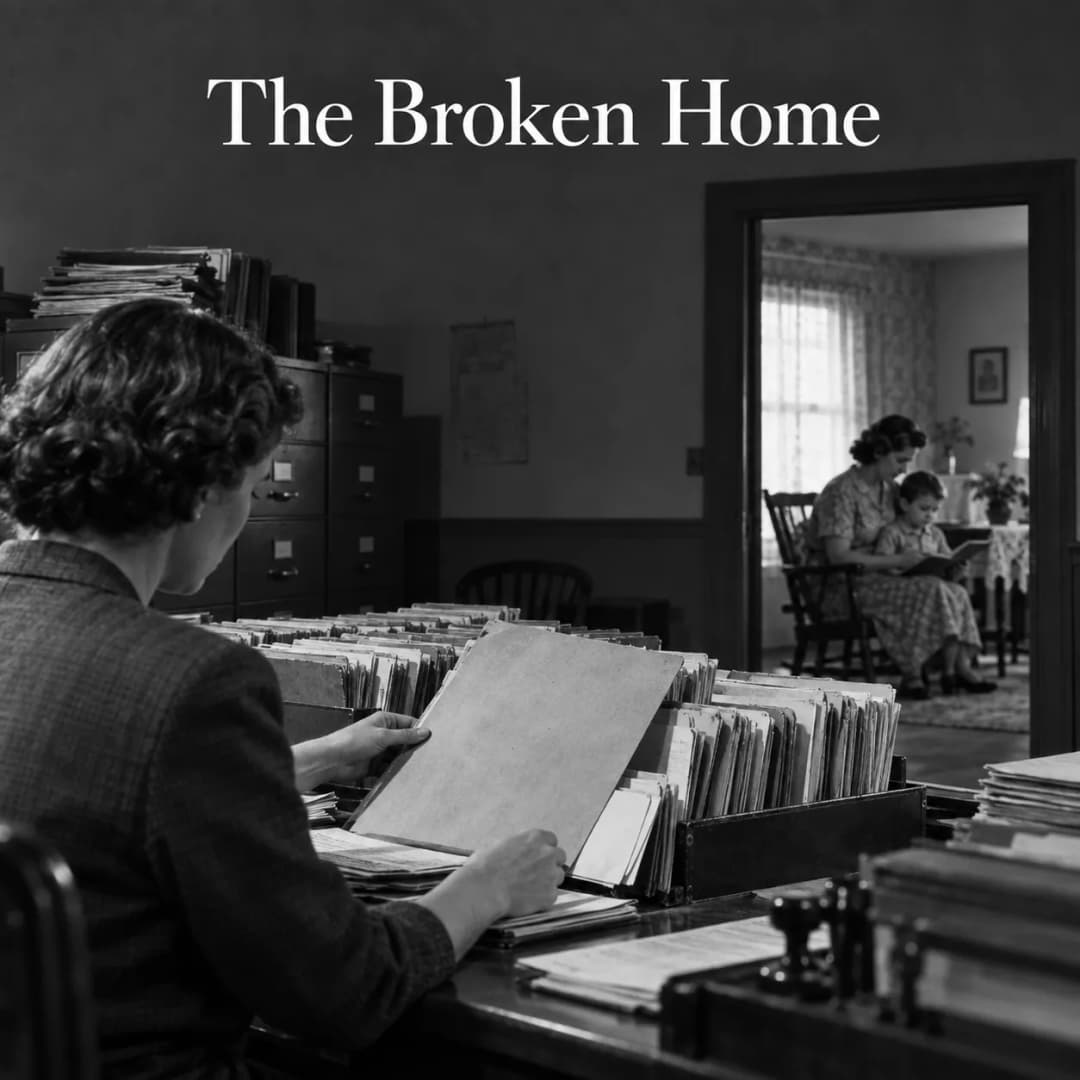
The broken home was a once-standard research category covering any household in which one or both parents were absent, through death, desertion, separation, divorce or illegitimacy. It ran through mid-century delinquency research and generated hundreds of percentages. It is a good example of a variable that measures a legal or demographic fact and is then asked to explain a psychological one, and the reason it is worth a page is that John Bowlby told the field to abandon it in 1951 and then used it for another hundred and fifty pages.
What it is
The category was in general use well before 1951 and is nobody's invention. What is Bowlby's is the explicit retirement notice, at page 12 of the World Health Organization report: that the concept of the broken home is scientifically unsatisfactory and should be abandoned, because it includes too many heterogeneous conditions having very different psychological effects. His replacement, in the same paragraph, was the concept of the disturbed parent-child relationship.
Then Appendix 1, at pages 161 to 165, tabulates fifteen broken-home studies. Table XIX at page 164 runs from Sheldon and Eleanor Glueck's juvenile delinquents through Swedish, French, British, American, Hungarian and Dutch samples of delinquents, maladjusted evacuees, neurotic soldiers and psychiatric patients. The percentages from broken homes before the age of sixteen run from roughly a third to roughly two thirds. The control figures Bowlby can find are a very large Parisian comparison group and three American sources, all clustering far lower. He concludes, reasonably, that the difference is almost certainly real. He also concedes at the head of the appendix that most of these studies lack controls, and he closes it by quoting a 1937 New York school survey and adding that its author concludes quite rightly that the concept of the broken home is not satisfactory for scientific purposes. The retirement notice is issued twice, at the start of the book and at the end of the appendix built on the thing being retired.
In effect
This is a clean, documented instance of a general failure. A researcher identifies that his measured variable is a bundle of unrelated things with different mechanisms, says so in print, proposes a better variable, and then keeps reporting the bundle because the bundle is what the existing literature counted.
The reason is not dishonesty, it is availability. The disturbed parent-child relationship was not in anyone's records in 1951. The broken home was, in every court file and every agency return in six countries. A better construct with no data loses to a worse construct with fifteen studies behind it, and it loses inside the book that declares it better.
The consequence is the one that matters. Michael Rutter's reassessment is in part the job Bowlby set and did not do: separating the bundle into separation, loss and never having had an attachment figure, and finding that the outcomes differ. The instruction was in the 1951 report. It took about twenty years and another researcher to carry it out.
The transferable test is short. When a source reports a category it has itself called unsatisfactory, ask what the category is standing in for and whether the data for the better variable existed. If it did not, the reported effect is a measure of what records happened to hold, and the honest reading is that something is going on in that neighbourhood, not that the named variable caused it.
What it does not say
It does not say that children in these households turn out badly. The samples were drawn from courts, clinics and institutions, most of the studies lack controls, and a percentage among people already identified as in trouble says nothing about the population of households the category names.
It does not carry figures this publication can vouch for. None of the fifteen tabulated studies is held in the vault, every figure reaches it through Bowlby's own tabulation, which he states was reconstructed from data not originally in tabular form, and no single figure from that table should be carried into published output without checking the original paper.
It does not survive as a variable. The category was retired by its own users, the work it was doing was redistributed into finer distinctions, and reviving it as a way of talking about family structure reintroduces exactly the problem Bowlby named.
Sources
- Bowlby, J. (1952). Maternal Care and Mental Health. World Health Organization, second edition. The retirement notice at p. 12; Appendix 1 at pp. 161-165; Table XIX at p. 164; the control figures and the closing note at p. 165. Read in full from the WHO repository, 20 September 2026.
- None of the fifteen studies tabulated in Table XIX is held in the vault, and every figure reaches this page through Bowlby's own tabulation, which he states was reconstructed from data not originally in tabular form. Do not carry any single figure from that table into published output without checking the original paper.
- Rutter, M. The reassessment separating the bundle into separation, loss and never having had an attachment figure. Carried on the maternal deprivation page.
- Evidence status: contested in the page frontmatter. The vault note itself records the status as superseded: the category was retired by its own users and the work it was doing was redistributed.