The Empathetic Witness
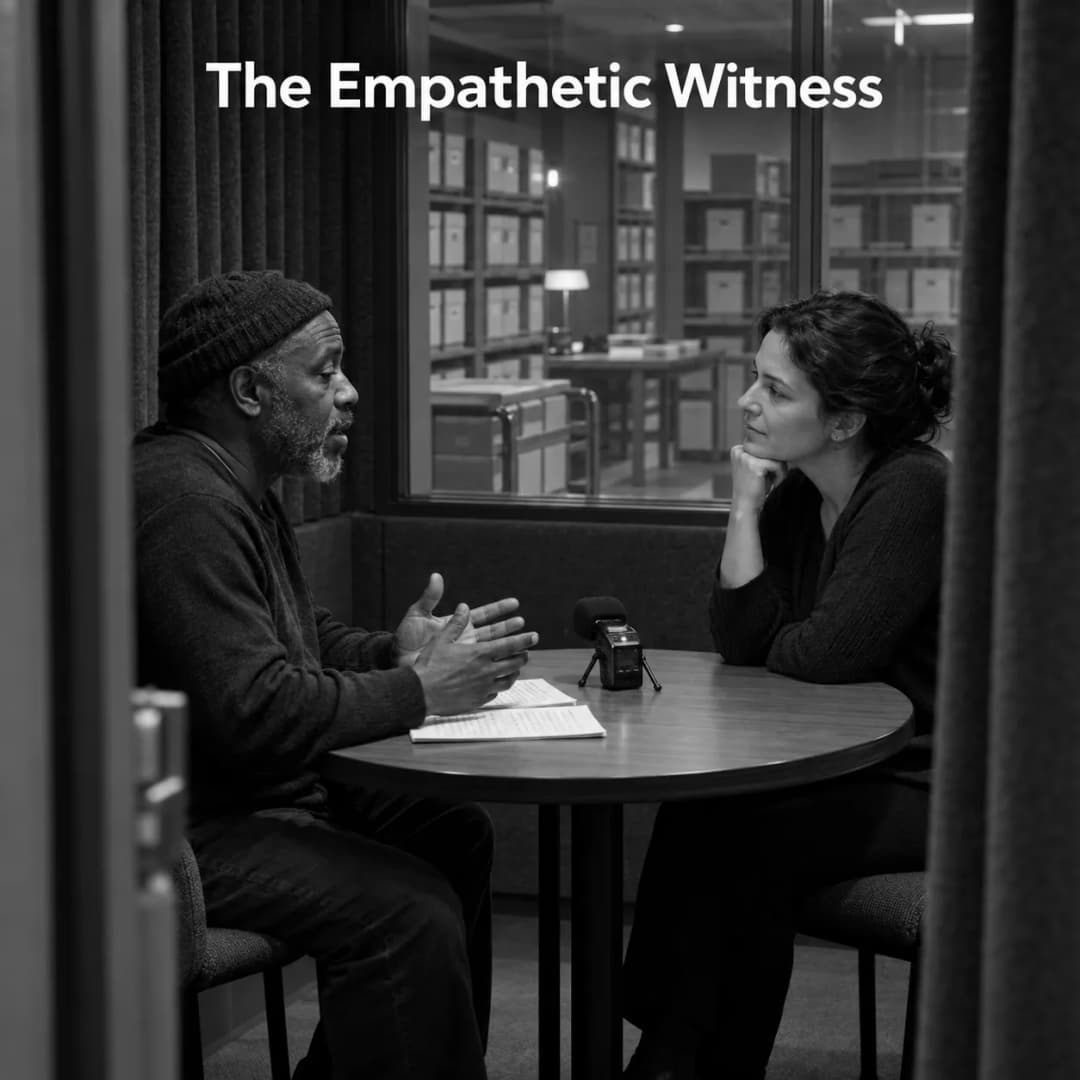
An empathetic witness is someone who receives your account of what happened to you and believes it. The term arrives in Benjamin Hardy's Personality Isn't Permanent in a quotation credited to the trauma clinician Peter Levine, though no publication is given for the line anywhere in the book, and the idea is most closely associated with Alice Miller's helping witness and enlightened witness. It is a term of art rather than a tested effect. The concept is worth keeping; the book's handling of it drifts, and the drift is the thing to know about.
What it is
The quotation appears at page 124: that trauma is not what happens to us but what we hold inside in the absence of an empathetic witness. Hardy's gloss is that the witness listens without judging and without advising, so that the experience can be spoken and its meaning revised.
Levine is a real trauma clinician and the originator of somatic experiencing. The line circulates widely under his name, and no primary publication for it was traced in the vault's verification pass, so it should be cited as attributed rather than sourced. The underlying idea, that being believed by someone is what separates an injury from a lasting one, runs through Alice Miller's later books under her own terms, and she is not mentioned in these pages at all.
This is handled as a health adjacent concept because of where it sits. The chapter covers childhood sexual abuse, domestic violence, addiction and dissociative identity, and the resource it proposes to the reader is a friend, a mentor or an accountability group. This page records that arrangement and carries no guidance about what any reader should do.
In effect
The drift is traceable page by page, and it happens across roughly six pages. At page 124 the opening is clinical: the witness is the person whose absence turns an experience into a trauma. Across pages 126 to 128 the illustration is an account of escalating domestic violence in which the witness is a relative who writes the story down, and the transferable lesson offered to the reader is a rule about listening, asking good questions, never judging and never advising. At page 129 the witness is a former church leader. At pages 130 to 131 the witnesses are a television production team. At page 131 the example becomes an entrepreneur and four accountability partners who read one another a sheet listing net worth, income, body fat percentage and blood work. At page 133 the question has become how large the team should be.
By the end of the section the category has moved from someone who is present for your pain to someone who holds you accountable to your metrics. The therapeutic warrant and the networking advice share a name, and nothing in the prose marks the change. The one clinical signpost in the chapter is a single sentence at page 136 noting that a professional counsellor is a good option for an empathetic witness, which arrives well after the abuse material.
What it does not say
It does not carry evidence. Across pages 116 to 149 no peer-reviewed paper is cited by author, journal or year. The only supporting claim offered for listening is a sentence at page 133 beginning research shows, with no author, no study and no year attached.
It does not mean that the nearby evidence is missing from the field. Being listened to matters, therapeutic alliance is one of the more robust predictors of outcome across therapies, and disclosure to a supportive listener is associated with better adjustment. Those are separate, separately sourced claims and should stay separate rather than being used to lend this term a warrant it did not arrive with.
It does not survive its own extension. A term of art carried in on a clinician's name loses its warrant the moment its meaning changes, and here it changes without the reader being told. The reasonable position is that the concept is worth keeping and the book's version of it should not be cited past page 129, with the sense being used named every time.
Sources
- Hardy, B. Personality Isn't Permanent. p. 124, the quotation credited to Peter Levine, no publication given; pp. 126-128, the domestic violence account; p. 129, the former church leader; pp. 130-131, the production team; p. 131, the accountability sheet; p. 133, the uncited "research shows" line on empathetic listening; p. 136, the counsellor sentence. Across pp. 116-149 no peer-reviewed paper is cited by author, journal or year.
- Vault verification pass, 2026-09-25. Verdict: not-a-research-claim, superseding the earlier inline unverified tag on this note. The Levine quotation circulates widely under his name but no primary publication was traced; cite it as attributed and do not attach a book or page. The witness idea is most closely associated with Alice Miller's "helping witness" and "enlightened witness", recorded as the likely prior source; the specific first book was not confirmed.
- Flückiger, C., Del Re, A. C., Wampold, B. E., & Horvath, A. O. (2018). "The alliance in adult psychotherapy: A meta-analytic synthesis." Psychotherapy, 55(4), 316-340. Cited in the vault as the well-supported nearby claim, which is a separate claim from this one.