The Focusing Illusion
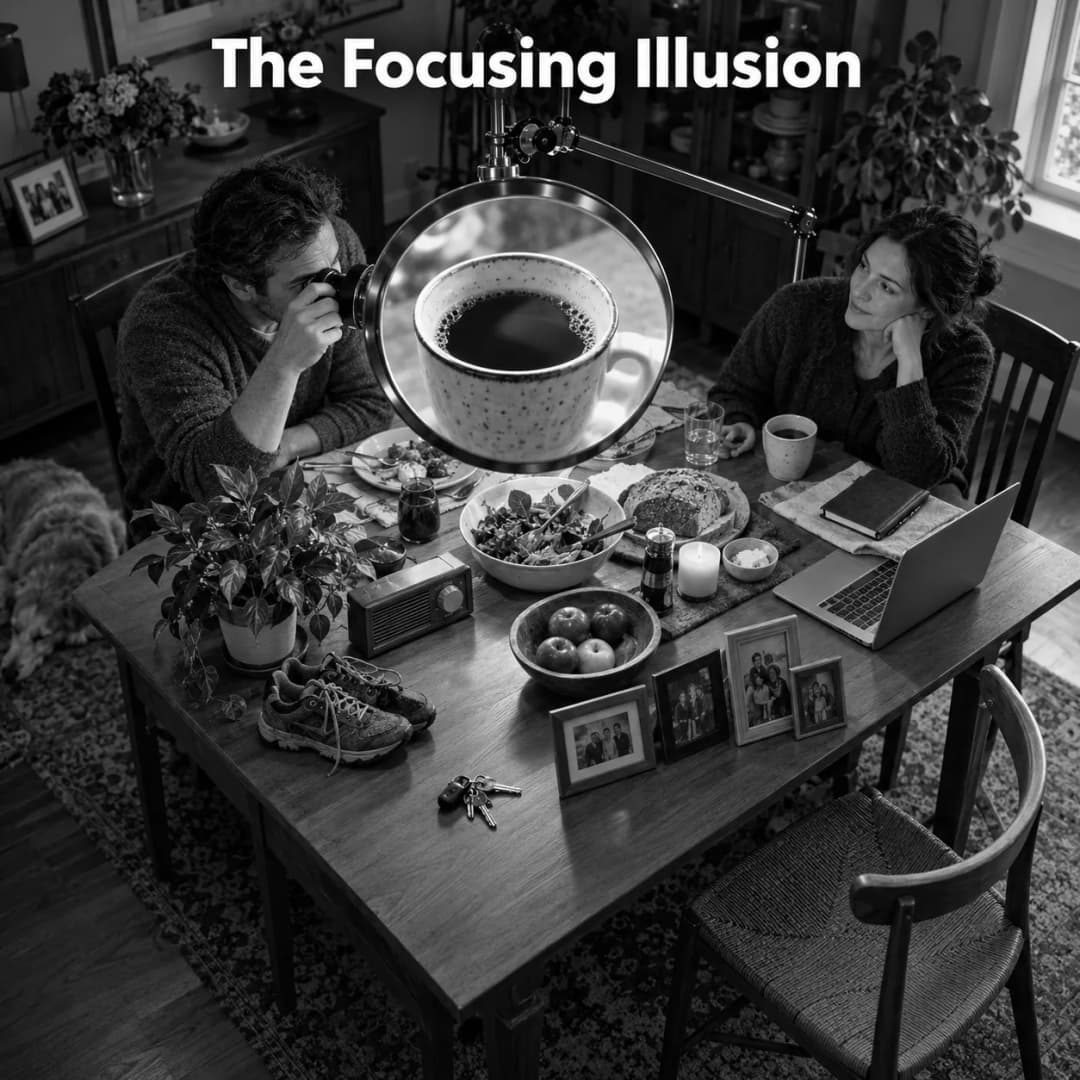
Daniel Kahneman's own one-sentence version, and he intended it to be quotable, is that nothing in life matters quite as much as you think it does while you are thinking about it. Direct attention at any single aspect of life and that aspect swells to fill the estimate. The illusion itself is a well-attested judgment effect and the attention account of adaptation that comes with it is a genuinely good mechanism. The flagship study arrives in the popular source without a sample size or a coefficient, which is why this page is not filed as robust.
What it is
Ask someone how much a thing matters and the asking is what makes it matter. The judgment is not a report on their life, it is a report on what they were pointed at.
The naming needs care, because two laboratories got there separately. Focusing illusion is Kahneman's term. Daniel Gilbert and Timothy Wilson call the same error focalism, and the related failure, predicting your own future feelings badly, is their miswanting. Both terms are in circulation, they are not competitors, and Gilbert and Wilson should be credited for their own rather than folded into Kahneman.
The mechanism is the most useful part. You do not adapt to a circumstance by growing numb to it. You adapt by ceasing to attend to it. That reframes hedonic adaptation from a fading of feeling into a redirection of attention, and it predicts which circumstances will and will not fade: anything that keeps recapturing attention never adapts away. The exceptions the book names are chronic pain, loud noise and severe depression, all of them built to hold attention.
In effect
The demonstration is a survey run by David Schkade and Kahneman across students in California, Ohio and Michigan, reported in chapter 38. Respondents were asked about satisfaction with various aspects of life, and some were additionally asked to predict how a person with their own interests living elsewhere would answer. The pattern is that climate is not a determinant of wellbeing: Californians are not, in aggregate, more satisfied with their lives than students in the Midwest. But ask the question and the answer changes, because asking installs the sunshine at the centre of the frame. Recent movers, whose attention is still on the change, do report themselves happier.
The consumer consequence falls directly out of the mechanism rather than being an extra empirical claim. Goods are over-bought because they command full attention at the point of decision and then stop commanding any: the car is the whole world in the showroom and is furniture within a month. Activities are under-bought because they are harder to picture in advance, yet they keep demanding attention while they happen, which is precisely the condition under which something does not adapt away.
What it does not say
It does not come with the numbers. The California study is described as using large samples, and the phrase is doing the work of a number. No sample size and no correlations are printed, and any figure from it should be traced through the endnotes before it appears anywhere.
It does not license the disability material that travels with it. Chapter 38 uses paraplegia and colostomy to argue that severe disability is not the exception people expect. No researchers are named for those findings, so there is nothing to check; claims about how people with disabilities feel about their lives can do real harm when they are wrong or flattened, and they get used to argue about other people's care; and the hedonic adaptation literature has been substantially revised since 2011, so the strong version, that people adapt to almost anything, is not the current position. Use the attention mechanism, which is the durable idea, and do not reproduce those examples as evidence.
It is not the same as wanting and liking. That is a neural account of a similar purchasing failure, and the two mechanisms should not be merged just because they predict the same behaviour.
It does not leave self-report untouched. If pointing attention at an aspect of life changes the rating, a satisfaction survey partly creates the satisfaction it measures, which is a methodological consequence rather than a footnote.
Sources
- Kahneman, D. (2011). Thinking, Fast and Slow. Farrar, Straus and Giroux. Ch. 38. Source of the one-sentence formulation, the California study with David Schkade, the attention account of adaptation, and the disability material. The book prints no sample size and no coefficients for the California study, and names no researchers for the paraplegia and colostomy findings.
- Schkade, D. A., & Kahneman, D. (1998). "Does living in California make people happy? A focusing illusion in judgments of life satisfaction." Psychological Science, 9(5), 340-346.
- Wilson, T. D., & Gilbert, D. T., on focalism and miswanting. Their terms for the same error and its forward-looking relative, credited to them rather than to Kahneman.
- Vault note on handling: this concept is health adjacent. The hedonic adaptation literature has been substantially revised since 2011, and the disability examples should not be reproduced as evidence without primary sources the book does not supply.
- The vault's reliability audit of Thinking, Fast and Slow applies in full here, including the disclosure that Kahneman was a Senior Scientist with the Gallup Organization while writing about Gallup wellbeing data.