The Fourfold Pattern
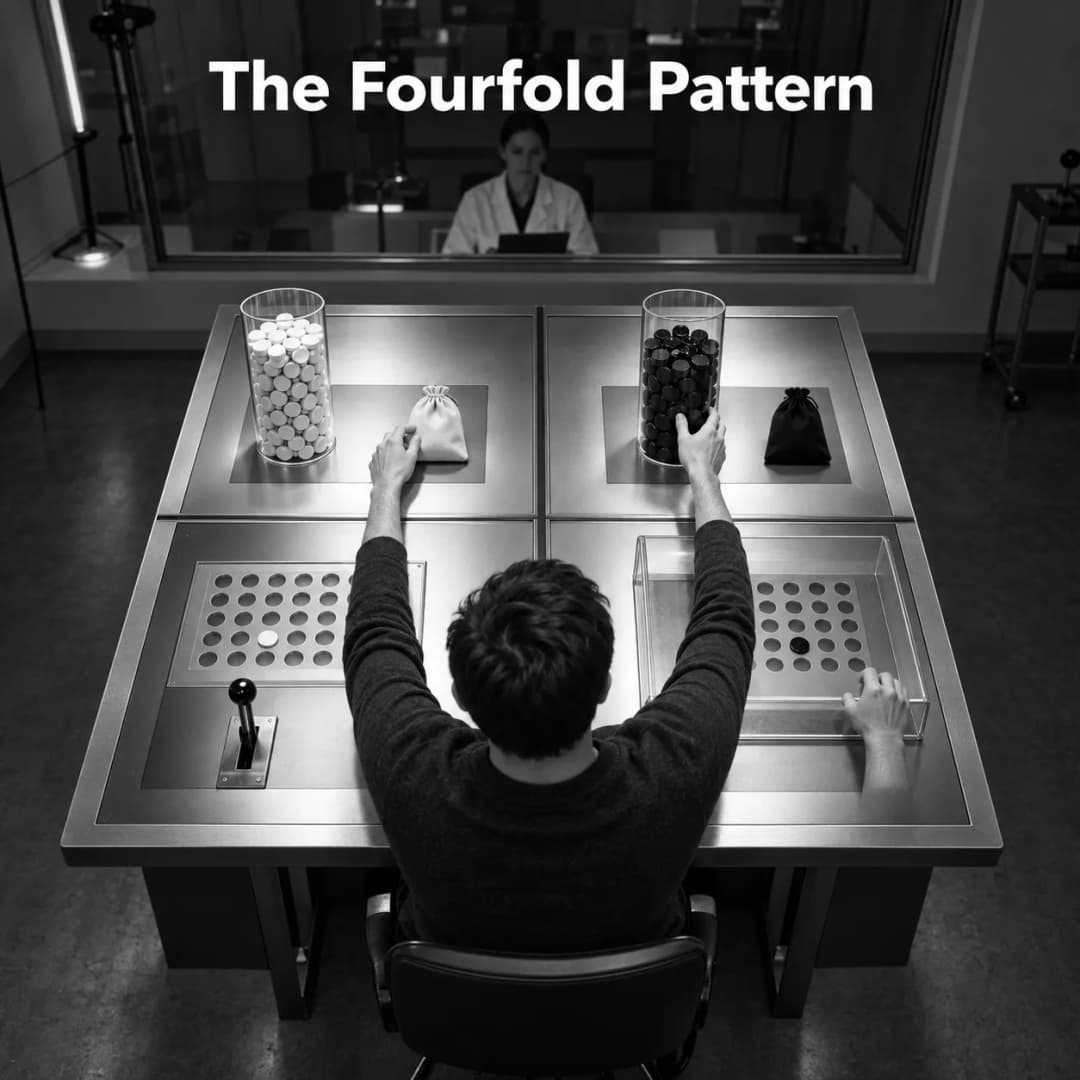
Cross gains against losses, and high probability against low probability, and you get four cells. Each has its own risk attitude and they are not the same attitude. People are not risk averse. They are risk averse in two of the four situations and risk seeking in the other two, predictably, and the same person does all four inside a single afternoon. The pattern is Daniel Kahneman and Amos Tversky's, an output of prospect theory, and it is among the extensively replicated elements of that theory. Its most quotable application, to civil litigation, rests on experiments the popular source declines to identify.
What it is
The point of the pattern is that it replaces a single trait with a two-by-two, and the two-by-two is what makes it testable.
For high-probability gains people are risk averse, out of fear of disappointment, and will accept an unfavourable settlement rather than gamble on the near-certain win. For high-probability losses they are risk seeking, out of hope of avoiding the loss, and will reject a favourable settlement and gamble on the near-certain loss. For low-probability gains they are risk seeking, out of hope of a large gain, and buy the lottery ticket. For low-probability losses they are risk averse, out of fear of a large loss, and buy the insurance.
The two rows have different engines. The top row runs on the certainty effect, the extra weight the mind gives to eliminating the last few percentage points of doubt. The bottom row runs on the possibility effect, the extra weight it gives to a chance existing at all rather than not existing. Both fall out of the decision-weight function in prospect theory, in which a very small probability is weighted well above its stated value and the step from nearly certain to certain is worth far more than the arithmetic difference.
It is also the theory's cleanest falsification target. Expected utility theory cannot generate this pattern at all, and it is observed.
In effect
The application that makes the pattern feel less like a laboratory curiosity is in civil litigation, credited by Kahneman to Chris Guthrie. Three consequences follow, and they run in different directions.
Plaintiffs with strong cases settle too cheaply. A likely win is a high-probability gain, which is the risk-averse cell, so the plaintiff takes an unfavourable settlement to avoid the small chance of getting nothing. Defendants with weak cases gamble. A likely loss is a high-probability loss, which is the risk-seeking cell, so the defendant rejects a favourable settlement and goes to trial in the hope of escaping. And plaintiffs with very weak cases can extract more than the statistics justify, because a very small chance of a very large award is a low-probability gain for the plaintiff and a low-probability loss for the defendant, putting both sides on the wrong side of the weighting. The defendant is buying insurance. The plaintiff is holding a lottery ticket the defendant has a reason to buy back.
The third case is the one worth writing about, because it explains a feature of the litigation system usually blamed on lawyers' ethics and at least partly a property of probability weighting.
What it does not say
It does not come with measured magnitudes. The cells are stated as directions rather than as sizes, no cell arrives with an effect size in the popular source, and none has been invented here. The pattern is robust as a set of signs.
It does not carry its own confirmation. Thinking, Fast and Slow states that the predictions about legal claims were confirmed by experiments with law students and practising judges, and names no researcher, no sample size, no jurisdiction and no year, and does not say whether the students and the judges behaved alike, which is the only thing a reader would want to know. Guthrie is named for the application; the confirmation is unattributed and should be traced before it is repeated.
It is not loss aversion. Loss aversion is about the steepness of the value curve. The fourfold pattern needs probability weighting as well, and the two are routinely merged in popular accounts that then cannot explain why anyone buys a lottery ticket.
It does not tell anyone what to do with their money. Insurance and settlement decisions are money decisions, the pattern describes how people do choose rather than how they should, and nothing here is advice.
Sources
- Kahneman, D., & Tversky, A. (1979). "Prospect theory: An analysis of decision under risk." Econometrica, 47(2), 263-291. The parent theory's originating paper. Thinking, Fast and Slow does not date the fourfold pattern separately and no separate date is asserted here.
- Kahneman, D. (2011). Thinking, Fast and Slow. Farrar, Straus and Giroux. Ch. 29, for the pattern, the certainty and possibility effects, and the litigation application.
- Guthrie, C., credited in Thinking, Fast and Slow with the civil-litigation application. No paper, journal or year is recorded in this vault and none has been invented.
- The confirming experiments with law students and practising judges: the book names nobody. Recorded as an unattributed claim rather than a citation.
- Evidence status: mixed. A well-replicated pattern whose legal application, the most quotable part, rests on experiments the source declines to identify.