The Grand Bargain
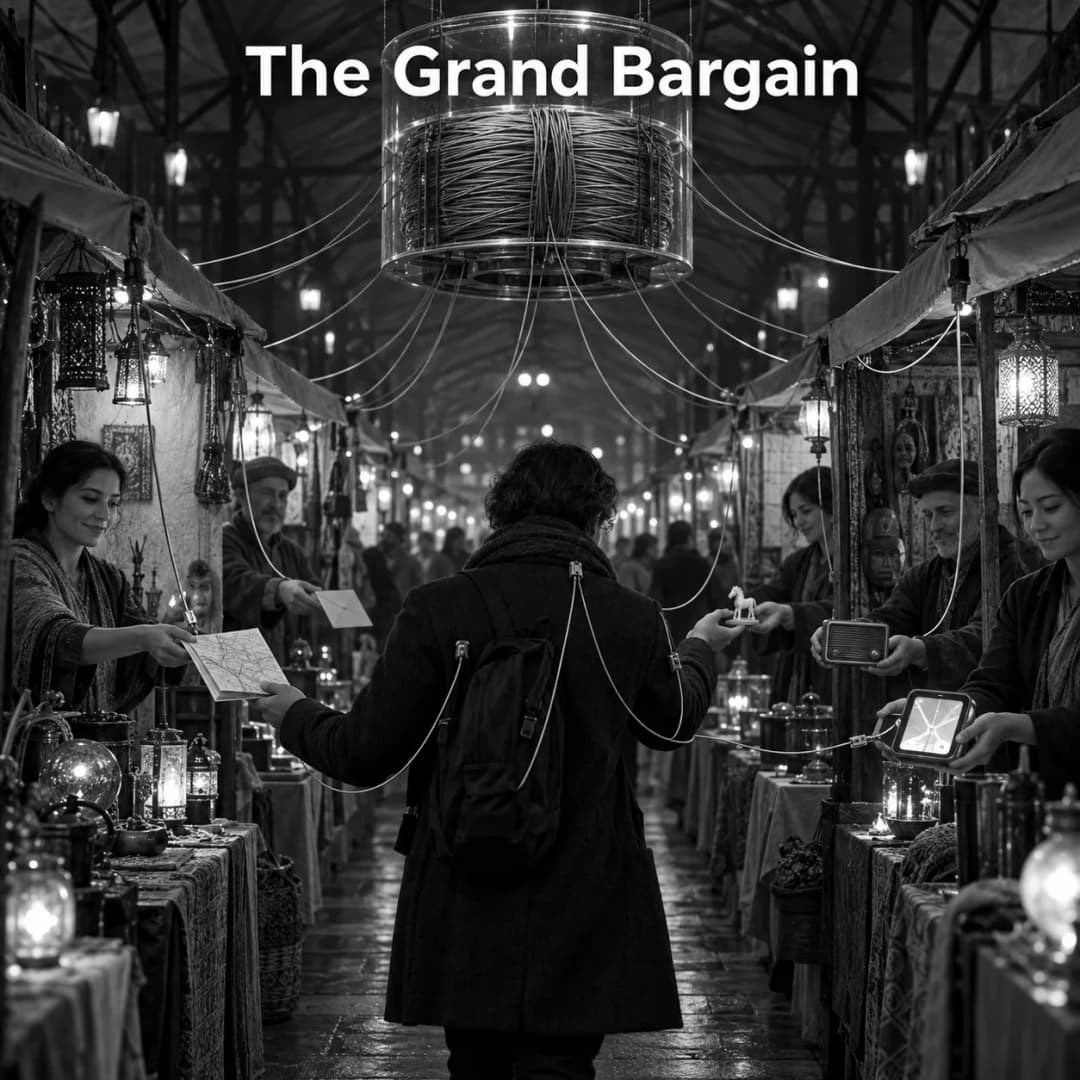
The grand bargain is Tim Wu's name for the implicit trade everyone keeps making without ever formally agreeing to it: hand over attention and privacy, receive free convenience and diversion in return. It is an interpretive argument about media history from The Attention Merchants in 2016, not a testable effect, and its force is in the arithmetic of accumulation rather than in any single deal.
What it is
Any one instance of the trade looks fine, even generous. Free news, free email, free games, free maps. Wu's claim, at page 5, is that the problem is the sum: nearly every space once treated as off limits to commerce has been opened to attention harvesting, one reasonable looking deal at a time. The home, the school, friendship, the last hour before sleep.
For the human type this produces he coins homo distractus at page 6, a person whose habits of mind have been reshaped by living permanently inside the bargain. The coinage is his and should be attributed to him.
In effect
The structural point is that no single company designed the outcome. It is the accumulation of a hundred separate free in exchange for attention deals, each negotiated in isolation and none of them put to a vote. That is why the usual remedies, which address one product or one company at a time, do not touch the thing Wu is describing.
It is also why the bargain has a non-consensual counterpart. Where a deal was struck, however lopsided, there is at least a trade. Attention theft is the category where no deal was struck at all, and the two are worth keeping separate when the question is what, if anything, should be regulated.
What it does not say
It does not measure the cost. The claim that the cumulative price of free services is large is an argument rather than a result. Work on privacy valuation and consumer surplus exists and would have to be cited directly for any quantitative statement.
It does not say the bargain is a swindle in every instance. Wu's point is about aggregation, and a reading that treats each individual deal as a fraud loses what makes the argument interesting.
It does not replace evidence about effects. Whether living inside the bargain changes attention, mood or memory is a separate empirical question with its own contested literature, and the historical framing does not settle it.
Sources
- Wu, T. (2016). The Attention Merchants. Knopf. The cumulative trade-off named at p. 5; "homo distractus" coined at p. 6.
- Vault verification pass, 2026-09-25. Verdict: not-a-research-claim. An interpretive argument about media history, so replication does not apply. The claim that the cumulative cost of free services is large is an argument, not a measured result; the privacy-valuation and consumer-surplus literature should be cited directly for any such figure.