The Interpretive Claim
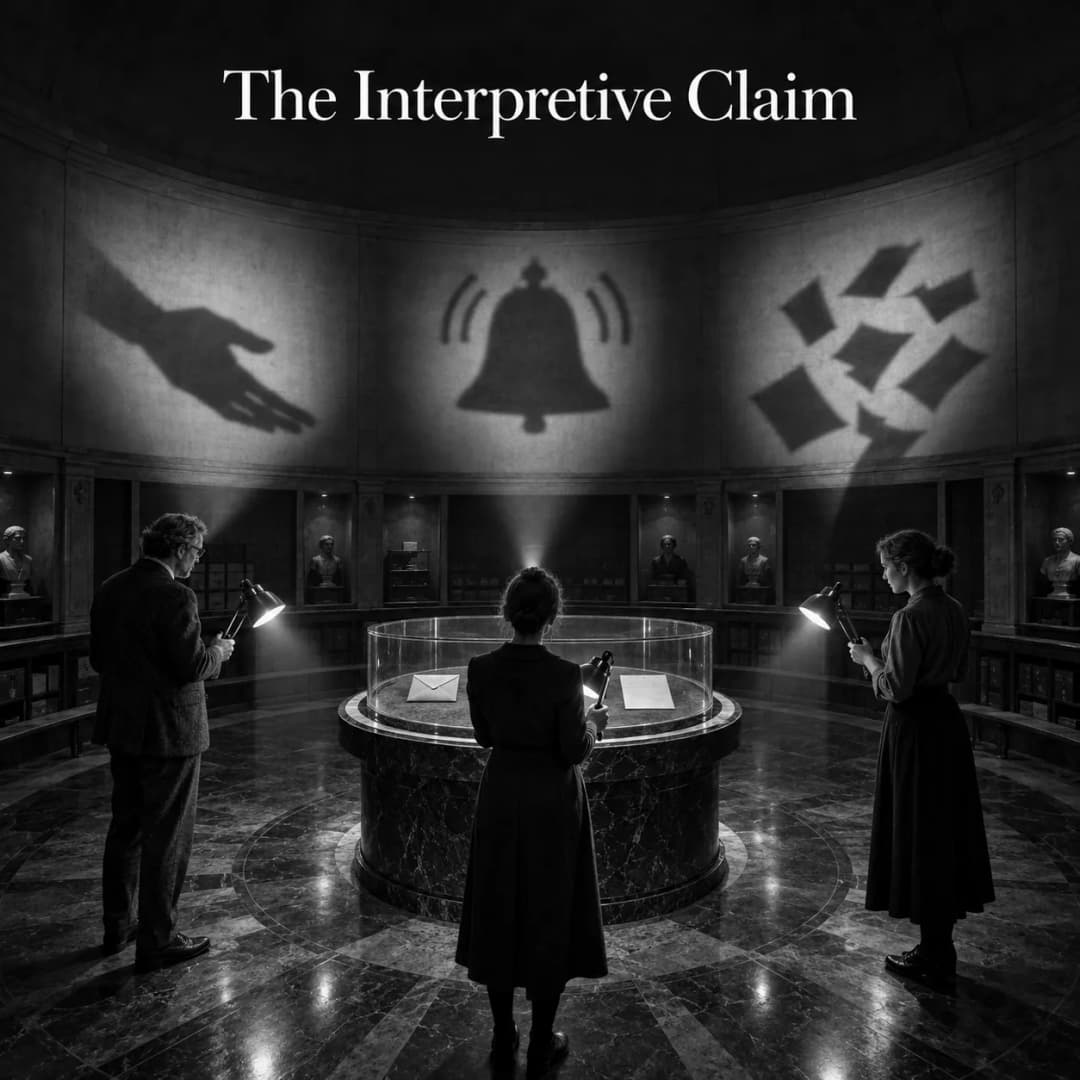
An interpretive claim is a claim about what a set of agreed facts means, and in particular a claim about somebody's intent. It is not a research finding and it is not a finding of any other kind. It is named here because it is the class of claim a careless reading turns into fact, and the rule that follows from it governs how this publication writes.
What it is
Nobody disputes that the document was written, that the campaign ran or that the message was sent. The dispute is over whether it was done in order to frighten people, or to help them, or out of nothing more interesting than haste.
The defining property is that no better source would settle it. A factual claim can be verified by going to the primary. An interpretive claim cannot, because there is no primary that answers it. Going looking for one is wasted effort, and failing to find one is not evidence either way.
The rule that follows is short. An interpretation of intent is not a finding and never enters the vault as fact, however plausible it sounds and however well sourced the surrounding chapter is. Every interpretive claim is attributed to whoever made it, in their own words where possible, and labelled as a reading. The correct form is that a named author reads a thing as meaning something, never that the thing was that something. This applies with most force where the reading is adverse to a named living person or a named institution, which is barred on two separate grounds.
In effect
The rule was written down while sorting the claims in one book into three kinds. Psychological claims go to the literature. Institutional claims follow a citation or are excluded. Interpretive claims are the ones no source could settle, and that third list is where such a book's argument usually lives. It is also the list a careless ingestion flattens into fact, because the surrounding chapters are often well sourced and the reading arrives wearing the same clothes as the evidence.
A worked instance. An official advisory sub-group recommended increasing the perceived level of personal threat among the complacent, using hard-hitting emotional messaging, and in the same recommendation said that to be effective this must also empower people by making clear what actions they could take. The document exists and is public. The narrow accurate statement is that an official advisory group made that recommendation. The reading that governments deliberately amplified fear is an interpretation: advice given is not action taken, a sub-group paper is not a government decision, and no committee or inquiry reachable in the verification pass examined the question of intent at all.
What it does not say
It does not say interpretations are worthless. They are how arguments are made, and a book with no readings in it would have nothing to say. The rule is about how they are recorded, not about whether they may be entertained.
It does not say the underlying facts are in doubt. In the worked instance the document is real and public, and the narrow statement about what it recommended is a factual claim that survives checking.
It does not say more evidence would resolve the dispute. That is precisely the property that defines the class, and it is why the evidence ladder, which grades sourced claims by the strength of their support, cannot grade this class at all.
Sources
- Dodsworth, L., & Fagan, P. Free Your Mind, 2026-09-26. The book's list C, and the reason this rule was written down.
- External verification pass, 2026-09-27. Established the narrow accurate version of the fear-messaging claim, that an official advisory sub-group recommended increasing perceived personal threat using hard-hitting emotional messaging while also saying that effective messaging must empower people by making clear what actions they could take, and recorded that the question of intent was not examined by any reachable official review.
- This page is a house rule rather than a research claim, and it is enforced through the publication's evidence status and production rules.