The Lipstick Effect
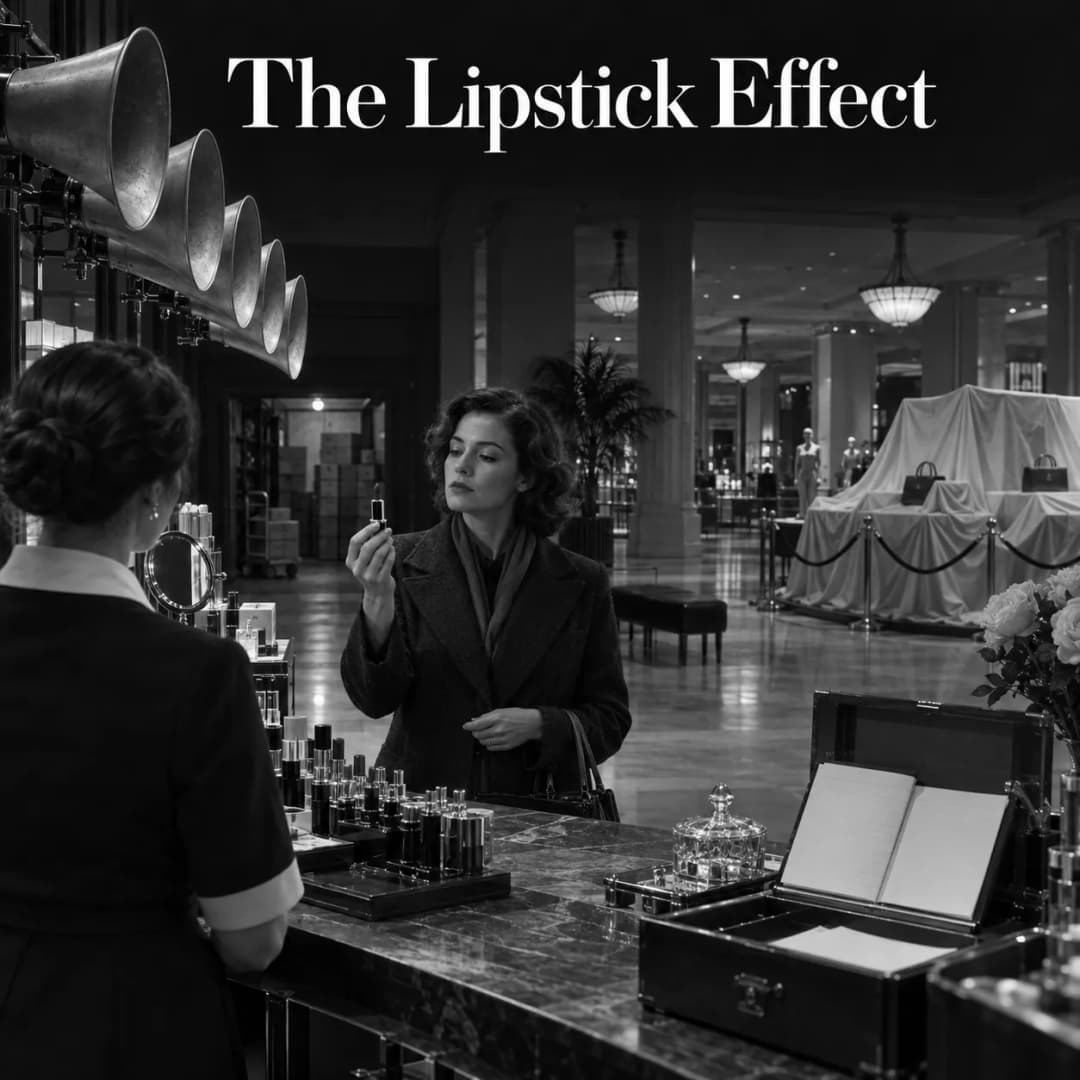
The lipstick effect is the claim that spending on beauty products, and on lipstick in particular, rises during recessions, because a small cosmetic purchase is the affordable substitute for the large discretionary one a shopper has just given up. It is one of the most repeated ideas in consumer journalism and one of the least secure. The right way to write about it is as a story the industry tells itself and as a case study in how an uncited claim becomes common knowledge, not as a finding.
What it is
The story as it is always told: department store lipstick sales climb while handbag sales fall, so a recession is legible in a cosmetics counter's till receipts. Retail commentary has attached the pattern to the downturn of the early 2000s and to 2008, and consumer-behaviour researchers have since offered a mating-motivation account, in which economic threat raises spending on goods that increase attractiveness to partners with resources.
Two distinct claims are routinely fused in the retelling. One is an experimental claim about what cues of economic threat do to spending preferences in a laboratory. The other is a macroeconomic claim about aggregate beauty sales tracking recessions. They have different evidence and different strength, and neither supports the other.
In effect
The sourcing is the reason this page exists. In Adrian Furnham's The New Psychology, the effect is introduced with the assertion that it has long been established, and no source is given: no study named, no researcher named, no year, no sample. It is not in the chapter's bibliography and not anywhere else in the book, and it is listed in this vault's record of citations from that book that do not resolve. The phrase doing the work a citation would normally do is the phrase itself.
Two italicised expressions surround the claim in that chapter, treating beauty as a currency and cosmetics as a form of therapeutic investment. Those are the author's own framings rather than established terms in the literature, and they should never be quoted as though they were named constructs. Anyone searching for them will find that book and nothing else.
What it does not say
It does not say beauty spending reliably tracks recessions. The aggregate claim is poorly supported, has been contradicted by sales data in several downturns, and the version that matters commercially is considerably weaker than the popular version.
It does not say the mechanism is nonsense. There is genuine experimental work showing that cues of economic threat can shift spending toward attractiveness-enhancing goods, and it is a coherent hypothesis. It sits in the part of consumer psychology hit hardest by replication problems, and it has drawn both replication criticism and specification criticism.
It does not give this publication anything to cite. The source through which it arrives supplies no year, no journal, no authors and no sample size. If the claim itself is ever wanted, it has to come from the primary literature, verified, and this page reopened.
Sources
- Furnham, A. The New Psychology, ch. 8. The claim is asserted with no source given, in the prose, in the bibliography or anywhere else in the book, and is recorded in this vault's unresolved-citations list for that book. The two italicised framings around it are the author's own and are not established terms in the literature.
- Primary literature: not traced. Year, journal, authors and sample sizes are all not given by this source, and nothing on this page carries a number into an article.
- Evidence status: contested. This is a verdict on the research as well as on the sourcing: the experimental mating-motivation work and the aggregate recession-tracking claim are not the same claim, and the second is poorly supported.