The Memex
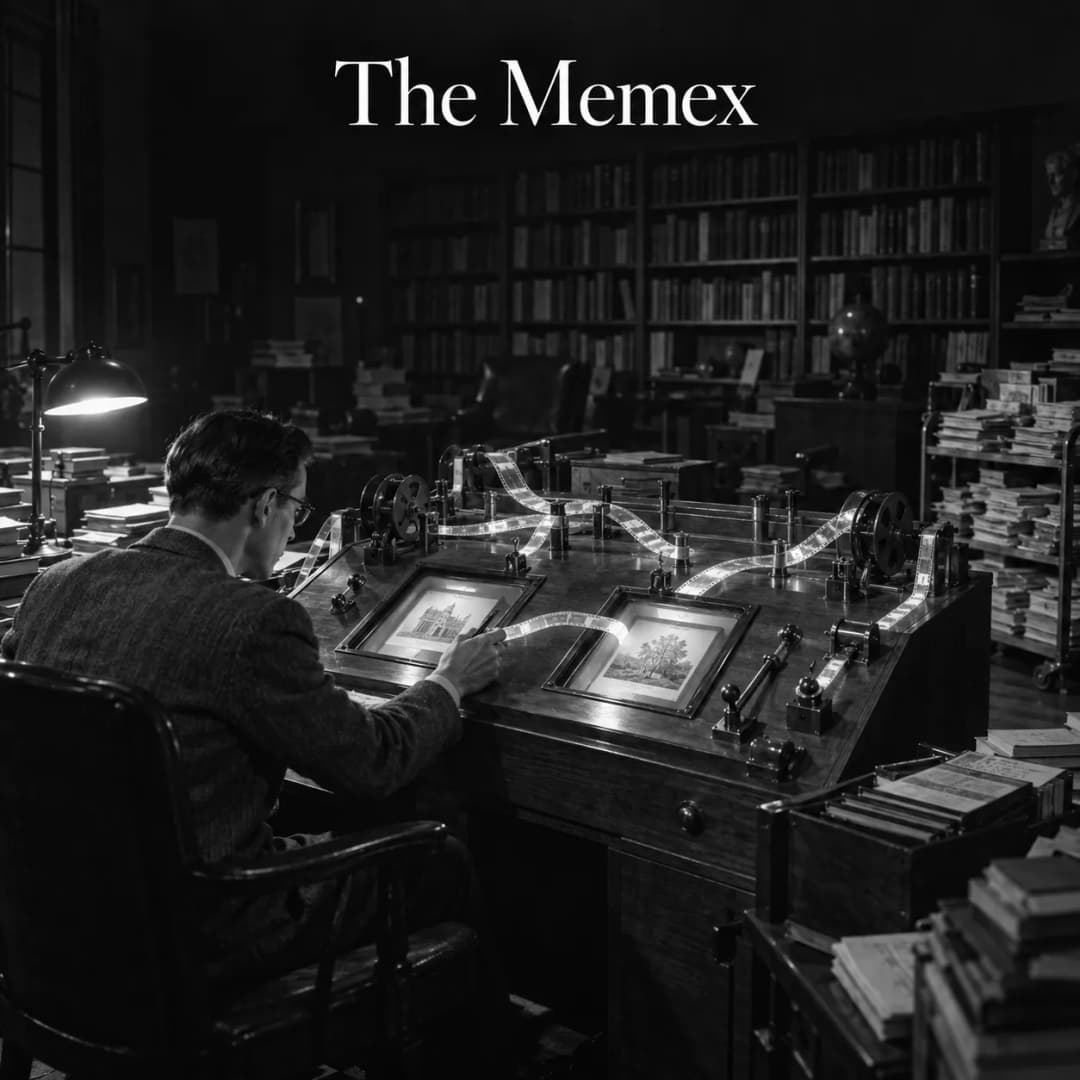
The memex is Vannevar Bush's proposed desk sized machine for storing a person's books, records and communications, retrievable by associative indexing: linking any item to any other so that trails of connected material could be built and followed. He described it in As We May Think in the Atlantic Monthly in July 1945. It is a design proposal and a piece of intellectual history rather than a research claim.
What it is
Bush's motivation was overload. The specialist researcher, he argued, could no longer keep up with the published record, and the difficulty was not storage but retrieval: indexing by category forces a reader down artificial paths, while the mind works by association. The memex was his answer, a machine that would let a user tie two items together permanently and then walk the trail later.
It is the conceptual ancestor of the hyperlink. It influenced Doug Engelbart and, through him, the personal computer, and the line from associative indexing to hypertext is one of the cleaner inheritances in the history of computing.
In effect
Nicholas Carr raises the memex in order to say that the cure has not worked. Search and filtering increase the volume of relevant material without adding any time in which to think about it, so the affliction Bush wanted to end has instead become permanent. The machine arrived, the trails arrived, and the overload arrived with them.
Worth holding alongside that is how old the complaint is. Barnaby Rich in 1600 and Robert Burton in 1628 both complained that there were too many books to read. Overload is not a condition the internet created, which does not undercut Carr's point but does set a useful bound on how much of it can be blamed on any one technology.
What it does not say
It does not say Bush built anything. The memex was described, not constructed, and the essay is a proposal.
It does not say associative linking causes shallow reading. That is Carr's argument elsewhere and it rests on separate evidence. Bush's own claim was about retrieval, and he made no prediction about what the machine would do to attention.
It does not say overload is new or that it is measured here. The four centuries of prior complaint are a reason to be careful with claims that this generation is uniquely swamped, not a demonstration either way.
Sources
- Bush, V. (1945). "As We May Think." The Atlantic Monthly, July 1945.
- Carr, N. The Shallows, chapter 9.
- Rich, B. (1600) and Burton, R. (1628) are cited in The Shallows as earlier complaints about there being too many books to read.