The Pleasure-Pain Balance
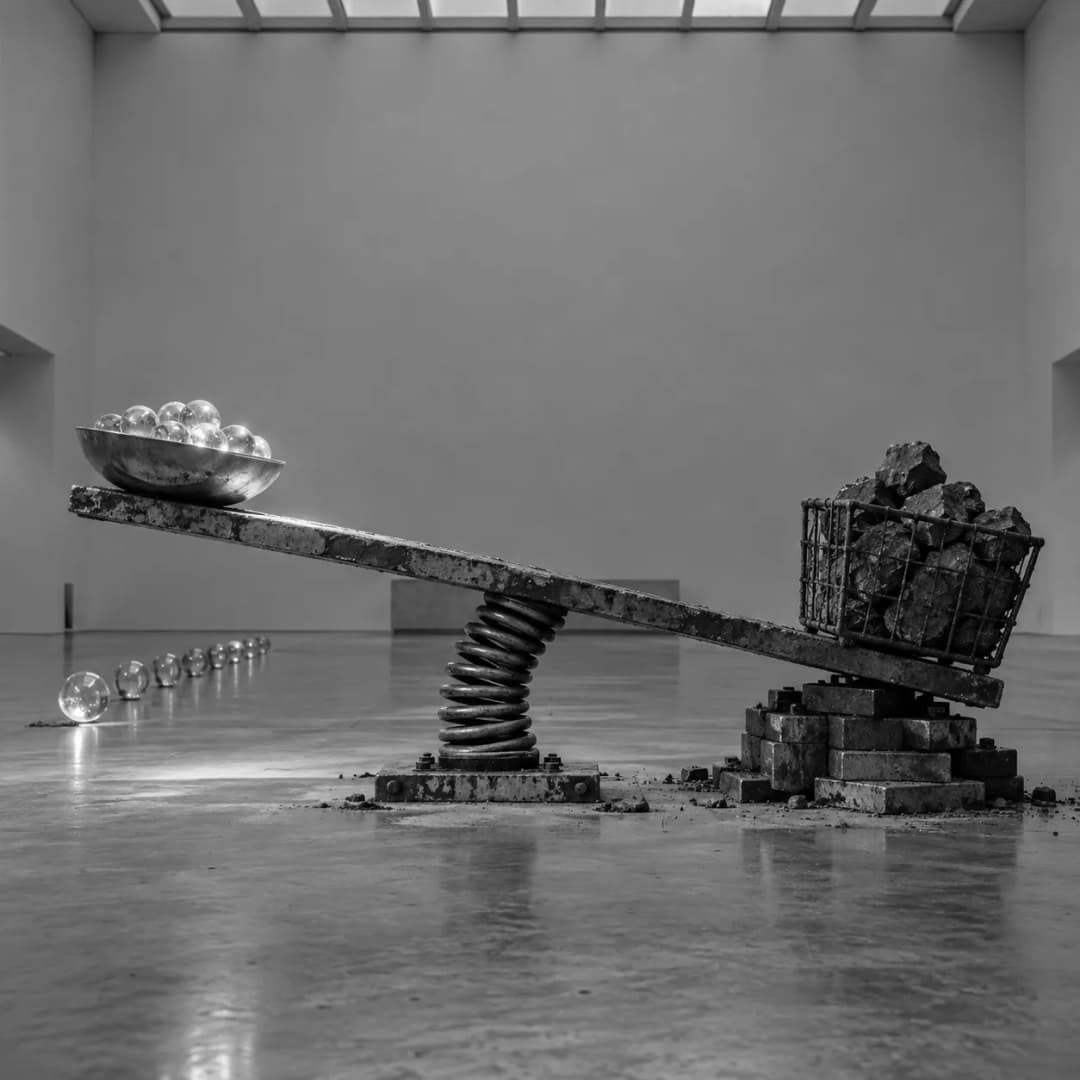
The pleasure-pain balance is Anna Lembke's central device in Dopamine Nation and the spine of the whole book. Pleasure and pain are drawn as a seesaw: tip it one way and the brain, which wants the thing level, pushes back until it tips the other way, and the overshoot into pain is craving. It is a framework and an image rather than a testable effect, and it should be cited as an idea. Structurally it is opponent-process theory with a picture on it, and that identification is this publication's rather than the book's, because the device is credited to nobody anywhere in the text or the notes.
What it is
Repetition changes the shape of the tilt. On Lembke's account the pleasure side weakens and shortens while the pain side that follows it strengthens and lengthens, which is neuroadaptation and which produces tolerance. With prolonged heavy use the balance no longer returns to level at all but sits weighted to the pain side, which is what she is describing when she reaches for the word homeostasis for a process that is better named allostasis, a regulated set point that has itself moved.
Every structural feature of the balance is a feature of the a-process and b-process in Richard Solomon and John Corbit's opponent-process theory of motivation, published in 1974. Lembke does name Solomon and Corbit, once, early in the book. The theory is therefore present. The credit for the device built on it is not, in a book whose apparatus otherwise runs to roughly a hundred and sixty-five bibliography entries with digital object identifiers.
In effect
The device does real explanatory work, which is why the book travelled. It makes withdrawal, craving, a shifted hedonic set point and anhedonia one mechanism rather than four, and a reader finishes the book able to say why a second use is less good than the first.
Lembke also prints the failure conditions of her own headline metaphor, which very few popular-science authors do, and that should be quoted back whenever the model is criticised. She gives a short section dismantling the balance, listing several ways in which real pleasure and pain do not behave like a scale: they can be experienced at the same time rather than only in opposition, a drug of choice is person-specific, not everyone starts from a level balance, and meaning and interpretation shape whether something is perceived as pleasure or as pain at all.
Both readings of the device are available and both are true. One is that an unattributed repackaging of a fifty-year-old theory has been sold as a personal synthesis, and that the missing credit matters because a reader who wanted the underlying research has nowhere to go. The other is that metaphors are how clinical ideas travel, that the underlying theory is named a few pages earlier, and that she is unusually honest about the metaphor's limits. Where this publication comes down: the limits section is genuinely creditable and the missing attribution is still a failure of the apparatus, because the two are separable. Naming Solomon and Corbit at the seesaw would have cost one clause.
What it does not say
It does not say that pleasure and pain are literally a mechanical balance, and the book says so itself.
It does not describe or recommend anything anyone should do. The balance is an explanatory image, and the interventions that circulate downstream of it are separate claims that have to be assessed separately.
It does not say anything about an individual. It is a general account of adaptation to repeated stimulation, offered as a framework, and nothing in it is clinical guidance or a description of any particular person's experience.
Sources
- Dopamine Nation, Anna Lembke. The balance is introduced in ch. 3 and runs to the end of the book. It is credited to nobody in the text or the apparatus.
- Dopamine Nation, p. 65, "The Balance Is Only a Metaphor". Lembke's own five limits on the device.
- Dopamine Nation, p. 52, the single place where Solomon and Corbit are named.
- Solomon, R. L., & Corbit, J. D. (1974). "An opponent-process theory of motivation." Psychological Review, 81(2), 119-145. The theory the balance is a picture of. This identification is ours, not the book's.
- Evidence status not-a-research-claim: cite as an idea, attributed to Lembke, and do not ask it to replicate.