The Triune Brain
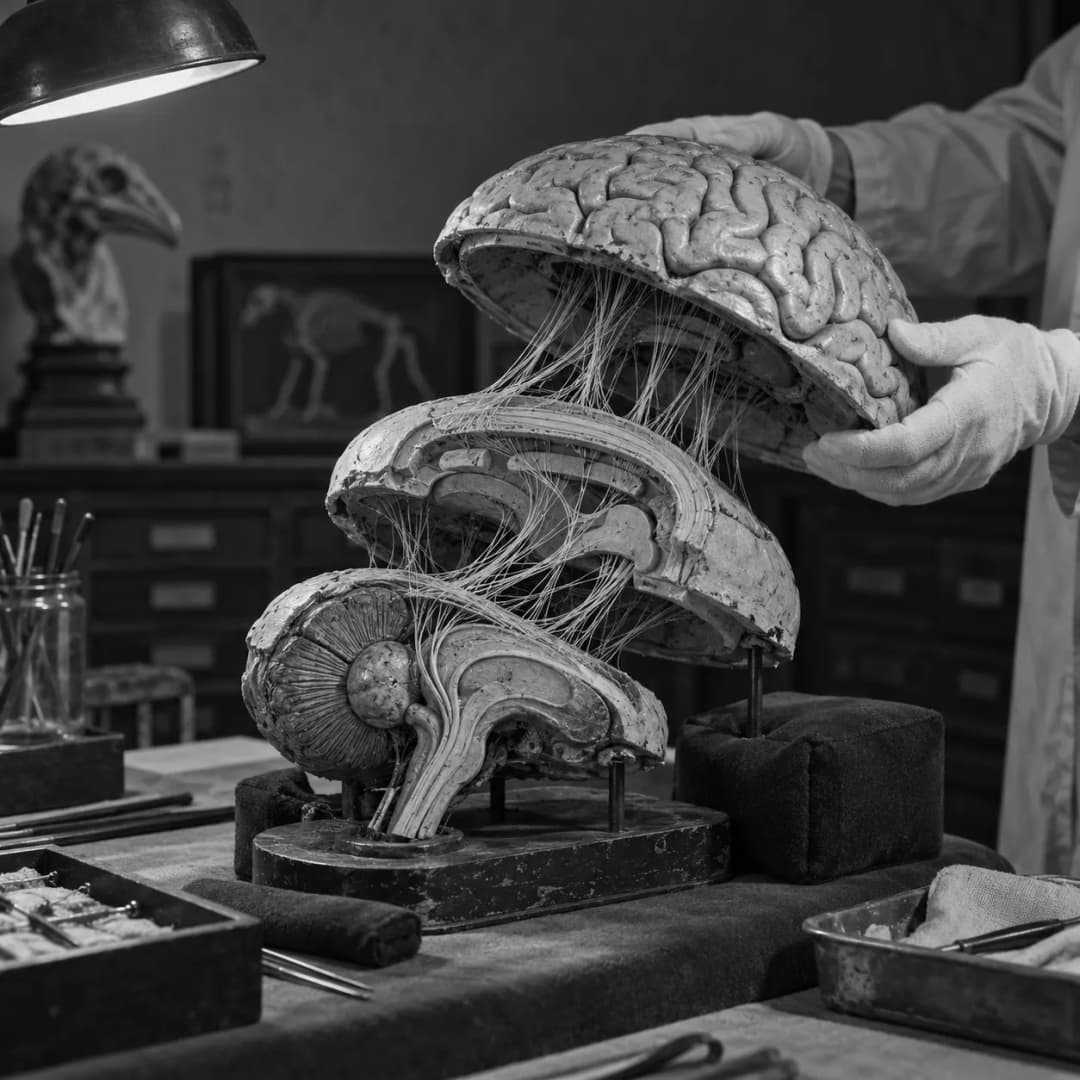
The triune brain is Paul D. MacLean's model of the brain as three layers stacked by evolutionary age: a reptilian complex governing instinct and survival, a limbic system governing emotion, and a neocortex governing reason, each added on top of the last and each capable of operating semi-independently. It is the source of the lizard brain and of every popular account in which emotion and reason are two structures fighting for the controls. Comparative neuroscience does not support it, and the dispute about the layering is settled against the model. The limbic system is a different question, and the two must be kept apart.
What it is
MacLean developed the model through the 1960s and set it out in full in The Triune Brain in Evolution in 1990. Carl Sagan popularised it for general readers in The Dragons of Eden in 1977, and the vocabulary has been in general circulation ever since.
The case against it is now the consensus. Brains did not evolve by adding layers. The mammalian neocortex is not a novel structure but a modification of tissue already present in reptiles, which removes the model's foundation. The functional half fails with the anatomical half: emotion is not confined to a limbic system, reason is not confined to a neocortex, and neither operates semi-independently of the other. Lisa Feldman Barrett, a working affective neuroscientist, characterises it as one of the most successful and widespread errors in science, and that is quoted as her characterisation rather than as a measurement.
The other side is owed even though the dispute is settled. MacLean was a serious researcher at the National Institute of Mental Health and the model was a reasonable synthesis of what was available when he proposed it. It put emotion into the biology of the brain at a time when that was not assumed, and it gave a generation of clinicians and writers a vocabulary. Being superseded is not the same as being at fault, and nothing here impugns MacLean's practice. What this concept records is the conduct of books still teaching the model sixty years later.
In effect
The distinction the vault insists on is not a quibble, and conflating the two is how the model survives its own refutation. The triune brain is rejected outright: the layered-addition premise is a nineteenth-century view superseded by comparative neuroanatomy, and specialists do not treat it as a serious account. The limbic system is one surviving component of that story, separately criticised on anatomical grounds rather than rejected. The structures are real. What is disputed is that they form one system with one job. Joseph LeDoux argues there is no single emotional system in the brain and that the concept lacks consistent structural and functional criteria. Rolf Kotter and Niels Meyer called it a non-empirical explanatory concept for poorly understood brain functions in 1992, Alf Brodal earlier characterised it as substituting naming for understanding, and Barrett argues the regions MacLean grouped are general-purpose hubs rather than an emotion module. Saying the triune brain is wrong is uncontroversial. Saying the limbic system does not exist overstates the case, because the phrase remains in use as shorthand. The defensible line is that the grouping is a historical convenience rather than a functional unit.
The model's commercial afterlife is the reason the concept matters here, and the clearest case is Simon Sinek's Golden Circle, which is the triune brain with a business diagram over it. What sits on the neocortex, presented as the seat of rational and analytical thought and of language. Why and How sit on the limbic system, presented as the seat of feeling, trust and loyalty and as having no capacity for language. The chapter asserting this is titled to declare that it is biology rather than opinion, and the book carries a hundred and five endnotes with no peer-reviewed article among them, the biology chapter's notes pointing at a children's picture book and at two marketing pages. The assertion that the limbic system has no capacity for language is the load-bearing sentence of the framework and it is false as stated. Subcortical structures are routinely implicated in language, subcortical aphasia is a recognised clinical entity, and the hippocampus is central to verbal memory and word learning. The honest caveat is that the basal ganglia and thalamus are not standardly counted as limbic, so the strictest reading of that sentence is not refuted by subcortical aphasia alone, and it does not rescue the claim.
Three further routes are recorded. Peter Watson's The Modern Mind passes the model on in 2001 as background anatomy with no owner at all, in a book that footnotes most of the ideas it attributes to a named originator. Hasard Lee's The Art of Clear Thinking states it twice in 2023 as current brain science and rests a breathing instruction on it, the claim being that controlled breathing shifts decision-making back to the neocortex. And popular usage supplies the lizard brain to everyone downstream. In each case MacLean is unnamed and the disagreement is absent.
What it does not say
It does not say that emotion and cognition are unrelated, or that no structure specialises. Distributed accounts of emotion, salience and control exist and are where the live research is.
It does not say the underlying intuition is worthless. The defensible version, that feeling precedes and shapes justification, belongs to Antonio Damasio's somatic marker hypothesis, whose mechanism is cortical rather than limbic, and which has itself been critically reviewed by Barnaby Dunn and colleagues, so it is live rather than settled.
It does not license the phrase reptilian brain as harmless shorthand. The shorthand is what carries the error, because it asserts that an older and separate structure takes over, and everything a reader does with it follows from that. Any use of the model in this publication must be historical, attributed to MacLean, and marked as superseded in the same sentence.
Sources
- MacLean, P. D. (1990). The Triune Brain in Evolution: Role in Paleocerebral Functions. Plenum Press. The full statement of the model, developed from the 1960s.
- Sagan, C. (1977). The Dragons of Eden. The popularisation for general readers.
- External verification pass, 2026-09-15. The model is rejected by neuroscientists and evolutionary biologists; the neocortex is a modification of pre-existing reptilian tissue rather than a new addition. Lisa Feldman Barrett's characterisation of it as one of the most widespread errors in science is quoted from that pass.
- On the limbic system specifically: Broca coined "limbique" in 1878 and MacLean coined "limbic system" in 1952. Criticism from Joseph LeDoux, from Kotter, R., & Meyer, N. (1992), from Alf Brodal and from Barrett. Subcortical aphasia is a recognised clinical entity. See The Limbic System for the narrower dispute.
- Start with Why (2009), Simon Sinek. The Golden Circle maps onto MacLean's layering; 105 endnotes with no peer-reviewed article among them. Quarantined: never cite this book for any neuroanatomical claim.
- The Modern Mind (2001), Peter Watson, p. 702. The model passed on with no credit to MacLean.
- The Art of Clear Thinking (2023), Hasard Lee, pp. 186-187 and p. 214, underpinning the mental-toughness material from p. 210. Stated twice as current brain science, with no researcher named. Quarantined.
- Damasio's somatic marker hypothesis, and the critical review by Barnaby Dunn and colleagues, for the defensible version of the underlying intuition.
- Evidence status contested, recorded as a courtesy to the dispute's history rather than to its present state.