Total Attention Control
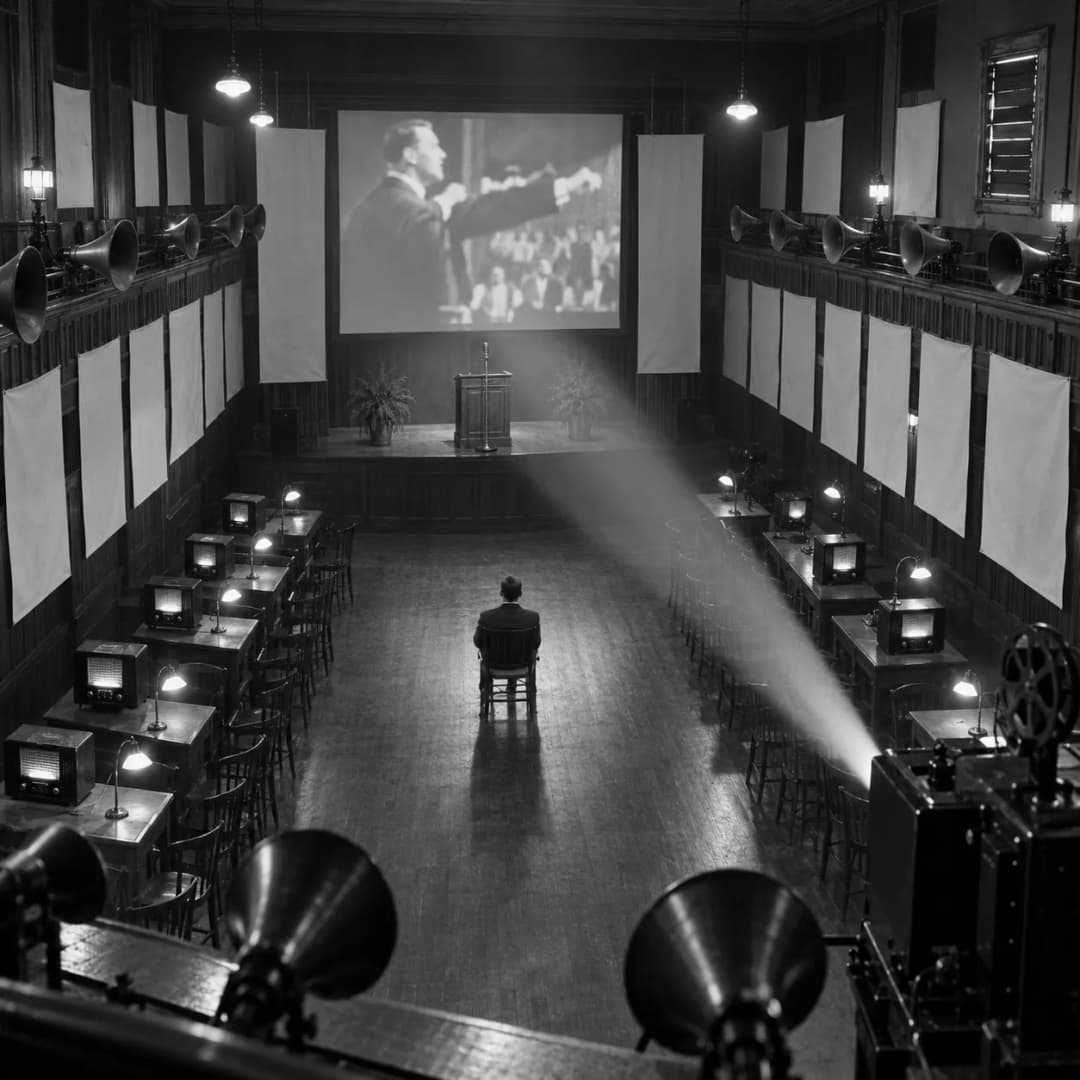
Total attention control is the deliberate strategy of occupying the whole attentional field so that no competing message has anywhere left to land. Tim Wu traces the idea through the propaganda campaigns of the First World War and reads it through Jacques Ellul, whose thesis, published in French in 1962 and in English in 1965, is that propaganda has to be total to succeed at all. It is a historical pattern and a theoretical claim rather than a testable effect, and the audience figures that circulate with it are mostly unverifiable.
What it is
The logic is the reason the strategy escalates. A mostly-total effort leaves gaps a rival voice can use, so the argument always pushes toward saturating every available channel and venue at once. That is what distinguishes it from advertising, where the goal is to out-compete an alternative rather than to erase it.
George Creel's Committee on Public Information is the American case. It trained roughly seventy-five thousand volunteer speakers, the Four Minute Men, to give short pro-war talks in cinemas and halls, on top of every poster, newsreel, pulpit and public venue the committee could reach. The audience figures vary by source and none of them is a head count. Wu's figure cannot be unique people, since it exceeds the population of the United States at the time, and it has not been traced to the committee's final report, so it is not printed here. Creel's own later boast and a library exhibition's estimate of the number of speeches differ from each other by an order of magnitude.
Nazi Germany is the fully realised version. The state subsidised a cheap radio set, the Volksempfanger or people's receiver, and household radio ownership rose several-fold across the 1930s. A body called the Funkwarte, or radio guard, checked what neighbours were actually tuned to. The scheduled national moments, the Stunden der Nation, were consciously modelled on the structure of church worship.
In effect
The response that followed is the more interesting half, because it was structural rather than rhetorical. Postwar West Germany deliberately decentralised broadcasting so that no single state actor could rebuild a chokehold of that kind. The lesson drawn was about the architecture of the channel rather than about the content carried on it.
The peacetime descendant is commercial. Scheduling a nation's attention around a fixed moment is what prime time did, and the same logic of occupying the field rather than persuading within it runs through the attention industries Wu describes.
What it does not say
It does not measure how much anyone was persuaded. Nothing here establishes the effect of saturation on belief, and the historical record supplies reach rather than outcome.
It does not license the audience numbers. Wu's figure for listeners reached by the Four Minute Men is untraced, sources disagree by large margins, and the radio ownership figures were not independently checked in the verification pass.
It is not Ellul's example. Ellul supplies the totality thesis; the Creel committee is Wu's illustration of it, and the two should not be dated together.
Sources
- Ellul, J. Propagandes (1962), translated as Propaganda (1965). The totality thesis Wu draws on.
- The Attention Merchants, Tim Wu. Creel's Committee on Public Information and the Four Minute Men at pp. 43-45; the Volksempfanger, the Funkwarte and the Stunden der Nation at pp. 116-120, with postwar West German broadcast decentralisation.
- Four Minute Men figures vary by source and none is a head count. Creel's own How We Advertised America (1920) claims 75,000 volunteers and over 7.5 million speeches to more than 300 million listeners; a Library of Congress exhibition gives about 750,000 speeches. Wu's figure of 134 million is untraced and is not cited here.
- German radio ownership is given in The Attention Merchants as rising from 4.5 million households to 16 million by 1942. Not independently checked in the verification pass.
- Evidence status not-a-research-claim. A historical pattern and a theoretical thesis, verified 2026-09-25, which also corrected an originator year of 1918 that cannot belong to Ellul.