Branding Agency UAE: What to Expect, Costs and Process
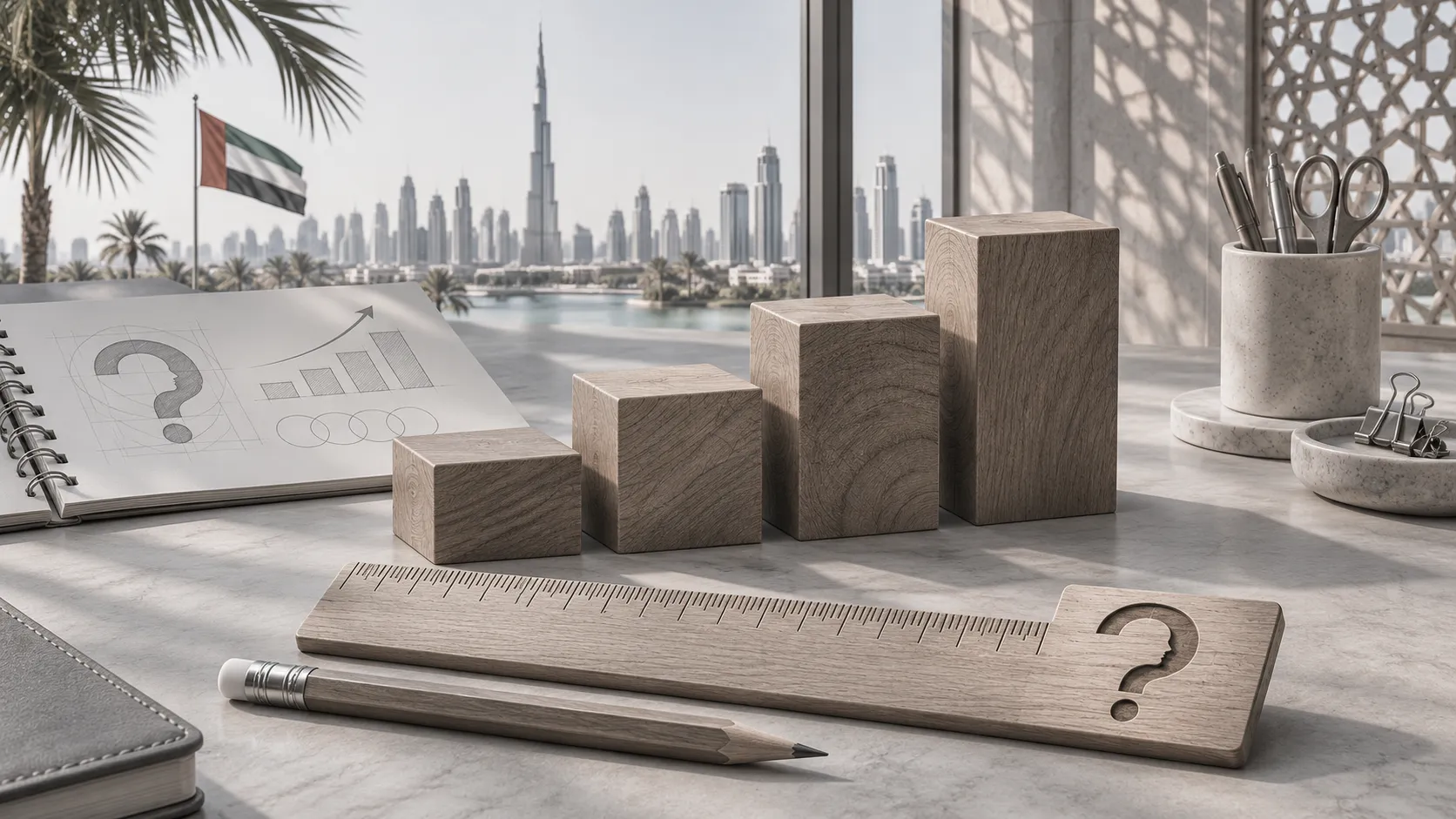
The four stages of a branding engagement, the psychology behind each one, and a table of what drives cost.
Answer to the question
What does a branding agency UAE businesses hire actually do?
A branding agency UAE businesses hire typically works in four stages: research, positioning, identity and rollout. Cost follows scope: the stages included, audiences and languages, approval rounds, design routes, team seniority, timeline and rights. Research on self-report, logo recognition and planning optimism helps explain each stage.
Key takeaways
- Richard Nisbett and Timothy Wilson reviewed evidence in 1977 that people often have little direct access to what moved their own responses, which supports pairing interviews with observation in the research stage.
- Jenni Romaniuk and colleagues reported in 2007 that perceived differentiation between brands was low across many categories and two countries, and that customers still bought.
- Jonathan Luffarelli and colleagues reported in 2019, across six studies, that more descriptive logos improved evaluations, purchase intentions and business performance, with a smaller benefit for familiar brands.
- Roger Buehler and colleagues found in 1994 that predictions of completion time were too optimistic until people connected them to relevant past experience.
Two businesses can ask the same branding agency UAE firms offer for "a brand" and receive quotes that differ widely, because the word covers anything from a name and a logo to several years of supervised rollout. The difference sits in scope, and scope is clearest when read through the work itself: research, positioning, identity and rollout.
What can customers actually tell a branding team?
The first weeks of a branding agency UAE engagement go to listening: interviews with the client's team, a review of the category, conversations with customers and a look at how the brand is seen today. Richard Nisbett and Timothy Wilson reviewed evidence, in a much-cited paper in Psychological Review, that people often have little direct access to what moved their own responses. Reports on the causes of a choice tended to rest on plausible theories, and they were more accurate when the stimulus was prominent and an obvious cause of the response. The wider consequences for shopping are traced in You Do Not Know Why You Bought It.
In practice that argues for pairing what customers say with what they do, which is our reading for branding work and not something the paper tested. A sound research plan sets interviews beside observation, sales and search data, and simple choice tasks in which people pick between options and the team records what they chose. Breadth is what lifts the bill: each added audience, language and market adds interviews and analysis, so a brand speaking to many communities across the region needs more fieldwork than one aimed at a single audience in one language.
What is the positioning stage meant to decide?
Positioning is the stage where the client decides what the brand will be known for and what it will leave to others. The output is usually a short document with an audience, a category frame, a core idea and the reasons to believe it. Byron Sharp argues in How Brands Grow that this stage should not expect too much from difference alone. Perceived differentiation between brands, Jenni Romaniuk and colleagues found in 2007, was low across many categories and two countries, and customers still bought. The authors placed distinctiveness at the centre of [brand strategy](https://thewhyweproject.com/articles/branding-strategy-agency), and the same line of work is the subject of Why the Odd One Out Gets Remembered.
The view is debated. Some practitioners hold that a brand should own a meaningful association more fully than its rivals do, and treat distinctiveness as a companion to that aim, not a replacement for it. A positioning workshop is where client and agency decide how much weight each idea gets, and a client working with any branding agency UAE market offers is entitled to see both options set out before choosing.
Naming one decision-maker before the first workshop is a practical way to keep this stage short, since workshops, stakeholder interviews and the number of people who must agree all draw on senior time.
How do identity and rollout build recognition?
Identity turns the positioning into things people see: name checks, a logo, colours, type, imagery and a tone of voice. Jonathan Luffarelli and colleagues published six studies in the Journal of Marketing Research in 2019. Logos that were more descriptive, meaning they signal the kind of product or service the brand offers, improved consumer evaluations, purchase intentions and business performance. The authors attribute this to processing fluency, since such logos are easier to take in, and to a stronger sense of authenticity. The benefit was smaller for familiar brands.
That last result suggests a new brand has more to gain from a mark that explains itself than an established one does. When a branding agency UAE team presents several identity routes, it can test how quickly people grasp what each route stands for, alongside whether they find it attractive. A route that people read at a glance is doing work before any advertising begins.
A bilingual identity, with Arabic and Latin versions that must sit together, adds design and testing time, so it is ordinary for a scope to state how many routes are shown, how many lockups are drawn and how many applications are designed before sign-off.
In a branding agency UAE engagement, rollout is where the identity meets signage, packaging, websites, social channels, uniforms and sales material. The deliverable is usually a set of guidelines and templates, sometimes with training for the client's own staff. Sharp's case for this stage rests on memory: retrieval needs cues, and cues that appear consistently are retrieved faster. He and Romaniuk call the chance that a brand comes to mind in a buying situation mental availability, and they call the colours, shapes, characters and sounds that make a brand identifiable its distinctive assets.
A client does well to track recognition for itself after launch, using simple measures such as how many people in the target audience can pick out the brand's cues without its name, repeated each season.
A hand-over of guidelines costs less at the start and moves the supervision work to the client's own team, while an agency that stays on adds to the fee in return for tighter control across touchpoints, markets and languages.
What moves a branding agency UAE quote up or down?
People predicting how long a task will take tend to be too optimistic, Roger Buehler and colleagues found in 1994, across a range of academic and non-academic tasks, and the optimism disappeared when participants were told to connect relevant past experiences to their predictions. Clients and agencies both make timelines, and a schedule built from comparable past projects is more likely to hold than one built from the ideal case. Timeline matters for cost because a compressed schedule needs more people working at once. The pattern is known as the planning fallacy, and Why the Planning Fallacy Persists follows it further.
Prices from a branding agency UAE firm vary with scope, so a useful comparison runs through the drivers and not the total, and the table sets out the main ones with a question for each, which a buyer comparing a shortlist can use alongside the questions in How to Choose the Top Branding Agency in Dubai, since that piece covers the buyer's side of the same comparison in more detail.
| Cost driver | What it changes | Question to put to the agency |
|---|---|---|
| Stages included | Whether research, positioning, identity and rollout are all in the scope | Which stages does the quote cover, and what is handed over at the end of each? |
| Audiences, markets and languages | The breadth of research and the number of design and copy versions | How many audiences and language versions does the scope assume? |
| People who approve | Revision rounds and workshop time | How many revision rounds are included, and who signs off? |
| Identity routes and applications | The depth of design work | How many routes are shown, and how many applications are designed? |
| Team size and seniority | The mix and number of hours | Who works on the account day to day, and for how many hours? |
| Timeline | Whether work runs in sequence or in parallel | Which comparable projects was the timeline built from, and what could extend it? |
| Rights and rollout support | Ownership of final files and who supervises use | Who owns the final files, and is supervision of rollout included? |
Common questions
What does a branding agency UAE businesses hire actually do?
A branding agency UAE clients hire typically works through research, positioning, identity and rollout. Research gathers what customers say and do, positioning decides what the brand stands for, identity designs the name, logo and voice, and rollout applies them across every touchpoint with guidelines.
What drives the cost of a branding agency in the UAE?
Cost for a branding agency UAE client follows scope: the stages included, the audiences, markets and languages, the number of approval and revision rounds, the identity routes and applications, the seniority of the team, the timeline and the rights transferred. Quotes are easiest to compare line by line, driver by driver.
Can customers explain why they prefer a brand?
Only in part. Nisbett and Wilson reviewed evidence in 1977 that people often rely on plausible theories about why they responded as they did, so research that also observes behaviour gives a branding agency UAE team a fuller picture than interviews alone.
How long does a branding project take?
The length depends on the same drivers as the cost, and Buehler and colleagues found in 1994 that predictions of completion time were too optimistic until people connected them to relevant past experience, so a timeline built from comparable past projects, with the client's own approval time counted in as part of the schedule, is the one most likely to hold from the first workshop to the last template.
Sources
Sharp, B. How Brands Grow: What Marketers Don't Know. Seed book; vault hub Books/How Brands Grow.
Nisbett, R. E., & Wilson, T. D. (1977). “Telling more than we can know: Verbal reports on mental processes.” Psychological Review, 84(3). doi:10.1037/0033-295X.84.3.231 https://doi.org/10.1037/0033-295X.84.3.231
Romaniuk, J., Sharp, B., & Ehrenberg, A. (2007). “Evidence concerning the importance of perceived brand differentiation.” Australasian Marketing Journal, 15(2). doi:10.1016/S1441-3582(07)70042-3 https://doi.org/10.1016/S1441-3582(07)70042-3
Luffarelli, J., Mukesh, M., & Mahmood, A. (2019). “Let the logo do the talking: The influence of logo descriptiveness on brand equity.” Journal of Marketing Research, 56(5). doi:10.1177/0022243719845000 https://doi.org/10.1177/0022243719845000
Buehler, R., Griffin, D., & Ross, M. (1994). “Exploring the planning fallacy: Why people underestimate their task completion times.” Journal of Personality and Social Psychology, 67(3). doi:10.1037/0022-3514.67.3.366 https://doi.org/10.1037/0022-3514.67.3.366