Willpower Is Not a Fuel Tank
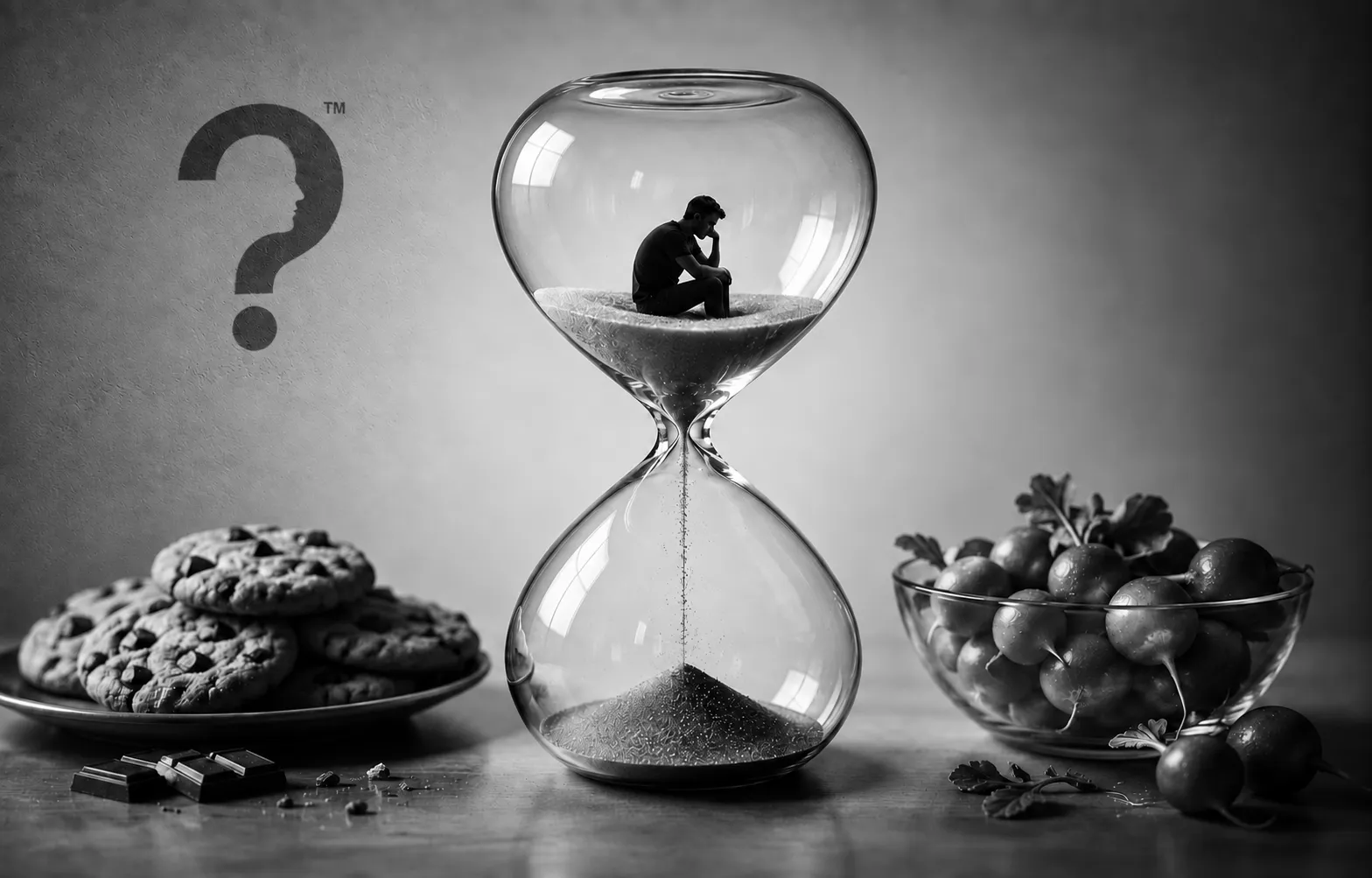
The resource theory of self-control shrank to almost nothing, and the belief theory brought in to replace it does not replicate either
Key takeaways
- The founding study, Baumeister and colleagues at Case Western Reserve in 1998, had 67 participants. Those made to eat radishes instead of cookies gave up on unsolvable puzzles after 8.35 minutes, against 18.90 minutes for the group allowed the cookies.
- A 2010 meta-analysis put the ego-depletion effect somewhere between moderate and large, big enough to see in a group though not in any one person, and big enough to plan a day around. Across three preregistered multi-laboratory replications with more than 7,000 participants between them, run from 2016 to 2021, what survives runs from nothing at all up to about a quarter of that.
- The glucose claim, that a sugary drink restores self-control, has not survived. Vadillo, Gold and Osman's 2016 p-curve analysis found the literature's evidential value weak, and the quantity of sugar involved is too small to change how a brain works.
- The replacement theory, Job, Dweck and Walton's 2010 finding that depletion strikes only people who believe willpower is limited, failed its own preregistered replication in 2023 by Carruth, Ramos and Miyake in PLoS ONE.
- In that literature, seven of the eight studies finding no effect were preregistered with publicly shared data, against one of the five studies that found an effect.
- Roy Baumeister has not conceded. He and Dianne Tice argued in 2022 that ego depletion is the best replicated finding in social psychology, citing Dang's 12-laboratory study, which did find a small effect, about a sixth of the size originally claimed and unlikely to be chance alone.
In 1998, at Case Western Reserve University, a laboratory baked chocolate chip cookies in the room before the participants arrived. Two dishes were set on the table: a stack of cookies with chocolates beside it, and a bowl of red and white radishes. A third of the sixty-seven students were told they could eat only the radishes. The experimenter left the room and watched through a one-way mirror to check that they did.
Everyone was then given geometry problems that had no solutions.
The radish group gave up after 8.35 minutes. The students who had been allowed the cookies lasted 18.90, and those who skipped the food stage lasted 19.40.
Roy Baumeister and his colleagues called what the radish group had spent [ego depletion](https://thewhyweproject.com/articles/does-decision-fatigue-spoil-our-choices), and the model they built on it shaped the next twenty years of research and advice. Self-control behaves like a muscle. Resist the cookies and there is less of you left for the puzzle.
It is a very good story.
The claim that got sold
The strength model made two claims that travelled beyond the journals: that self-control draws on a limited resource which depletes as you use it, and that the resource is glucose, restorable with a sugary drink.
Baumeister and John Tierney put both in Willpower in 2011, and the second is the reason someone once told you to eat something before a hard conversation. The first went further. It is behind the idea that [a day of small decisions leaves you weaker by evening](https://thewhyweproject.com/articles/what-is-decision-fatigue).
The evidence base for all of it was a 2010 meta-analysis by Martin Hagger and colleagues, covering close to 200 experiments, which put the depletion effect somewhere between moderate and large. Big enough to see in a group, though still not something you could spot in any one person. Big enough to plan a day around.