The Mere Exposure Effect Has a Ceiling
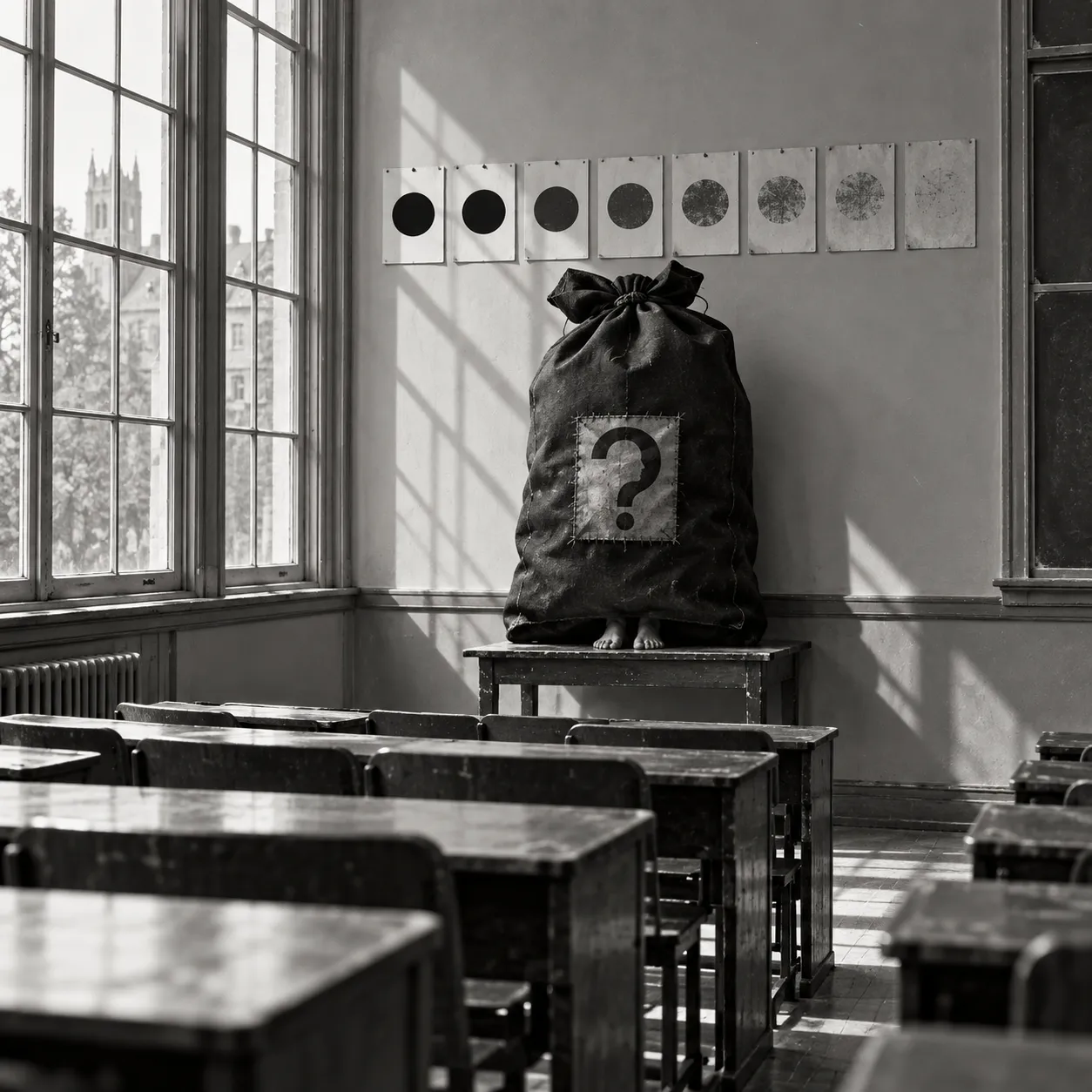
In 1968 a psychologist opened his monograph with a student who sat through classes inside a black bag. The research it started explains why a song or an advert wins people over, and when it begins to grate.
Answer to the question
Why do songs and adverts grow on you over time?
Because familiarity breeds liking, up to a point. Robert Zajonc showed in 1968 that nonsense words, characters and faces were rated more favourably the more often people saw them. A 2017 meta-analysis of 268 curve estimates found liking rises and then falls with repetition, and a 2004 music study found liking fell after about eight close listens.
Key takeaways
- In Robert Zajonc's 1968 experiments, nonsense words shown up to 25 times were rated more favourably the more often people had seen them.
- A 2017 meta-analysis of 268 curve estimates from 81 articles found liking rises and then falls with repetition, for visual stimuli though not for sounds.
- In a 2004 study, liking for orchestral music fell after about eight close listens but kept rising when the music was heard incidentally, and a 1980 study found repeated television commercials wore out.
In February 1967 the Associated Press reported on a student at Oregon State University who had attended a basic persuasion class for two months inside a big black bag, with only bare feet showing. In 1968 Robert Zajonc reprinted the story in his monograph on the mere exposure effect, the finding that people come to like things they have merely seen often. The bag sat on a small table near the back of the room every Monday, Wednesday and Friday. None of the 20 other students knew who was inside. According to the professor, their attitude moved from hostility to curiosity and finally to friendship.
Zajonc turned a strange campus story into a laboratory experiment
Zajonc tested the idea on material nobody could have feelings about in advance. In his first experiment, 72 people were told they were learning Turkish adjectives. They saw and pronounced twelve seven-letter nonsense words, each shown 0, 1, 2, 5, 10 or 25 times, then rated each word on a scale from bad to good. The more often a word had been seen, the more likely it was to be rated good. That is what the monograph's opening sentence predicted, and the core of it fits on one line:
> "mere repeated exposure ... enhances his attitude toward it."
Part of his case was correlational. He noted that words standing for good, desirable and preferred things are used more often than words for bad ones, and his experiments were built to ask whether frequency could produce the warmth rather than only reflect it.
He repeated the design with Chinese-like characters, which people looked at for about two seconds each, and found the same pattern. Then he used photographs of men's faces, graduating seniors from Michigan State University. Students rated how much they thought they might like each man, and nine of the twelve faces were liked more the more often they had been shown.
The exposures were brief but clearly visible. Zajonc was not flashing images below awareness. Experiments that did that came later and are a separate question. What he showed in 1968 was that seeing something again, with nothing else attached to it, nudged ratings upwards.
A fourth experiment measured skin conductance, a rough index of arousal, while people looked at nonsense words. Responses fell as the words became familiar, which suggests that the unfamiliar provokes slightly more arousal than the familiar. That gave the mere exposure effect a candidate mechanism: repetition may let people relax.
Repetition proved to have a ceiling for advertisers and listeners
Advertisers had a commercial reason to ask how far the effect would go, and in 1980 a study in the Journal of Marketing Research gave them an uncomfortable answer. Repeating a pattern of television commercials caused wearout: viewers' evaluations of both the commercials and the products being advertised turned down. The abstract's second finding was the harder one for an industry that buys attention:
> "wearout was not forestalled by strategies designed to enhance attention."
Advertising wear-out is the name for the point at which further repetition starts to lower how people judge an advert. In the 1980 study it appeared in judgements of the product as well as of the commercial, so a tired advert can cost goodwill for the very brand that paid for it. Making the commercials more attention-getting did not reset the clock.
In 1989 Robert Bornstein published a review and meta-analysis of the field in Psychological Bulletin, covering two decades of research on the mere exposure effect that followed Zajonc's monograph. The exposure effect appeared across that body of work, and its size depended on the details: the type of stimulus, how complex it was, the order in which items were shown, how long each exposure lasted and whether people recognised what they had seen. Bornstein also revised an older account of the effect in which liking that grows with familiarity competes with boredom that grows with repetition.
Music put that account to a direct test. In 2004 researchers at the University of Toronto Mississauga played orchestral excerpts to 40 students up to 32 times. When people had to listen closely, liking rose at first and then fell. The paper reports that after 32 close listens satiation was complete, and states that the
> "benefits of exposure were no longer apparent."
When people heard the same music incidentally, with their attention on something else, liking kept rising across the same number of hearings.
A popular book makes a strong case for comfortable familiarity
Jonah Berger's Invisible Influence (2016) leans on the mere exposure effect early. Its introduction states, at page 11, that the effect "has actually been shown in hundreds of experiments", and its endnote points to Bornstein's 1989 review. The book's case is that much of what people like is shaped by what they have been around, without their noticing.
Chapter 4 brings the argument closer to the evidence on wear-out. Berger argues that people like things most when they are moderately familiar, neither too new nor too well known, and reports a British study of surnames in which moderately familiar names were liked most. An endnote records a study that found the opposite shape.
Chapter 4 also describes, at pages 157 to 160, shapes flashed for five milliseconds that raised liking. A finding about images too brief to see does not inherit the strength of Zajonc's visible exposures, and the decades of evidence behind the general mere exposure effect say little about it either way. The inverted U, by contrast, is where the larger review published in 2017 also landed.
A finding about images too brief to see does not inherit the strength of Zajonc's visible exposures.
The largest review found liking rises and then falls
In 2017 a second meta-analysis of the mere exposure effect, led by R. Matthew Montoya at the University of Dayton, appeared in Psychological Bulletin, this time modelling the shape of the relationship rather than only its size. They drew 268 curve estimates from 81 articles.
| Review | Studies pooled | Main finding |
|---|---|---|
| Bornstein, 1989 | Mere exposure studies published from 1968 to 1987 | The effect's size depended on stimulus type, complexity, sequence, exposure duration and recognition |
| Montoya, Horton, Vevea, Citkowicz and Lauber, 2017 | 268 curve estimates from 81 articles | Liking rose and then fell with repetition, an inverted U, for visual stimuli though not for sounds |
The inverted U appeared for every type of visual stimulus, for exposures shorter than 10 seconds and longer than a minute, and when ratings were taken after all the stimuli had been shown. The authors concluded that none of the existing models of the mere exposure effect adequately accounted for what they found, and proposed a framework for future research.
The finding about sounds is hard to square with the 2004 music study, which found an inverted U for focused listening to orchestral excerpts. The Toronto work found the downturn only for the most realistic music under close attention, a small slice of everyday listening, and an average across studies of sound could miss a pattern that confined. Even so, the rise-then-fall shape is a more defensible summary of the evidence than the rule that more exposure always means more liking.
Songs and adverts grow on you, but only so far
The mere exposure effect matches the everyday experience behind the question. A song that sounds odd on first hearing can improve with repetition, and a jingle or a logo can become more likeable just by being around. Zajonc's nonsense words and Montoya's 268 curves agree that liking climbs with the first exposures.
They also agree that it does not rise forever. Under close attention, liking turned down after about eight exposures in the music study, and the 2017 meta-analysis found the same turn for visual material. The 1980 advertising study found wearout in how viewers judged both the commercial and the product, and it could not be fixed by making the adverts more attention-grabbing.
Background listening behaved differently. Material met in passing kept gaining liking in the 2004 study, while material met head-on wore out. Much everyday exposure is of the first kind: a single rotated on the radio during the drive to work, or a poster on a daily commute. In the 2004 study, the mere exposure effect was strongest where attention was lowest.
Material met in passing kept gaining liking in the 2004 study, while material met head-on wore out.
For a brand, the practical rule is to spread an advert across many brief, incidental encounters and to stop forcing it on people at full attention again and again.
The turning point is not fixed. It depends on what is being repeated, how closely people attend to it and how many times they have already met it, which is why one listener can be humming a chorus in the same week that another, who played it on repeat, cannot stand it.
Common questions
Why do songs and adverts grow on you over time?
Because familiarity breeds liking, up to a point. Robert Zajonc's 1968 experiments found words, characters and faces were rated more favourably the more often they had been seen, and a 2017 meta-analysis of 268 curve estimates found liking rises and then falls as exposures pile up.
What is the mere exposure effect?
It is the finding that people come to like things they have merely seen or heard often. Zajonc named and tested it in 1968, showing nonsense words up to 25 times, and Robert Bornstein's 1989 review of the following two decades found the effect varied with stimulus type, complexity and exposure duration.
Can an advert be repeated too often?
Yes. The mere exposure effect has a ceiling. A 1980 study in the Journal of Marketing Research found repeated television commercials wore out, lowering evaluations of the commercials and the products, and attention-grabbing tactics did not stop it. A 2004 music study found liking fell after repeated close listening but kept rising for background exposure.
Sources
Zajonc, R. B. (1968). 'Attitudinal effects of mere exposure.' Journal of Personality and Social Psychology, 9(2, Pt. 2), 1-27. doi:10.1037/h0025848. Full text read: the Associated Press Black Bag story of 27 February 1967; Experiment I with 72 subjects, twelve 'Turkish' words at 0, 1, 2, 5, 10 and 25 exposures, 0 to 6 good-bad scale; Experiment II Chinese-like characters about 2 seconds each; Experiment III photographs of graduating Michigan State University seniors, 9 of 12 showing the effect; Experiment IV skin conductance falling with exposure.
Calder, B. J., & Sternthal, B. (1980). 'Television commercial wearout: an information processing view.' Journal of Marketing Research, 17(2), 173-186. doi:10.1177/002224378001700202. Abstract read: repetition caused wearout in evaluations of the commercials and the products; not forestalled by strategies designed to enhance attention.
Bornstein, R. F. (1989). 'Exposure and affect: overview and meta-analysis of research, 1968-1987.' Psychological Bulletin, 106(2), 265-289. doi:10.1037/0033-2909.106.2.265. Abstract read: stimulus type, complexity, presentation sequence, exposure duration and stimulus recognition influence the size of the effect; changes to the two-factor model discussed.
Szpunar, K. K., Schellenberg, E. G., & Pliner, P. (2004). 'Liking and memory for musical stimuli as a function of exposure.' Journal of Experimental Psychology: Learning, Memory, and Cognition, 30(2), 370-381. doi:10.1037/0278-7393.30.2.370. Full text read: University of Toronto Mississauga; Experiment 2 with 40 undergraduates and orchestral excerpts; focused listening an inverted U, decreasing from 8 to 32 exposures; incidental listening monotonic; the two-factor model described as familiarity against boredom.
Montoya, R. M., Horton, R. S., Vevea, J. L., Citkowicz, M., & Lauber, E. A. (2017). 'A re-examination of the mere exposure effect: the influence of repeated exposure on recognition, familiarity, and liking.' Psychological Bulletin, 143(5), 459-498. doi:10.1037/bul0000085. Abstract read: 268 curve estimates from 81 articles; inverted U for all visual but not auditory stimuli, exposures under 10 s and over 1 min, ratings after all stimuli; existing models do not adequately account for the findings.
Berger, J. (2016). Invisible Influence: The Hidden Forces That Shape Behavior. Simon & Schuster. Read in full by this publication, with a reliability audit. Introduction, p. 11, mere exposure 'has actually been shown in hundreds of experiments', with the endnote to Bornstein (1989); ch. 4, pp. 157 to 160 for the five-millisecond exposure claim presented without qualification, p. 169 for the surname-familiarity study and the note reporting a contrary U-shaped finding.