The Office That Stopped People Talking
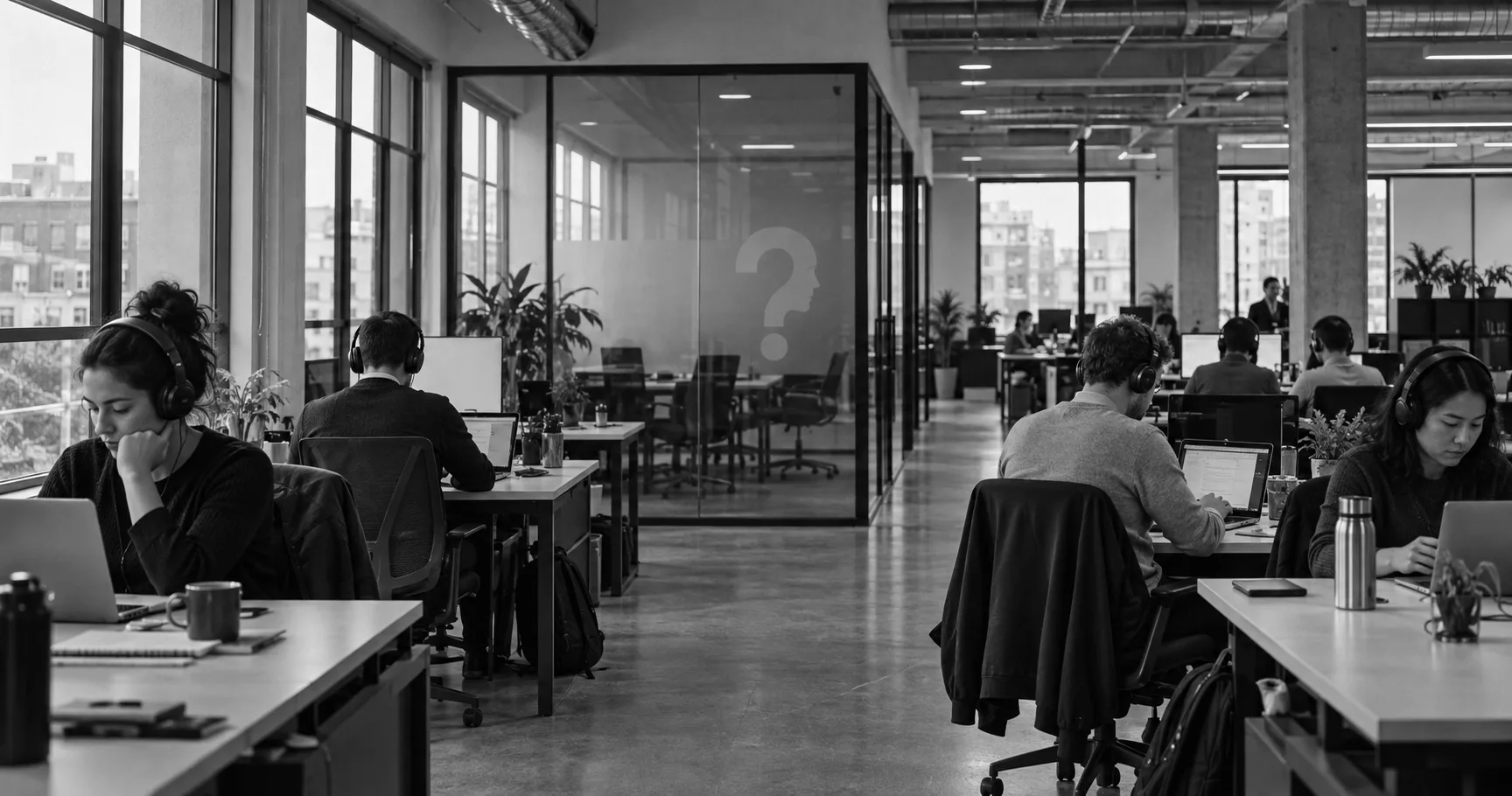
Open plan was sold on collaboration. When somebody finally measured it with sensors instead of surveys, face-to-face interaction fell by about seventy per cent. Here is that finding, its limits, and the part of the case against open plan we think should be dropped.
Key takeaways
- Two corporate headquarters were instrumented with wearable sensors and messaging-server data before and after moving to open plan. Face-to-face interaction fell by roughly seventy per cent and electronic interaction rose.
- The authors read that as social withdrawal: put permanently in view, people retreated into a channel where retreat was possible.
- The sensors detect proximity and speech activity, not conversation, and nobody has separated out how much of the drop is a measurement question.
- A systematic review of 46 empirical studies found open plan reduces property costs and lowers performance, with the single office associated with the best performance for knowledge workers. The selection confound on that last point is unresolved.
- The claim that open plan makes people ill does not survive employer absence records. That is the part of the case against it we think should be dropped.
The headphones are the tell. They arrive within a couple of weeks of any move to an open-plan floor, they get bought by people who never wore headphones at work before, and nobody in the building reads them as a result.
The room was opened up so that people would talk to each other. The first thing people bought was a device for not being talked to.
If you work in one of these rooms and cannot change it, the practical part of this article is four steps long and sits near the end. If you are the one signing off the refit, the relevant part is that the most direct measurement anybody has taken of what open plan does to conversation pointed the opposite way from the brief.
What the sensors found
The Royal Society published the study in 2018. Two corporate headquarters were moving from conventional offices to open ones, and instead of surveying people afterwards, where most of this literature lives, Ethan Bernstein and Stephen Turban instrumented the move. Wearable devices logged face-to-face interaction. The companies' own email and instant messaging servers supplied the rest. Before, and after.
Face-to-face interaction fell by roughly seventy per cent. Electronic interaction rose.
Bernstein and Turban read this as social withdrawal. Removing the walls put everybody permanently in view, and people responded by retreating into a channel where retreat was possible. The paper notes that it was the first study to measure both kinds of interaction across such a change, which is a remarkable thing to be able to say about a decision that has been taken by thousands of organisations.
One caution the piece should carry, because the paper is more careful about its instrument than its coverage was. The devices detect proximity and speech activity. They do not record conversations. Some portion of a drop that size is a question about what the sensor counts, and nobody has yet separated that portion out.
Two firms is two firms, so the next question is whether the finding sits inside anything larger. It does, loosely. A systematic review in Management Review Quarterly in 2023, by Andrea Gerlitz and Marcel Hülsbeck, began with 429 papers on office concepts and performance and narrowed to 46 empirical studies. Open-plan, in their summary, reduces real-estate costs and lowers performance, and they describe the productivity loss as a tax that outweighs the saving. Activity-based working, where nobody has a fixed desk, comes out worse on performance, satisfaction and health, while keeping the potential to improve collaboration under proactive management. For knowledge workers, the arrangement associated with the best individual and organisational performance was the single office.
Take the last of those with the confound attached. People who get their own office differ from people who do not, in seniority, in job type and in how much control they have over their day, and a review of this kind reports the association without being able to remove those differences. The cost claim needs the same caution. A narrative review across 46 heterogeneous studies is a considered judgment from people who read all of them, and it is not a common metric with a number on it. Who sits at the desks matters as well as how the floor is laid out, and one article asks whether [dark triad traits help at work](https://thewhyweproject.com/articles/do-dark-triad-traits-help-at-work).
Where the case against goes too far
The popular argument against open plan includes a claim that does not hold up, and it is worth giving that ground before asking anybody to accept the rest. Open-plan offices have been said for years to make people ill, on evidence that was mostly self-reported sickness absence, and that depends on how people remember and how they feel about the place when asked. Loretta Platts and colleagues went at it with employer records, in PLoS ONE in 2020, across three Swedish organisations, comparing recorded absence with self-reports.
Office type was generally not associated with the number of episodes or days of absence in the employer data. It was not associated with sickness presence either, meaning turning up while ill. A couple of isolated associations appeared and the authors conclude that their study does not support the claim.
The setting limits how far that travels, and Swedish sick leave is generous enough that recorded absence may behave differently there than elsewhere. Even so, it is the better-measured study on that specific question, and the honest response is to stop leading with the health argument. The interaction and performance findings are the strong material. Adding a weak claim to a strong case is how strong cases get dismissed.
What we think
Space changes behaviour. That is the part worth holding on to, because it cuts against the assumption that office design is decoration with a budget attached.
What the measurement addresses is the direction. Open architecture was sold as a way to produce more unplanned conversation. Measured at two large organisations, it produced substantially less, and moved what remained into text.
The claim that is actually dead is the confident one: that opening a floor plan reliably increases collaboration. That has now been tested directly, twice, and it failed both times, which is a long way from proof and a long way past the evidence anybody had when the refits started. A firm that opens a floor to save money on real estate is doing something defensible and should say so. A firm that opens a floor for collaboration is making a claim the best available measurement contradicts, and it should be asked what it plans to measure.
For the people already in the room, the question is smaller.
1. Buy the headphones and do not feel bad about it. You are compensating for somebody else's design decision, not failing at teamwork.
2. Put the conversation in the calendar. What disappeared was the unplanned exchange, so the exchanges that survive are the scheduled ones.
3. Pick a channel and commit to it. Half-migrated communication, where the important things happen in text and the office pretends otherwise, is worse than either option done properly.
4. Ask what the refit was for. Cost is a real answer. Collaboration is a claim, and claims have evidence.
Before the next refit, ask the people proposing it what number will tell them whether it worked, and ask them to write it down while the old floor still exists. Anything measured only afterwards cannot be compared with anything. That single request will separate the organisations making a design decision from the organisations making a case.
Sources
Bernstein, E. S., & Turban, S. (2018). 'The impact of the open workspace on human collaboration.' Philosophical Transactions of the Royal Society B, 373(1753), 20170239.
Gerlitz, A., & Hülsbeck, M. (2023). 'The productivity tax of new office concepts: a comparative review of open-plan offices, activity-based working, and single-office concepts.' Management Review Quarterly, 73, 1889-1926.
Platts, L. G., Seddigh, A., Berntson, E., & Westerlund, H. (2020). 'Sickness absence and sickness presence in relation to office type: an observational study of employer-recorded and self-reported data from Sweden.' PLoS ONE, 15(4), e0231934.