What an AI Label Does to a Product
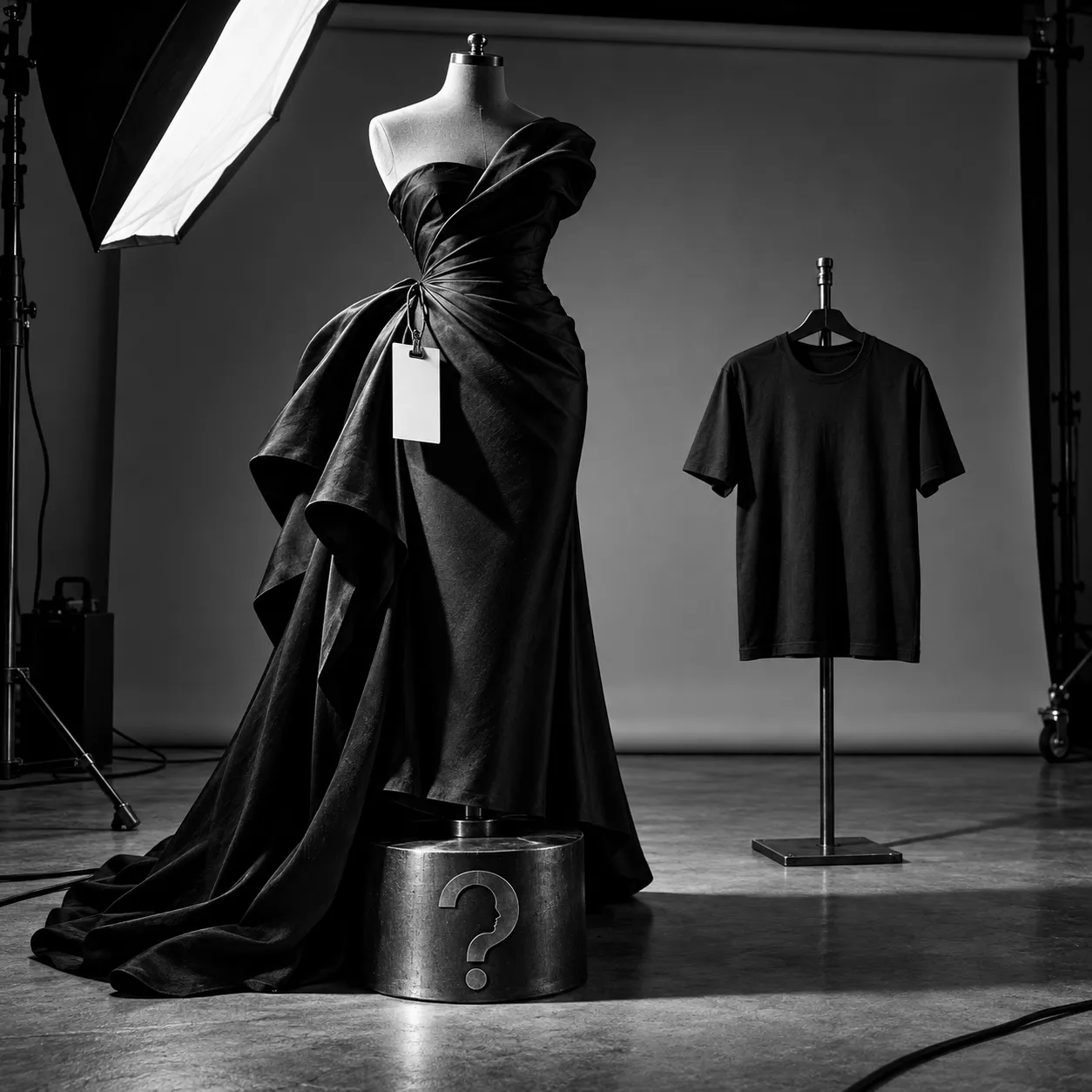
A 2026 experiment found that captioning a model as AI-generated made shoppers far less willing to use a dress to express themselves, while a T-shirt showed no reliable difference. Research on algorithm aversion suggests the type of product decides what the label costs.
Key takeaways
- In Xiaolian Cheng and Inwoo Nam's 2026 experiment with 200 American adults, captioning a model as AI-generated went with self-expression scores for a dress of 1.97, against 4.37 without the label.
- The same AI label made no reliable difference for a plain black T-shirt, so the cost depended on whether the product was bought to say something about the wearer.
- Algorithm aversion (Dietvorst and colleagues, 2015) and algorithm appreciation (Logg and colleagues, 2019) both appear, and Castelo and colleagues' 2019 studies tie the difference to how subjective the task seems.
- In 2023 experiments with 1,708 participants, artwork labelled as AI-made was rated less creative and less awe-inspiring than the same work without that label.
In a 2026 experiment, shoppers looked at a photograph of a black dress with one of two captions underneath. When the caption said the model was AI-generated, their score for how well the dress could express who they are was 1.97, against 4.37 for people who saw the same picture without the label. The picture was identical in both versions. Only the AI label differed.
Read the caption before you judge the photograph
The study was published in Frontiers in Psychology in July 2026 by Xiaolian Cheng and Inwoo Nam of Chung-Ang University in Seoul. They recruited 200 adults in the United States through Amazon Mechanical Turk and asked each to imagine buying clothes online, so each of the four conditions had about 50 people. Some saw a dress and some saw a plain T-shirt, both in black and both worn by a model. Under the image, a line read either "displayed by an AI-generated model" or "displayed by a human model". Every image had in fact been made with the same AI tool, so the photograph itself could not explain any difference between the groups.
The researchers measured self-expression, meaning how willing people were to use the product to convey their self-image and the identity they want others to see. They also measured eeriness, with statements such as "This model is creepy", and two kinds of risk: unease at the thought of buying, and doubt that the product would deliver what it promised. In the authors' model, the AI label went with higher eeriness, eeriness with both kinds of risk, and both risks with lower self-expression. Almost all of that happened on the dress.
| Product | Caption: human model | Caption: AI-generated model | Reliable difference? |
|---|---|---|---|
| Black dress | 4.37 | 1.97 | Yes |
| Black T-shirt | 4.71 | 4.27 | No |
The table gives the average self-expression scores in each group; higher means more willing to use the garment to say something about oneself. For the T-shirt, the AI label made no reliable difference to eeriness, to either risk, or to self-expression. The authors read this as a boundary condition, and argue that how consumers respond to AI imagery depends on what the product is for. On the one functional product tested, the model's origin made no reliable difference. On a product bought for what it says about the wearer, the model is part of the message.
The authors name the main weakness themselves. A dress and a T-shirt differ in more than symbolism, including formality, femininity and how much pleasure they promise, so the comparison carries several variables at once. It was a single scenario study, the images showed female models, and 70 per cent of the sample were women. The participants also imagined a purchase rather than making one, so the result describes a stated willingness and leaves real spending untested.
Ask what the machine is being trusted to do
The finding lands in a long argument about whether people distrust machines. In 2015 Berkeley Dietvorst and colleagues at the University of Pennsylvania gave one side of it a name: algorithm aversion, the tendency to abandon an algorithm once you have seen it make a mistake. Across five studies, participants who watched a forecasting algorithm at work became less confident in it and less likely to tie their pay to it over a human forecaster. That held even for people who had just watched the algorithm beat the human.
Four years later Jennifer Logg and colleagues reported the opposite pattern. In six experiments, ordinary people followed advice more closely when they were told it came from an algorithm than when they were told it came from a person. They made numeric estimates about an image and forecast both the popularity of songs and romantic attraction between people, and the preference for the algorithm held across all of these tasks. The authors called it algorithm appreciation. It faded in two places: when people weighed an algorithm against their own judgement, and among experienced professionals who forecast for a living.
The two results come from different tasks, and they need not conflict. In 2019 Noah Castelo and colleagues tested reliance on algorithms across a wide range of tasks, in four online lab studies with more than 1,400 participants and two field studies with more than 56,000. People trusted algorithms less for tasks they saw as subjective than for tasks they saw as objective. Describing a task as one that benefits from quantitative analysis raised trust in the algorithm, and so did making the algorithm seem more humanlike in its feelings. The question that predicts the reaction is what the machine is being asked to do.
The question that predicts the reaction is what the machine is being asked to do.
Look for the self inside the product
Medicine shows why the subjective side resists. In nine studies published in 2019, Chiara Longoni and colleagues found that people were less willing to use healthcare from an AI provider, would pay less for it, and paid less attention to differences in how well it performed. The cause they identified was uniqueness neglect, a worry that a machine cannot take account of a person's own characteristics and circumstances. The resistance was stronger among people who saw themselves as more unique. It eased when the AI's care was described as personalised, or when the machine only supported a decision made by a human doctor.
Art shows the same thing from another angle. In four experiments with 1,708 participants, published in 2023, Kobe Millet and colleagues found that the same artwork was rated lower when it was labelled as made by AI, because it seemed less creative and inspired less awe. The bias was strongest among people who believed that creativity belongs to humans alone.
Set those beside the dress and a pattern appears. An AI label seems to cost most where the product is meant to carry something personal: care that should fit your body, a painting that should come from another mind, clothing that should say who you are. Where the product is a tool, the label costs little and sometimes nothing. Our reading, which goes beyond this study, is that clothing chosen for identity sits close to what a luxury label buys, and to your name on a product: when a purchase is about the self, the source of its meaning may matter as much as its materials.
An AI label, or any label naming a machine as the source, costs most where the product is meant to carry something personal
Start from the old question of identity
Brand writers reached this territory long before AI models existed. The Consumer Mind, a 2012 book by Pepe Martínez published in association with the market-research agency Millward Brown, gives chapter 9, "Who's the boss here?", to identity and the self. Its marketing argument, made more by example than by statement, is that consumers choose brands partly to answer two questions: who am I, and what am I like. The chapter presents this as a summary of psychology and cites no study for it. The book has no notes of any kind, and its own evidence elsewhere rests on the agency's unpublished research.
The Frontiers experiment gives that claim something it lacked, a measured mechanism in one category. If a dress helps answer the question of who I am, a caption saying the person wearing it is synthetic interferes with the answer. A T-shirt answers a smaller question, and the caption hardly registers.
Our view is that the task-dependent reading explains more than either blanket position. Aversion and appreciation each appeared under particular conditions, and the conditions differ in how much of the person is at stake. Cheng and Nam's result fits that reading closely, since the same AI label did damage on the garment people wear to be seen and almost none on the basic one. Even so, a single online study of two garments is a small base, and consumer psychology has a long list of studies that did not replicate.
For a brand that has to attach an AI label to its imagery, which the paper says some new laws, including the European Union's AI Act, may require, this single study suggests trying synthetic models on functional lines first and keeping people on products sold as self-expression. The authors also suggest naming AI models, giving their body measurements, and adding close-ups and customer reviews, so that the AI label is not the only thing a shopper learns about the model. None of those remedies was part of the experiment.
What the research cannot yet say is whether the penalty fades as synthetic models become ordinary. If every catalogue carries the same caption in five years, will shoppers still read an AI label as a statement about themselves, or will it shrink into the small print beside the care instructions, where nobody goes looking for an answer to who they are?
Common questions
What does an AI label do to a product?
In Xiaolian Cheng and Inwoo Nam's 2026 experiment with 200 American adults, saying that a model was AI-generated raised eeriness and perceived risk. People shown the label rated the dress at 1.97 for self-expression, against 4.37 for those who saw no label. For a plain T-shirt, the same AI label made no reliable difference.
What is algorithm aversion?
Algorithm aversion is the name Berkeley Dietvorst and colleagues gave in 2015 to people abandoning an algorithm after seeing it err, even one that had beaten a human forecaster. In 2019 Jennifer Logg and colleagues found the reverse in six experiments, where lay people followed advice more closely when it came from an algorithm.
Do people value art less when it is made by AI?
In Kobe Millet and colleagues' 2023 experiments with 1,708 participants, the same artwork was rated lower when labelled as AI-made, because it seemed less creative and inspired less awe. The bias was strongest among people who believed that creativity belongs to humans alone.
Sources
Cheng, X., & Nam, I. (2026). “Understanding the influence of AI labels on consumer psychology: the moderating role of product type.” Frontiers in Psychology, 17, 1878095. doi:10.3389/fpsyg.2026.1878095. Full text read (Frontiers JATS XML): published 2 July 2026; Chung-Ang University; 200 US adults on Amazon Mechanical Turk; 2 (AI vs human model label) x 2 (dress vs T-shirt) between-subjects scenario experiment; identical images, all generated with Dreamina AI; self-expression AI 3.12 vs human 4.54 overall; dress 1.97 vs 4.37 (p < 0.001); T-shirt 4.27 vs 4.71 (p = 0.137); interaction on self-expression F(1, 196) = 23.10; 70 per cent female sample; authors list dress and T-shirt differing in hedonic value, formality and femininity as a limitation.
Dietvorst, B. J., Simmons, J. P., & Massey, C. (2015). “Algorithm aversion: people erroneously avoid algorithms after seeing them err.” Journal of Experimental Psychology: General, 144(1), 114-126. doi:10.1037/xge0000033. Abstract read (authors' PDF, Wharton): five studies; participants who saw the algorithm perform were less confident in it and less likely to choose it over an inferior human forecaster, even after seeing it outperform the human.
Logg, J. M., Minson, J. A., & Moore, D. A. (2019). “Algorithm appreciation: people prefer algorithmic to human judgment.” Organizational Behavior and Human Decision Processes, 151, 90-103. doi:10.1016/j.obhdp.2018.12.005. Abstract read (RePEc): six experiments; lay people adhered more to advice labelled as algorithmic; effect waned when choosing between an algorithm and their own estimate and among experienced forecasters.
Castelo, N., Bos, M. W., & Lehmann, D. R. (2019). “Task-dependent algorithm aversion.” Journal of Marketing Research, 56(5), 809-825. doi:10.1177/0022243719851788. Abstract read (SAGE page, paraphrased there) and Boston University summary page read: algorithms trusted less for subjective than objective tasks; raising perceived objectivity and affective humanlikeness increases reliance; four online lab studies (over 1,400 participants) and two online field studies (over 56,000).
Longoni, C., Bonezzi, A., & Morewedge, C. K. (2019). “Resistance to medical artificial intelligence.” Journal of Consumer Research, 46(4), 629-650. doi:10.1093/jcr/ucz013. Abstract read (OUP page): nine studies; uniqueness neglect; stronger for people who see themselves as more unique; curbed when care is personalised or AI only supports a human provider.
Millet, K., Buehler, F., Du, G., & Kokkoris, M. D. (2023). “Defending humankind: anthropocentric bias in the appreciation of AI art.” Computers in Human Behavior, 143, 107707. doi:10.1016/j.chb.2023.107707. Abstract read (VU Amsterdam research portal): four experiments, 1,708 participants; AI-labelled art rated less creative and less awe-inducing; stronger among people holding anthropocentric views of creativity.
Martínez, P. (2012). The Consumer Mind: Brand perception and the implications for marketers. Kogan Page, in association with Millward Brown. Read in full by this publication, with a reliability audit. Ch. 9, "Who's the boss here?" (identity and the self); the vault files give no page numbers for this chapter. The book has no notes and cites no study for the claim.