Why Splitting the Bill Makes Us Order More
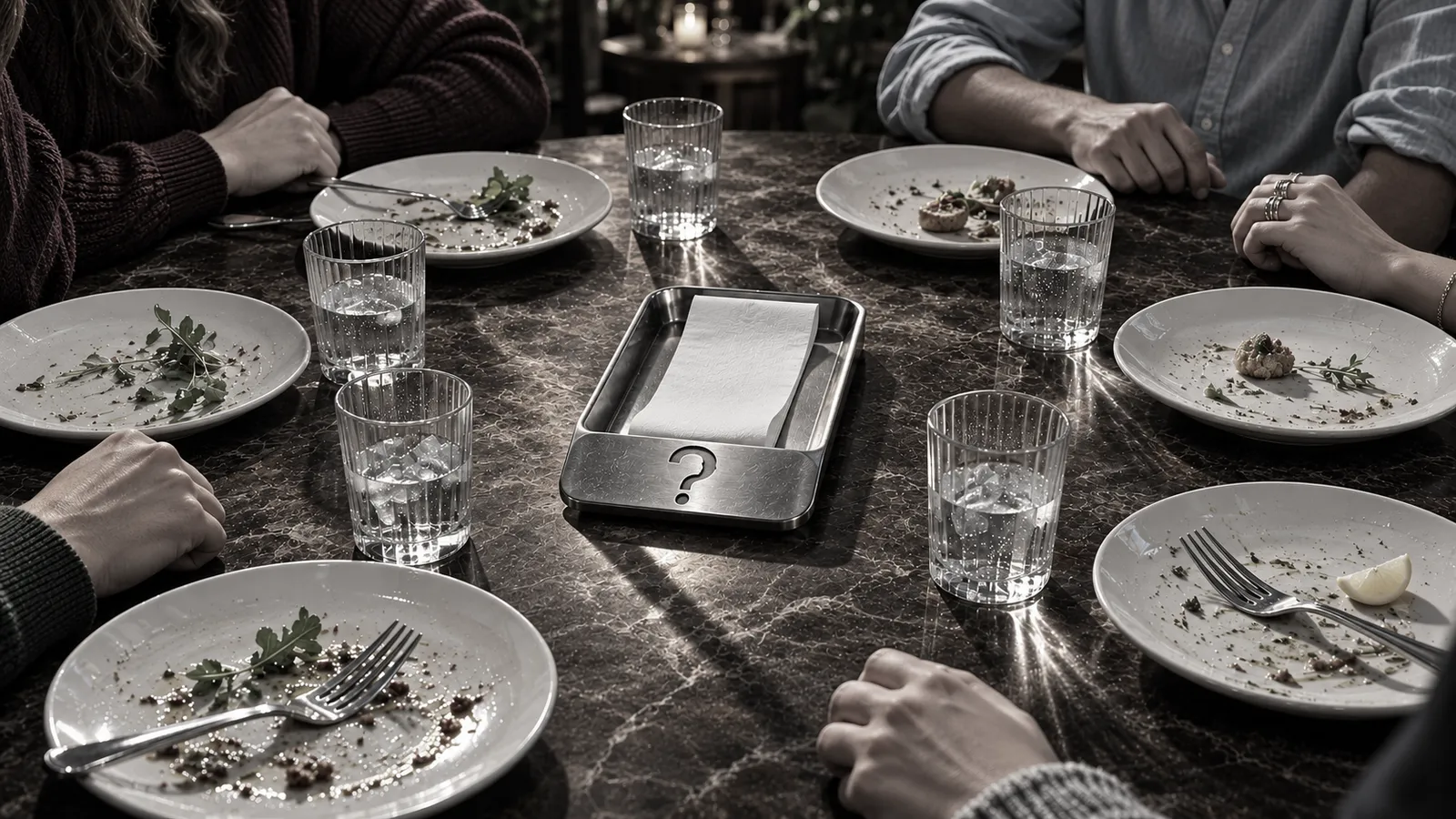
A shared bill lowers the price of every extra dish to the person ordering it, while the full cost lands on the table. The research shows how much more people order, and where friends and the act of ordering change the picture.
What is the diner's dilemma?
The diner's dilemma is the pull a shared bill creates: when cost is split evenly, each diner pays only a fraction of what their own order adds, so people order more. In a restaurant study with groups of six, meals cost about 36 per cent more under an even split than under individual payment.
Key takeaways
- In a 2004 restaurant study with groups of six, the average meal cost about 36 per cent more under an even split than under individual payment (Gneezy, Haruvy and Yafe).
- When the experimenters paid for the whole meal, the average meal cost about 2.2 times the individual-payment figure (Gneezy, Haruvy and Yafe, 2004).
- Diners who paid one sixth of their own order, so that no table-mate bore its cost, ordered about as much as under an even split, which points to the lower personal price as what moved the order.
- In a 2017 field study of groups mostly made up of friends or colleagues, an even split went with higher spending, and spending was lower when the payment method was uncertain at the time of ordering (Shani).
- In a brewery study described in Predictably Irrational, tables that ordered aloud in turn chose a more varied mix of beers and were less happy with their choices than tables that wrote orders privately.
A dish that costs 30 and is shared among six diners costs the person who orders it 5, while the other five cover the rest. That small piece of arithmetic is the heart of what researchers call the diner's dilemma: a table where each person gains from ordering a little more and the cost is carried by everyone. In a restaurant study, groups of six diners ordered meals that cost about 36 per cent more when they knew the bill would be split evenly than when each person knew they would pay for their own. Uri Gneezy, Ernan Haruvy and Hadas Yafe ran it in 2004 at a real lunchtime restaurant.
| Payment arrangement | Share of an order's cost the diner pays | What the research found |
|---|---|---|
| Individual payment | All of it | Lowest average meal cost in the 2004 restaurant study |
| Even split among six | One sixth | About 36 per cent higher average meal cost |
| One sixth of own order | One sixth, with no cost to table-mates | Average cost close to the even split |
| Meal paid by the experimenters | None | About 2.2 times the individual figure |
| Method unknown until the check | Varies | Lower overall spending than when the method was known |
What did the 2004 restaurant study measure at the table?
The diners were recruited volunteers, three men and three women in each group, who had not been placed with people they knew. Each wrote an order from the menu in silence, and the one thing that changed between groups was what they had been told about the bill. In the diner's dilemma setting, under individual payment, the average diner ordered 1.67 items. Under an even split, the average meal cost about 36 per cent more and came to 1.87 items.
When the experimenters paid for the whole meal, the average meal cost about 2.2 times the individual figure, with 3.00 items. The differences in cost between the three arrangements were larger than chance would produce, while the differences in the number of items were less clear cut.
A fourth arrangement asked each diner to pay one sixth of the cost of their own order, with the experimenters covering the rest. Average spending there sat slightly above the even-split figure, with 2.08 items, and was not reliably different from it, though only 12 diners took part. When asked, 19 of 24 diners said they would rather pay individually. Most of those asked, then, preferred the arrangement that led to less ordering, which is the mark of a diner's dilemma: a rule most would choose to avoid, yet one that makes sense to each person at the moment of ordering.
What is the arithmetic behind the diner's dilemma at tables?
With six people splitting evenly, a diner who adds a dish pays a sixth of its price. The dish looks cheap to the person choosing it even though it costs the table its full price. Each diner, reasoning alone, finds that ordering more is the better move, and when every diner reasons that way the table spends more than any of them would choose to spend together.
Economists call a cost that lands on people outside a choice an externality, and an evenly split bill produces one with every order. It is the shared pasture in miniature, the tragedy of the commons, where each herder gains from one more animal and the grazing is paid for by all. The theory assumes diners who weigh only their own share of the cost, and it predicts more ordering under an even split and more again under a free meal, which is the order the results came out in.
The fourth arrangement gives a way to ask whether generosity or fairness could be involved. Those diners paid for only their own order, so no table-mate bore the cost of what they chose, yet they ordered about as much as under an even split. That points to the lower personal price, not a decision to lean on others, as what moved the order.
A laboratory version of the diner's dilemma with a similar pool of volunteers and no food gave a different picture: choices under an even split were not reliably different from choices under individual payment, while a one-sixth rule raised them. The authors suggest that a laboratory can bring out confusion or a sense of being tested, which a lunch table does not.
What changes when the diners are friends and not strangers?
Real tables are rarely made of strangers, and diners often do not know how the bill will be paid when they order. Yaniv Shani took that question to real tables in a field study published in 2017. Some groups stated their preferred payment method before ordering, and others settled it only when the check arrived. An even split went with higher spending in both, and overall spending was lower when the method was uncertain at the time of ordering.
In a controlled follow-up, randomising the payment method after people had ordered removed the link between payment method and spending, which fits the idea that the diner's dilemma depends on knowing about the split while choosing.
The 2004 authors also offered a reason why splitting persists: repeated contact among friends and colleagues may restrain waste. A shared meal carries a second layer of meaning, which Why We Spend More With Friends traces in what people buy when a companion is beside them.
Three experiments with 2,640 people in all, run by Aimee Smith and colleagues, looked at that layer: participants expected to enjoy a shared experience more when they imagined paying the whole cost than when it was split 50:50, a pattern that showed with close companions and that the authors link to expected reciprocity. The measure was anticipated enjoyment, not spending, so it adds a social side to the split without testing what people order.
What else besides the bill pulls on a table's orders?
Beside the diner's dilemma over the bill, a table has a second social force, the ordering itself. In a brewery study described in Dan Ariely's Predictably Irrational and run with Jonathan Levav, tables of drinkers either gave their orders aloud in turn, as at any restaurant, or wrote them privately. Tables that ordered aloud ended up with a more varied mix of beers, and their drinkers were less happy with what they had chosen than the ones who wrote privately.
The paper the two published in 2000 adds a lunch study, in which real groups chose more varied dishes than random sampling of individual choices would predict, and describes the variety as coming from interaction among members, since it faded when they chose separately.
Hearing others order is also why a most popular label steers a menu, as Why We Order the Most Popular Dish describes, and why a purchase settled by several people at once, the subject of Group Decisions at the Checkout, is a different problem from one person's. Ariely's practical suggestion was to decide before the waiter arrives, order first or put orders in writing, and the brewery data fit it: the first person to order was as happy as anyone who wrote privately, so the gap opened only for those who ordered after hearing others.
Common questions
What is the diner's dilemma?
It is the pull a shared bill creates. When cost is split evenly, each diner pays only a fraction of what their own order adds, so people order more than they would if they paid for their own. In a restaurant study with groups of six, meals cost about 36 per cent more under an even split than under individual payment.
Does splitting the bill make people spend more?
In the 2004 restaurant study it did, by about 36 per cent on average. A 2017 field study found that an even split went with higher spending among groups that were mostly friends or colleagues, and that spending was lower overall when the payment method was uncertain at the time of ordering.
Do people prefer to pay individually?
When asked in the 2004 study, 19 of 24 diners said they preferred paying individually. Yet an even split is common among friends, and the authors suggest that repeated contact may restrain waste at tables where people expect to dine together again.
Is the diner's dilemma only about money?
No. Diners also adjust to each other: in a brewery study described in Predictably Irrational, tables that ordered aloud in turn chose a more varied mix of beers and were less happy with their choices than those who ordered privately. The bill and the ordering are two separate social pulls on the same table.
Sources
Ariely, D. Predictably Irrational. Seed book.
Gneezy, U., Haruvy, E., & Yafe, H. (2004). The inefficiency of splitting the bill. The Economic Journal, 114(495), 265-280. doi:10.1111/j.1468-0297.2004.00209.x https://doi.org/10.1111/j.1468-0297.2004.00209.x
Shani, Y. (2017). When sharing is not caring: Does (un)certainty about bill payment method lead diners to consume more and spend more money? Journal of Behavioral Decision Making, 30(2), 453-461. doi:10.1002/bdm.1963 https://doi.org/10.1002/bdm.1963
Smith, A. E., Barton, B., & Zlatevska, N. (2025). Payment and pleasure: Monetary and social ties in shared consumption experiences. Psychology & Marketing, 42(11), 2807-2819. doi:10.1002/mar.70011 https://doi.org/10.1002/mar.70011
Ariely, D., & Levav, J. (2000). Sequential choice in group settings: Taking the road less traveled and less enjoyed. Journal of Consumer Research, 27(3), 279-290. doi:10.1086/317585 https://doi.org/10.1086/317585
Related concepts
People
More articles
- Why One Story Beats a Thousand Numbers
A neighbour's broken kettle outweighs a test of two thousand. The research on vivid cases shows how large that pull is, when figures still win, and four questions that put a story back in its place.
- Why a Price That Creeps Up Still Gets Paid
A price agreed once and raised later is paid more often than the same price quoted at the start. The research on the low-ball technique points to the yes, and not the price, as the part doing the…
- Why Most of Us Only Watch Online
Online communities are written by few and read by many. The research behind the 1 per cent rule shows how uneven that split is, and what the readers bring to a community.
- Why Two Discounts Feel Bigger Than One
Two cuts of 20 per cent leave a price 36 per cent lower, not 40. The research on how shoppers read multiple discounts shows why the larger number is the one that sticks.