What is the red sneakers effect?
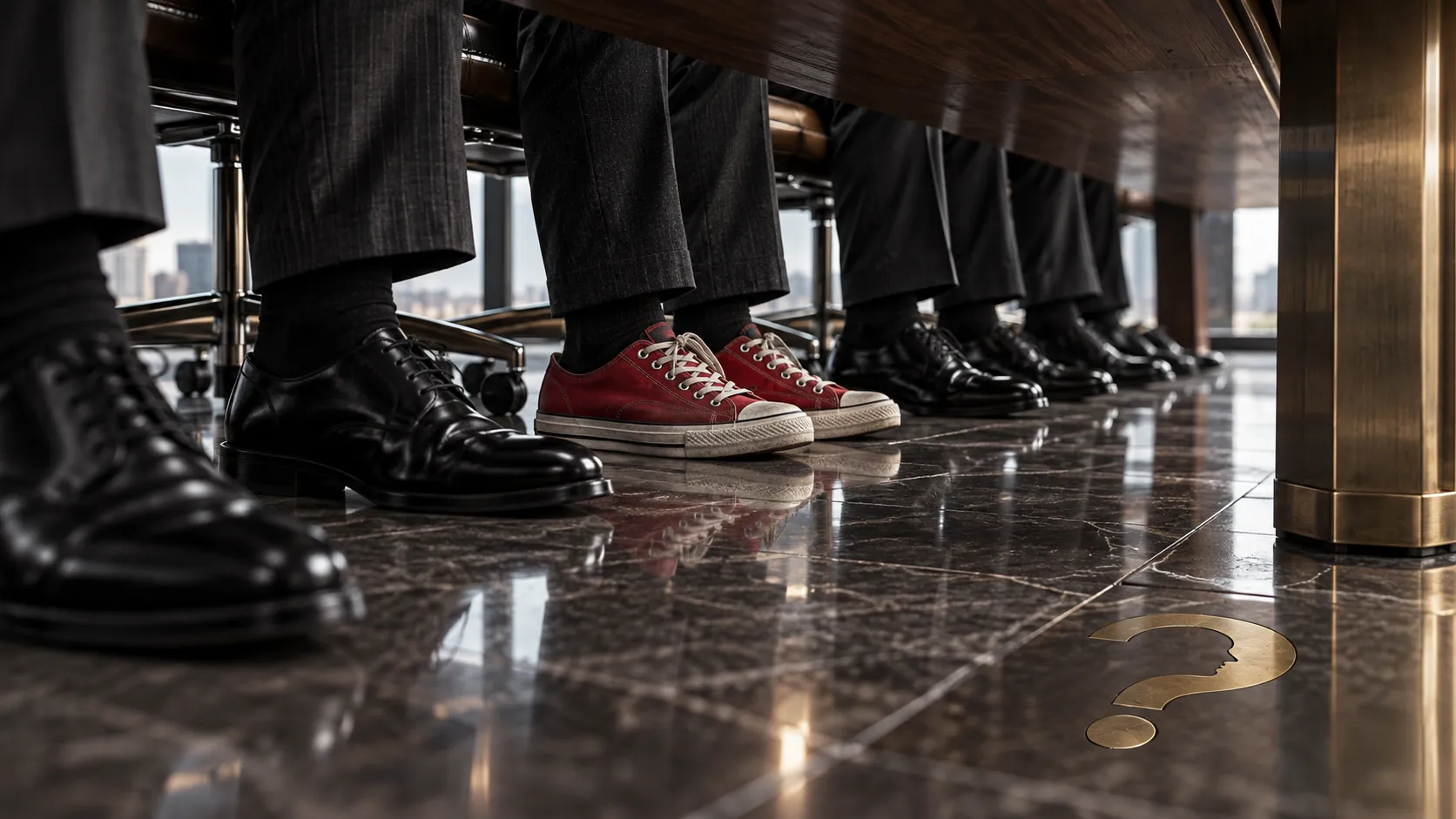
The red sneakers effect is the finding that a deliberate break from a dress code can raise how much status and competence observers credit to a person. The research is clear about when it appears and when it does not.
Answer to the question
What is the red sneakers effect?
The red sneakers effect is the finding that observers can credit a person who deliberately breaks a dress code with higher status and competence than a person who conforms. Silvia Bellezza and co-authors reported it in 2014. It depends on the observer knowing the norm and seeing the choice as intentional.
Key takeaways
- Bellezza and co-authors (2014) reported that observers attributed higher status and competence to people who broke a dress code than to people who conformed.
- The authors identified perceived autonomy as the mechanism: observers read the broken rule as a sign that the person is free to choose.
- The effect disappeared when the observer did not know the environment, when the nonconformity looked unintentional, and when no shared norms of formal conduct existed.
- Berger and a colleague (2010) found across four studies that knowledgeable consumers preferred understated cues that other people misread.
- The studies measure observer impressions of a person, not whether a brand that borrows the look sells more.
Gym clothes worn into a luxury boutique and red sneakers worn in a professional setting are the two examples that Silvia Bellezza and her co-authors gave for a result that sounds backwards, now called the red sneakers effect. Observers who saw a person break the dress code credited that person with higher status and competence than a person who followed it. Richard Shotton's The Illusion of Choice puts the effect among the biases behind what people buy, and that is where many readers first meet it.
| The effect at a glance | Detail |
|---|---|
| Named for | Red sneakers worn in a professional setting, one of the authors' examples |
| Reported | Silvia Bellezza and co-authors, Journal of Consumer Research, 2014 |
| Mechanism | Perceived autonomy |
| Theoretical frame | Costly signalling |
How a Deliberately Broken Dress Code Reads as Higher Status
The red sneakers effect is the finding that observers can credit a person who deliberately breaks a dress code with higher status and competence than a person who conforms. Bellezza and her co-authors reported it in the Journal of Consumer Research, and the publisher's news release describes the work as five laboratory and field studies with different populations. The name comes from one of their examples, but the pattern is not tied to footwear, since a gym outfit in a boutique is a case of the same thing.
The authors describe this kind of nonconformity as a costly and visible signal, and as a particular form of conspicuous consumption. Costly signalling supplies the theoretical frame: a signal is believable in proportion to what it costs to fake. Here the cost is the risk of disapproval. A person who breaks the rule and carries on shows that the rule does not bind them.
The mechanism the paper identifies is perceived autonomy. Observers read the broken rule as evidence that the person is free to choose, and that reading carried the higher ratings of status and competence. The two inferences travel together, so the red sneakers effect concerns what an observer believes a person can do as well as what the observer believes a person has.
Where the Red Sneakers Effect Holds and Fails
The paper reports where the red sneakers effect does not appear. The positive inferences vanish when the observer is unfamiliar with the environment, when the nonconformity seems unintentional, and when there are no shared norms of formal conduct.
Each condition removes a different ingredient. A person who does not know the dress code cannot see it being broken, so an outsider has nothing to read. A rule broken by accident says nothing about autonomy, because an accident is not a choice, and the news release records what makes a departure look intentional as a question the authors left open. Where no norm exists, there is nothing to depart from. The exceptions mirror the argument: the signal needs a norm, a deliberate choice and an audience that knows the norm, and it fails when any one of the three is missing.
Observers also differed from one another. Need for uniqueness was a moderator, which means the strength of the red sneakers effect varied with how much observers valued standing apart from others.
The University of Chicago Press news release for the 2014 paper describes one design in detail. Students ranked the professional status of a professor who was either clean-shaven in a business suit or bearded in a T-shirt, and the professor taught at either a local college or a top-tier university. According to the release, the unshaven professor at the top-tier university was given more status and more competence.
The example is useful because nothing is for sale in it. The signal is a beard and a T-shirt, and the setting is a university, where observers share an idea of how a professor dresses. That fits the exceptions to the red sneakers effect reported in the paper, which depend on a shared norm and an observer who knows it. The red sneakers effect is about impressions, meaning the ratings observers gave to a person they were shown.
Quiet Cues and Informed Audiences
Four years before the red sneakers effect was named, the same journal published a paper by Berger and Ward on subtle signals, reported across four studies. Less obvious branding made observers more likely to misjudge a product, for example by taking an expensive item for a cheaper one. Consumers with deep knowledge of a product domain preferred the understated cues, because the cues set them apart from mainstream consumers and because they could read what others missed.
The preference was stronger when the product related closely to the buyer's identity and when the purchase was visible to others. The authors take that pattern to indicate that the signalling is aimed at outside audiences.
A deliberate rule-break needs an observer who knows the rule, and a quiet cue needs an observer who knows the category, so the same object sends one message to the informed and a weaker or mistaken one to everyone else. What carries the signal is a visible departure from a norm in the 2014 work by Bellezza's team and, in the 2010 work by Berger and Ward, a restraint that only some observers can decode.
Common questions
What is the red sneakers effect?
The red sneakers effect is the finding that observers can credit a person who deliberately breaks a dress code with higher status and competence than a person who conforms. Silvia Bellezza and co-authors reported it in the Journal of Consumer Research in 2014.
Why does breaking a dress code raise perceived status?
The authors found that perceived autonomy explained the effect. Observers read a visible, deliberate departure from a norm as a sign that the person is free to choose, and they rated that person higher on status and competence.
When does the red sneakers effect not work?
The paper reports that the effect disappears when the observer is unfamiliar with the environment, when the nonconformity seems unintentional, and when there are no shared norms of formal conduct.
Sources
Shotton, R. (2023). The Illusion of Choice. Harriman House. Seed book; vault hub Books/The Illusion of Choice.
Bellezza, S., Gino, F., & Keinan, A. (2014). “The red sneakers effect: Inferring status and competence from signals of nonconformity.” Journal of Consumer Research, 41(1), 35-54. doi:10.1086/674870 https://doi.org/10.1086/674870
Berger, J., & Ward, M. (2010). “Subtle signals of inconspicuous consumption.” Journal of Consumer Research, 37(4), 555-569. doi:10.1086/655445 https://doi.org/10.1086/655445
University of Chicago Press Journals (2014). News release on Bellezza, Gino & Keinan, “The red sneakers effect,” Journal of Consumer Research. https://www.sciencedaily.com/releases/2014/02/140211094254.htm