What Red Actually Does
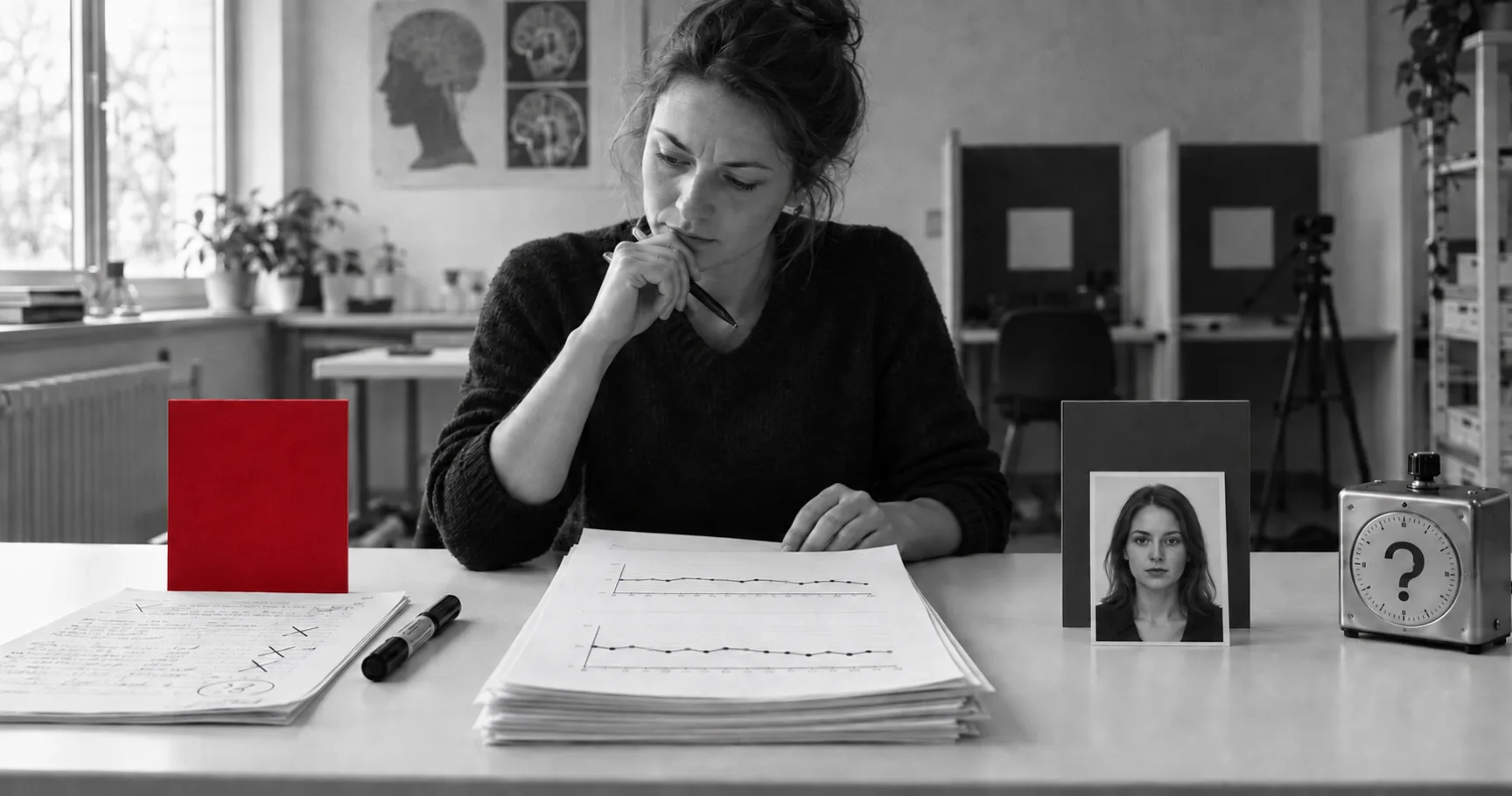
Red does not lower your IQ and it does not make you more attractive. The theory underneath those claims is in better shape than the claims are, and the most cautious voice in the field belongs to the researcher who built it.
Key takeaways
- The serious claim was never that red does one thing. It is that red carries whatever meaning it has acquired in the setting you are standing in, and acts without announcing itself.
- Elliot and colleagues found in 2007 that a brief glimpse of red before a test lowered scores, with converging behavioural and cortical measures.
- The attraction result that followed has not held. Peperkoorn and colleagues found nothing across 830 men, and a pre-registered replication with the original materials found a very weak effect, pointing the other way for women rating men.
- Elliot's own 2015 review calls the field nascent and recommends patience and prudence about real-world application. That sentence does not appear in the decks that cite him.
- What survived is the framework. Red reduced consumption of unhealthy food far more than healthy food, which is context doing exactly what the theory predicted.
[Red is the colour](https://thewhyweproject.com/articles/red-color-psychology) of a ripe strawberry and of the mark on a failed exam paper. The serious version of the claim has never been that red does one thing, then. It is that red carries whatever meaning it has picked up where you are standing.
That version is testable. It has been tested. The results are more interesting than either the marketing literature or the eye-rolling would suggest, and they arrive in a particular order.
2007, the demonstration
In 2007 the Journal of Experimental Psychology: General published four experiments showing that a brief glimpse of red before an important test, an intelligence test among them, made people do worse. The reasoning ran through context. In a room where you are being assessed, red is the colour of the failing mark, so it should carry an association with the danger of failing, and that association should tip a person towards avoidance. Two further experiments chased the mechanism instead of the outcome, looking for avoidance in what participants chose to do and in cortical activation, and found signs of it in both. Nobody reported noticing anything.
Andrew Elliot led that paper, with Markus Maier, Arlen Moller, Ron Friedman and Jörg Meinhardt. Judged by the standards of its moment it is a good piece of work: a stated mechanism, a prediction that could have come out the other way, two kinds of converging measure, and a conclusion the authors keep narrow, that care is needed in how red gets used where people are being assessed.
2008, the escape
A year later Elliot and Daniela Niesta published the finding that got out of the building. Across five experiments, red made men rate women as more attractive and more sexually desirable than other colours did. The men seemed unaware of it. Red did not change how women rated other women, and it left judgments of likeability, kindness and intelligence alone, which is the kind of narrowness that makes a result look like a mechanism and not an accident. Whether men and women simply gravitate towards different colours is a separate matter, and one article asks whether [men and women have different colour preferences](https://thewhyweproject.com/articles/men-women-colour-preferences).
The paper names its own audience. The findings, the authors wrote, have clear practical implications for fashion consultants, product designers and marketers. That sentence was correct, and it is roughly where the evidence and the story stopped travelling together. Once a colour is tied to a brand, a different dispute begins, over whether [a brand can own a colour](https://thewhyweproject.com/articles/who-owns-a-brand-colour).
2016, the first failure
Three experiments, 830 men in total, no red effect. Leonard Peperkoorn, Craig Roberts and Thomas Pollet had set out to refine the result, not to attack it, separating short-term from long-term mating contexts, and one of their studies was a larger-sample replication of a study that had previously found the effect. It did not find it.
2017, the replication
Then came the version that is hard to argue with. Gabrielle Lehmann and Robert Calin-Jageman obtained the original materials, worked out their sample sizes in advance, pre-registered the design, built in a positive control so that a null could not simply mean a dead method, and ran it online and in person. For men rating women the effect was very weak, pointing the way the theory predicted. For women rating men it was very weak and pointing the other way.
They are careful about what that establishes. The original studies may have overestimated the effect, theirs may have underestimated it, or something not yet identified may be moderating it heavily. All three remain live.
2015, the author's own verdict
The most cautious voice in this literature belongs to the researcher who built it. Elliot wrote a review in 2015 setting out the theoretical and empirical advances of the previous decade, and then spent the remainder of it on the weaknesses in each. The literature on colour and psychological functioning, he concluded, is at a nascent stage of development, and he recommended patience and prudence about theory, findings, and real-world application.
That has been sitting in the open for ten years under the name the brand consultancies cite. It does not turn up in the decks.
2015, the result that held
Something did survive, and what survived is the framework and not the headlines. Take the claim that red makes people eat less, which had been explained by red acting as a stop signal. If that were the mechanism, red would suppress eating across the board. Leonie Reutner, Oliver Genschow and Michaela Wänke found that it does not. Red had a stronger effect on unhealthy food than on healthy food, both in how much people ate and in what they chose, and the effect faded gradually as the options got healthier. They describe the response as adaptive, not generalised.
Measured against the theory, that is a hit. Red did what red means in a setting where the food might harm you, and much less where it might not. The prediction was about context, and context is what came back. Yellow has its own appetite folklore, and the evidence on whether [yellow really makes people hungry](https://thewhyweproject.com/articles/does-yellow-really-make-people-hungry) gets the same treatment. A green pack sets up a context of its own, and one article looks at whether [green packaging makes food look healthier](https://thewhyweproject.com/articles/does-green-packaging-look-healthier).
So our reading is that the framework is in better condition than the famous experiments built on top of it, while the commercial advice descends almost entirely from those experiments. Keep the theory. It says colour carries meaning that depends on setting, is learned at least as much as inherited, and can move behaviour quietly. Drop the attraction result, which has now failed under better methods than the ones that produced it. Hold the test-performance result as unsettled, which is where its own author holds it.
For a shopper, the residue is smaller than the genre promises and more useful than nothing. A red sale sign is not reaching into your brain. It is catching your eye and signalling urgency, and both of those are real, well understood, and completely visible to you the moment somebody names them. How far the colour of a shop can hold you inside is the subject of an article on whether [shop colour keeps people longer](https://thewhyweproject.com/articles/does-shop-colour-keep-people-longer). The names given to colours are weighed in an article on whether [fancy colour names sell more](https://thewhyweproject.com/articles/do-fancy-colour-names-sell-more).
What is missing
The unanswered question is the one the whole field now rests on, and it has an awkward shape. If colour effects depend on context, then every published result is a result about one context. A decade of experiments run largely on students, in laboratories, in a handful of countries, has told us a great deal about laboratories and students and very little about which findings travel. Nobody has mapped that. Nobody is obviously trying to. Packaging is one such setting, and an article explains why [black packaging looks expensive](https://thewhyweproject.com/articles/why-black-packaging-looks-expensive).
Until somebody does, the honest statement is short. Red means something. The room decides what. Colour claims of this kind are tested again in an article on [what the pink cell never proved](https://thewhyweproject.com/articles/does-pink-really-calm-people-down).
Sources
Elliot, A. J., Maier, M. A., Moller, A. C., Friedman, R., & Meinhardt, J. (2007). 'Color and psychological functioning: The effect of red on performance attainment.' Journal of Experimental Psychology: General, 136(1), 154-168. Four experiments in which brief perception of red before an achievement task, including an IQ test, impaired performance, apparently outside awareness; two further experiments linked red to avoidance motivation through task choice and cortical activation. doi:10.1037/0096-3445.136.1.154
Elliot, A. J., & Niesta, D. (2008). 'Romantic red: Red enhances men's attraction to women.' Journal of Personality and Social Psychology, 95(5), 1150-1164. Five experiments; men appeared unaware; no effect on women's ratings of other women, nor on likeability, kindness or intelligence; the authors name fashion consultants, product designers and marketers as practical audiences. doi:10.1037/0022-3514.95.5.1150
Peperkoorn, L. S., Roberts, S. C., & Pollet, T. V. (2016). 'Revisiting the red effect on attractiveness and sexual receptivity: no effect of the color red on human mate preferences.' Evolutionary Psychology, 14(4). Three studies, 830 men in total, failing to support the prediction, including a larger-sample replication of a study that had found it. doi:10.1177/1474704916673841
Lehmann, G. K., & Calin-Jageman, R. J. (2017). 'Is red really romantic?' Social Psychology, 48(3), 174-183. Pre-registered replication using the original materials, with planned sample sizes, a positive control and quality controls, run online and in person; very weak effects, in the predicted direction for men and in the opposite direction for women. doi:10.1027/1864-9335/a000296
Elliot, A. J. (2015). 'Color and psychological functioning: a review of theoretical and empirical work.' Frontiers in Psychology, 6, 368. Concludes that the literature is at a nascent stage of development and recommends patience and prudence regarding conclusions about theory, findings and real-world application. doi:10.3389/fpsyg.2015.00368
Reutner, L., Genschow, O., & Wänke, M. (2015). 'The adaptive eater: perceived healthiness moderates the effect of the color red on consumption.' Food Quality and Preference, 44, 172-178. Red affected intake and choice more strongly for unhealthy than healthy food, with the effect decreasing gradually as options became healthier; the authors describe the response as adaptive rather than generalised. doi:10.1016/j.foodqual.2015.04.016