What Your Clothes Do to How You Think
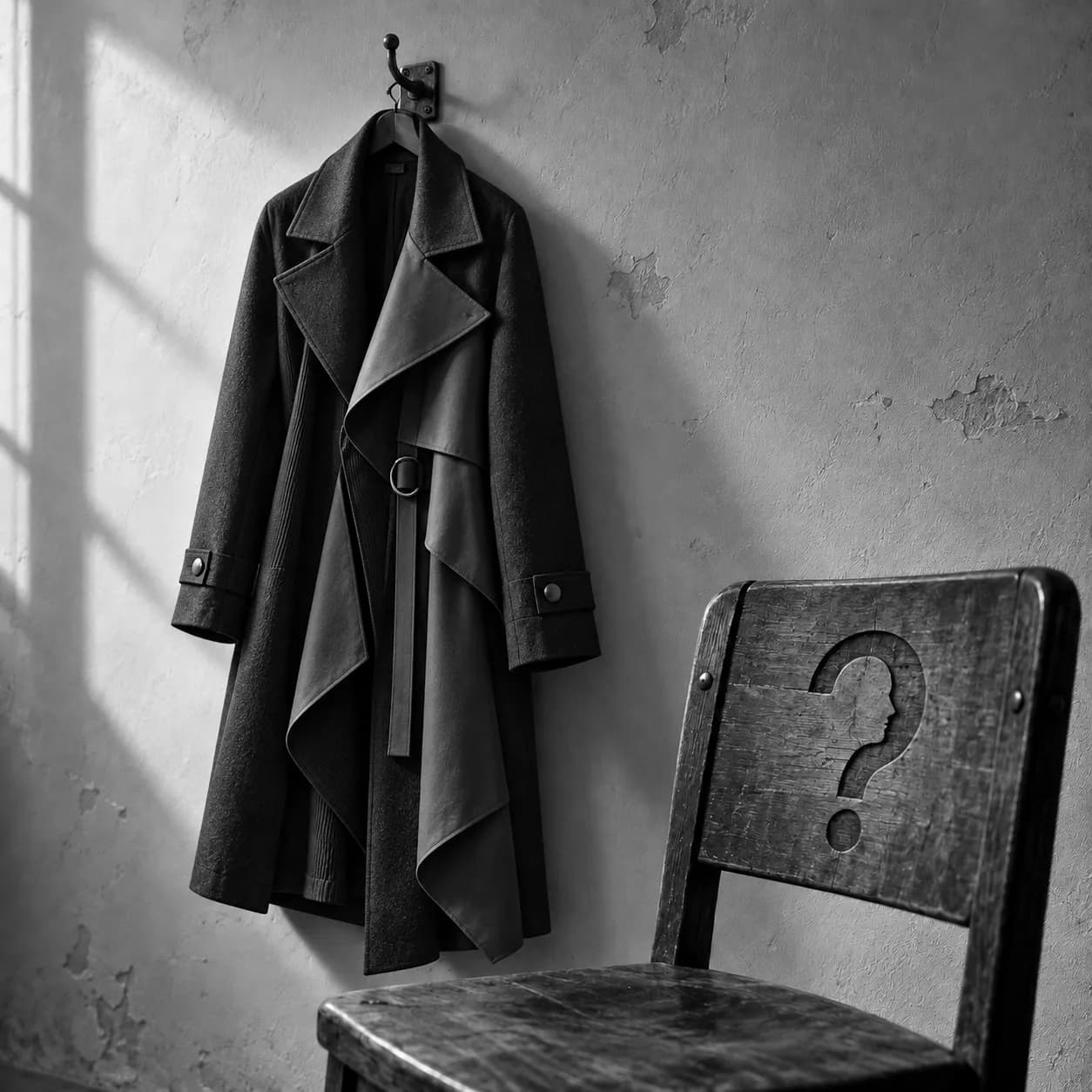
The 2012 lab coat study made enclothed cognition famous, and a preregistered repeat found no reliable effect. Clothes change how strangers treat you more reliably than how you think.
Key takeaways
- In Hajo Adam and Adam Galinsky's 2012 study, wearing a lab coat improved attention; a preregistered repeat of their first experiment, led by Devin Burns in 2019, found no reliable effect.
- A 2023 analysis of 105 effects from 40 studies raised concerns about early enclothed cognition studies and found evidential value in those published after 2015.
- In Leonard Bickman's 1974 field experiments, passers-by complied more with a researcher dressed as a guard than as a civilian or a milkman.
Put on a white coat and you will make fewer mistakes on a test of attention; be told it is a doctor's coat and you will hold your attention better. That was the finding that launched a small field more than a decade ago. Its strongest form reaches further: the clothes you wear change how you think, whether or not anyone sees you.
What did the lab coat experiments show?
The experiments deserve a fair hearing first, because the design was clever. Hajo Adam and Adam Galinsky, writing in the Journal of Experimental Social Psychology, began with a pretest showing that people associate a lab coat with attentiveness and carefulness. In their first experiment, participants who wore a lab coat did better on a test of selective attention than participants who did not. In the next two, the same white coat was used throughout, and the description changed between groups. Wearing it as a doctor's coat improved sustained attention compared with wearing it as a painter's coat, and compared with simply seeing a doctor's coat on the desk.
That last comparison is what drew most attention to the paper. A coat on the desk did little. A coat on the body did something, but only when it carried the right meaning. The authors called the effect enclothed cognition, and defined it as "the systematic influence that clothes have on the wearer's psychological processes". It depended, they argued, on two things at once: what the clothes symbolise, and the physical experience of wearing them.
The idea also had a past. A decade earlier, Bettina Hannover and Ulrich Kühnen had asked students to turn up to an experiment in either formal or casual dress, then had them describe themselves by accepting or rejecting trait words. Formally dressed students chose more words like cultivated and accurate. Casually dressed students chose more words like easygoing and tolerant, and responded faster to those words.
In 2015 a team led by Michael Slepian published five studies in Social Psychological and Personality Science suggesting that formal clothes make thinking more abstract. People in more formal clothes described actions in terms of their purpose rather than their mechanics, grouped objects into broader categories, and saw the overall shape of a pattern before its details. In the fifth study, the link ran through how powerful people felt. Taken together, the work painted a consistent picture of clothes reaching inside the head.
What happened when the coat went back on?
A prominent repeat of the original lab coat test of attention came from a team led by Devin Burns in 2019, again in the Journal of Experimental Social Psychology. They preregistered the study, meaning they fixed their methods and analysis before collecting data, and used the same colour-word task as the first experiment, in which errors on mismatched trials measure attention. Wearing the lab coat made no detectable difference. Their conclusion was that an effect of that kind, if it exists, is too small for the original design to have found reliably. The same study picked up other effects as small as seven thousandths of a second, which makes poor equipment or weak technique an unlikely excuse.
Formal clothing fared a little better. Axel Burger and Herbert Bless ran two preregistered studies in 2017 testing whether more formal dress goes with more abstract thinking. The first found the link when the data were pooled. The second found no link at all. One positive result against one null settles nothing.
It does not settle whether the effect is there at all.
How much survives across forty studies?
The most careful defence of the field came from inside it. In 2023, C. Blaine Horton, with Adam and Galinsky as co-authors, gathered every study they could find, 105 effects from 40 studies in 24 articles, with 3,789 participants, and ran two kinds of analysis on them. One was a standard meta-analysis. The other, called a z-curve, looks at the pattern of published results to estimate how many would replicate if the studies were run again, and whether the literature shows signs of selective reporting.
Their answer split the field in two. Studies published before 2016 raised real concerns about replicability, a conclusion the authors drew about the early literature, including their own. Studies published after 2015 showed evidential value, and in the authors' reading support the core principle that what people wear influences how they think, feel and act.
Put in its advocates' terms, then, enclothed cognition is a young idea whose first demonstrations were too small, and whose better-run later studies still point the same way. That is a serious position, held by the people best placed to judge their own data, and it should be weighed as one.
A z-curve has limits of its own. It estimates how a body of published results would fare if run again; it does not run them again. The test that failed to reproduce the original lab coat finding was a fresh experiment, and a z-curve cannot say which of the later studies would survive one.
Who are clothes really talking to?
The other account starts from the observer. Clothes, on this view, are mainly signals, and their effects show up most clearly in how other people treat the wearer. The evidence for that is older and comes partly from the street.
In two field experiments published in 1974, Leonard Bickman had a researcher, dressed as a civilian, a milkman or a guard, stop passers-by and ask them to pick up a paper bag, give a dime to a stranger or move away from a bus stop. People complied more with the guard. In separate questionnaire studies, college students did not rate the guard as having more power or legitimacy than the milkman or the civilian, which suggests people underrate the effect.
Labels do similar work. Rob Nelissen and Marijn Meijers reported seven experiments in 2011 in which luxury was signalled by a brand label on someone's clothes. The labelled wearer received more favourable treatment, which in some cases brought financial benefits.
A guard's uniform and a luxury label change how strangers behave.
The Elephant in the Brain, by Kevin Simler and Robin Hanson, makes this account the default. Its argument across the book is that many everyday choices serve motives we would rather not state, and status is one of the motives it returns to most.
In its chapter on consumption, a table on page 175, drawn from Geoffrey Miller's Spent, sorts goods into those used privately, such as underwear, and those used to show off, such as branded clothes, shoes and watches. A thought experiment on pages 174 to 177 imagines everyone suddenly unable to notice one another's possessions, and predicts that clothes would standardise, because "individuality is just signaling by another name". On page 202 the authors add that fashion separates itself from mere clothing by being impractical. The book argues these clothing claims from a thought experiment rather than from data, and says as much.
So who are your clothes for?
The book also explains why the signalling account feels wrong from the inside. On page 181 it leans on the third-person effect, the finding that people believe media messages move others more than themselves, and argues that we prefer to think our purchases are for us, and to look stylish without seeming to try. When people explain their clothes in terms of confidence, mood or identity, the book's reading is that this is the account we prefer to give, and some of the wearer research does find felt power doing the work. That observation does not decide between the two accounts, but it does suggest where they meet.
Felt power is a social feeling, a sense of where you stand relative to others. Slepian's fifth study found it carrying the link between formal clothes and abstract thinking, and Burger and Bless found their first study compatible with a route through subjective social status and power. If the strongest wearer effects run through an imagined audience, then enclothed cognition and signalling are less rivals than two views of the same exchange, one from each side of the room. That reading is ours, offered as a hypothesis rather than a result.
If the strongest wearer effects run through an imagined audience, then enclothed cognition and signalling are less rivals than two views of the same exchange, one from each side of the room.
The field evidence weighs most with us. A guard's uniform and a luxury label change how strangers behave, in the street and in the laboratory, and that work rests on direct observation of behaviour. The wearer's side is real enough to keep studying, but its famous lab coat result did not hold up when repeated in its original form, and the case for it now rests on later studies that its own authors judge more trustworthy.
When you choose clothes for a job interview or a difficult meeting, they are most likely to help through the people who see you, and through your own sense of how you are being seen, rather than through any direct change in your attention or reasoning.
Common questions
What is enclothed cognition?
It is the idea, named by Hajo Adam and Adam Galinsky in 2012, that clothes influence the wearer's thinking through their symbolic meaning and the experience of wearing them. Their best-known result was that a lab coat described as a doctor's coat improved sustained attention.
Did the lab coat study replicate?
Not in its original form. A preregistered direct replication led by Devin Burns in 2019 found no effect of wearing a lab coat on a colour-word attention task. A 2023 analysis of 40 studies found concerns about early studies, while finding evidential value in work published after 2015.
Do clothes change how other people treat you?
Yes, and the evidence is older, though it rests on fewer and less recent studies than one would like. In Leonard Bickman's 1974 field experiments, passers-by complied more with a researcher dressed as a guard. In seven experiments reported in 2011, luxury brand labels on clothing earned the wearer more favourable treatment.
Sources
Adam, H., & Galinsky, A. D. (2012). “Enclothed cognition.” Journal of Experimental Social Psychology, 48(4), 918-925. doi:10.1016/j.jesp.2012.02.008. Abstract read: pretest links lab coat with attentiveness and carefulness; Experiment 1 selective attention, coat against no coat; Experiments 2 and 3 sustained attention, doctor's coat against painter's coat and against seeing or identifying with a doctor's coat.
Hannover, B., & Kühnen, U. (2002). “‘The clothing makes the self’ via knowledge activation.” Journal of Applied Social Psychology, 32(12), 2513-2525. doi:10.1111/j.1559-1816.2002.tb02754.x. Abstract read: formal or casual dress; trait self-descriptions and response times.
Slepian, M. L., Ferber, S. N., Gold, J. M., & Rutchick, A. M. (2015). “The cognitive consequences of formal clothing.” Social Psychological and Personality Science, 6(6), 661-668. doi:10.1177/1948550615579462. Abstract read: five studies; action identification, category inclusiveness, global processing; mediation by felt power in Study 5.
Burns, D. M., Fox, E. L., Greenstein, M., Olbricht, G. R., & Montgomery, D. (2019). “An old task in new clothes: a preregistered direct replication attempt of enclothed cognition effects on Stroop performance.” Journal of Experimental Social Psychology, 83, 150-156. doi:10.1016/j.jesp.2018.10.001. Abstract read: equivalence testing and small telescopes; effect too small to have been reliably detected under the original design; sequential effects as small as 7 ms detected.
Burger, A. M., & Bless, H. (2017). “Cognitive consequences of formal clothing: the effects of clothing versus thinking of clothing.” Comprehensive Results in Social Psychology, 2(2-3), 228-252. doi:10.1080/23743603.2017.1396185. Abstract read: two preregistered studies; pooled Study 1 supports a positive correlation with abstraction, compatible with a route through subjective social status and power; Study 2 no evidence.
Horton, C. B., Adam, H., & Galinsky, A. D. (2025). “Evaluating the evidence for enclothed cognition: z-curve and meta-analyses.” Personality and Social Psychology Bulletin, 51(2), 203-221. Published online 17 July 2023. doi:10.1177/01461672231182478. Abstract read: 105 effects, 40 studies, 24 articles, N = 3,789; concerns about replicability of early studies; evidential value for effects published after 2015.
Bickman, L. (1974). “The social power of a uniform.” Journal of Applied Social Psychology, 4(1), 47-61. doi:10.1111/j.1559-1816.1974.tb02599.x. Abstract read: two field experiments, civilian, milkman or guard; more compliance with the guard; questionnaire studies found students did not perceive the guard as more powerful or legitimate.
Nelissen, R. M. A., & Meijers, M. H. C. (2011). “Social benefits of luxury brands as costly signals of wealth and status.” Evolution and Human Behavior, 32(5), 343-355. doi:10.1016/j.evolhumbehav.2010.12.002. Abstract read: seven experiments; luxury manipulated through brand labels on clothes; preferential treatment and financial benefits.
Simler, K., & Hanson, R. (2018). The Elephant in the Brain: Hidden Motives in Everyday Life. Oxford University Press. Read in full by this publication, with a reliability audit. Ch. 10, Consumption: Table 1 at p. 175 after Geoffrey Miller's Spent; the Obliviation thought experiment at pp. 174 to 177 and the quotation at p. 177; third-person effect at p. 181. Ch. 11, Art, p. 202, fashion and impracticality. Page numbers refer to the later paperback reissue photographed for the audit.