Why We Choose the Store Brand
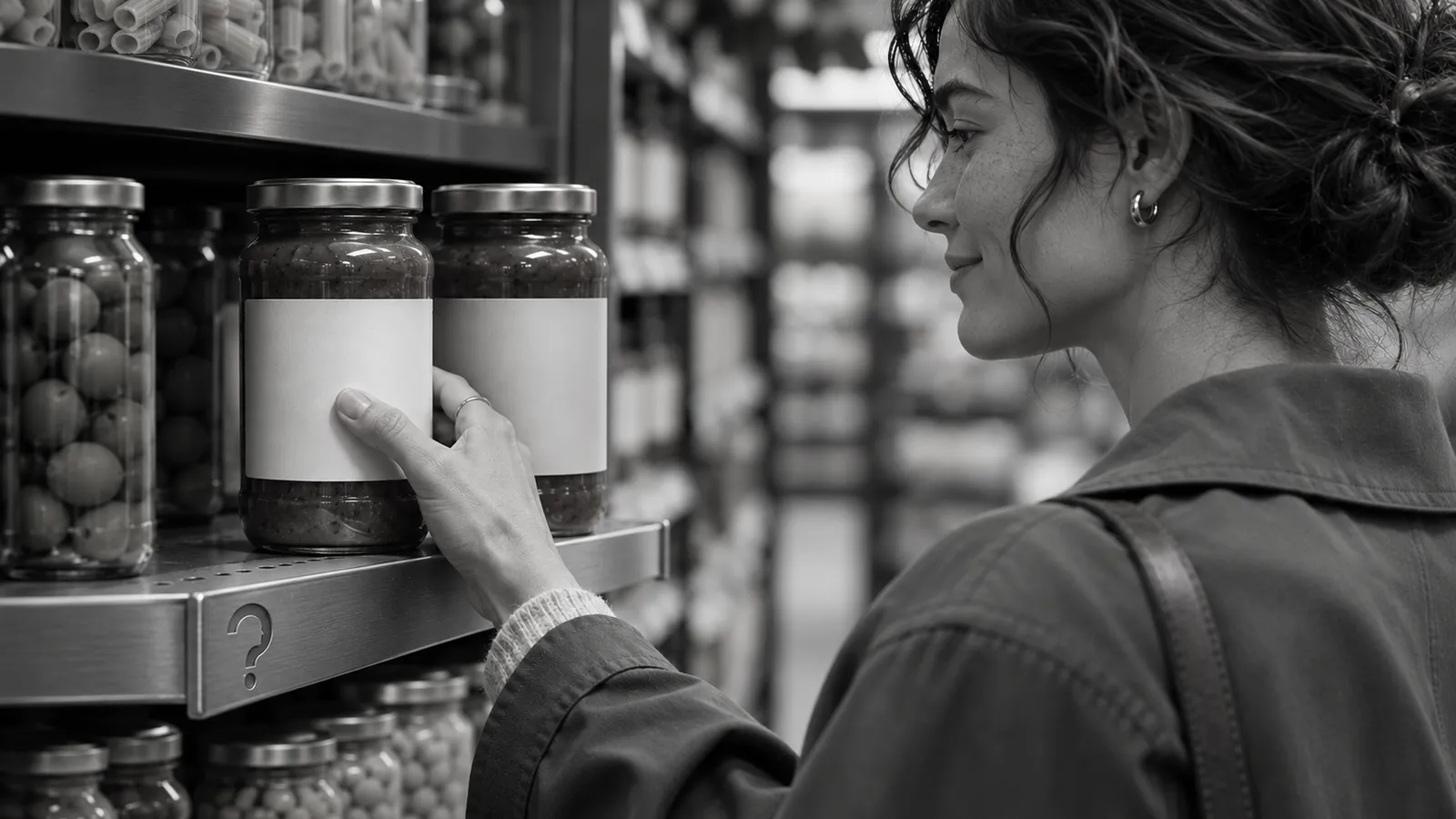
How shoppers judge a retailer's own range, why the store's name carries so much weight, and what price and the economy add.
Why do shoppers buy own-label products?
Shoppers buy own-label products because the price is lower, the retailer's name carries trust and, in many categories, a poor choice costs little. Studies find that shoppers judge store brand quality mostly from cues around the product, and that own-label share rises when the economy contracts.
Key takeaways
- In an experiment with 1,564 shoppers and five products, evaluations of store brand grocery items were driven mainly by extrinsic cues and not by intrinsic characteristics (Richardson, Dick and Jain, 1994).
- In a survey of 22,623 respondents in 23 countries, willingness to pay a premium for national brands ran through perceived quality and value and declined as private labels matured (Steenkamp and colleagues, 2010).
- In a survey of 904 household grocery shoppers, store brand purchases rose with trust in the retailer's own brands (Sarantidou, 2018).
- A survey of shoppers found that quality variability, price consciousness, belief that price signals quality and brand loyalty all related to private label purchase, and that the pattern differed by category (Glynn and Chen, 2009).
- Time-series evidence from the United States and Europe links economic contractions to a higher private-label share, with a slower return to national brands (Lamey and colleagues, 2007).
Most of what decides an own-label purchase happens before the pack is opened. Shoppers buy own-label products because the price is lower, because the retailer's name carries trust and because in many categories a poor buy costs little, and the evidence suggests that quality at the shelf is read mostly from the cues around a product and not from the product itself. A pack of pasta or a bottle of washing-up liquid cannot be tried in the aisle, so the shopper weighs the price, the look of the pack and the name above the door, and decides on those.
The pull also rises and falls with the economy. Using time series from the United States and Europe, Lien Lamey, Barbara Deleersnyder, Marnik Dekimpe and Jan-Benedict Steenkamp found that own-label share rises when an economy contracts and falls when it expands, and that the two movements are not equal in size and speed: buyers moved towards the store's own range faster than they moved back.
The measure is a country's own-label share, so the pattern describes whole markets and not any single retailer or shopper. Spending in a downturn does not all shift one way, as Do People Buy Lipstick in a Recession shows for a small treat whose sales held up through the 2007 to 2009 downturn, but in the staples aisle the move is clear, and it unwinds slowly once growth returns.
Own-label trust is earned across the other aisles
A shopper whose trolley has held a retailer's goods for years has a record to judge by, the first source of trust set out in What builds brand trust, and that record travels to anything carrying the same name. Paraskevi Sarantidou, setting out to explain why store brand penetration differs from one retailer to the next, surveyed 904 household grocery shoppers about nine retailers and ten product categories in one European country. Purchases of store brands rose with trust in the retailer's own brands, which gave the question a measurable answer.
Byron Sharp's How Brands Grow suggests that trust works alongside something plainer. Its preface pairs national brands with retailer brands among the cases its patterns cover, and asks readers not to assume the patterns stop at their own category just because an example comes from store brands. The book names two sources of growth, mental availability and physical availability, meaning how readily a brand comes to mind and how easy it is to find and buy.
On that account an own-label range grows as any brand does, by reaching many buyers and being easy to find, and not by winning a small devoted group, and those buyers also buy other brands, the pattern described in Brand Loyalty Is Mostly Brand Size.
Here the retailer holds an advantage no manufacturer can copy.
The chain puts the range in every branch, which is physical availability at no extra cost, and its name carries a record earned in the aisle for other reasons, so own-label gains less from being cheap than from being present and trusted. That is also why one shopper can fill a trolley with own-label staples and a few favourite manufacturer names: the retailer's range is competing for a place in each shopping trip, not for devotion.
A low price on the shelf must look cared for
Price is itself a cue, and an awkward one for a cheaper range. The price-quality heuristic holds that a dearer product is a better one, so a low price can read as a lower grade unless something else tells the shopper otherwise. Most packaged goods cannot be tested before they are paid for, so shoppers lean on what they can see. Extrinsic cues are the things attached to a product and not part of it, such as its price, its packaging and the name on the label, while intrinsic characteristics are what the product is made of and how it performs.
When Paul Richardson, Alan Dick and Arun Jain ran an experiment with 1,564 shoppers and five products, judgements of store brand grocery items followed the extrinsic cues a product displays far more than its intrinsic characteristics. The same authors judged that a value-for-money pitch for private label lines may be a weaker strategy than a quality pitch, and they recommended the quality pitch. Read against the heuristic, the advice makes sense: an own-label product that is inexpensive and also looks cared for hands the shopper two cues that point the same way.
Whole markets show the same dependence on perception. To see what lets a manufacturer's brand command more than an own-label rival, Jan-Benedict Steenkamp, Harald van Heerde and Inge Geyskens surveyed 22,623 respondents in 23 countries, across about 63 packaged goods categories per country. The premium ran through perceived quality and perceived value, and it narrowed as own-label ranges matured, an effect the spread of countries at different stages made visible. A range that has sat on the shelf for years has had time to shape those perceptions.
For manufacturers the authors point to marketing and manufacturing fundamentals as the route to keeping a premium, and the result is a reminder that the gap in the shopper's mind, and not the gap in the product, sets what a name is worth.
Where the saving is easiest for a shopper to take
Price does not pull with equal force in every aisle.
Perceived risk, the worry that a product will not perform, grows where products in a category differ widely and shrinks where they look and work alike. A mall-intercept survey by Mark Glynn and Shaoshan Chen, which extended an earlier study of category-level effects, found four consumer factors related to buying private label, with a pattern that changed from one category to the next:
- quality variability within the category
- price consciousness
- a belief that price signals quality
- loyalty to manufacturer brands
The last two belong together, since each makes a name or a price tag count for more than what sits inside the pack. The first is perceived risk seen from the shelf. Where one pack can differ sharply from the next, an unfamiliar cheaper one is a gamble. Where packs look and work alike, the gamble mostly disappears and the cheaper pack asks the buyer to give up almost nothing.
Common questions
Why do shoppers buy own-label products?
Because the price is lower, the retailer's name carries trust and, in many categories, a poor choice costs little. Shoppers judge store brand quality mostly from cues around the product, and own-label share rises when the economy contracts.
Is own-label the same as a store brand?
Yes in everyday use. Own-label, store brand and private label all describe a range sold under the retailer's name or a name the retailer controls.
Do shoppers judge own-label products by what is inside?
Less than they judge them by the cues around them. In an experiment with 1,564 shoppers, evaluations of store brand grocery items followed extrinsic cues more than intrinsic characteristics.
Does a downturn change how many people buy own-label?
Yes. Time-series evidence from the United States and Europe links economic contractions to a higher private-label share. The return to manufacturer brands is slower.
Sources
Sharp, B. How Brands Grow. Seed book; vault hub Books/How Brands Grow.
Richardson, P. S., Dick, A. S., & Jain, A. K. (1994). Extrinsic and intrinsic cue effects on perceptions of store brand quality. Journal of Marketing, 58(4), 28-36. doi:10.1177/002224299405800403 https://doi.org/10.1177/002224299405800403
Steenkamp, J.-B. E. M., van Heerde, H. J., & Geyskens, I. (2010). What makes consumers willing to pay a price premium for national brands over private labels? Journal of Marketing Research, 47(6), 1011-1024. doi:10.1509/jmkr.47.6.1011 https://doi.org/10.1509/jmkr.47.6.1011
Sarantidou, P. P. (2018). Store brand adoption and penetration explained by trust. Spanish Journal of Marketing - ESIC, 22(3), 359-376. doi:10.1108/SJME-04-2018-0025 https://doi.org/10.1108/SJME-04-2018-0025
Glynn, M. S., & Chen, S. (2009). Consumer-factors moderating private label brand success: further empirical results. International Journal of Retail & Distribution Management, 37(11), 896-914. doi:10.1108/09590550910999343 https://doi.org/10.1108/09590550910999343
Lamey, L., Deleersnyder, B., Dekimpe, M. G., & Steenkamp, J.-B. E. M. (2007). How business cycles contribute to private-label success: Evidence from the United States and Europe. Journal of Marketing, 71(1), 1-15. doi:10.1509/jmkg.71.1.001 https://doi.org/10.1509/jmkg.71.1.001
Related concepts
People
More articles
- Pay What You Want: Why People Still Pay
What a roller coaster photo experiment and research on voluntary prices show about fairness, reciprocity and self-image.
- The Tip Screen Problem
What a tip screen changes about the moment of choice, what presets do, and what research finds on whether screens raise tips.
- Why Bigger Trolleys Fill Up Faster
What experiments say about the size of a cart, its handles and the space around it, and why the first cart was built to hold more.
- Why We Buy Refurbished
What research on perceived risk, contamination worries and warranties says about the barriers to buying refurbished products and what wins buyers over.
In these themes
- Shopping and Retail
How the shop, the shelf and the checkout shape what ends up in the basket.
- Brand and Identity
What a brand is in the mind, and what it says about the person who chooses it.