Why We Spend More Abroad
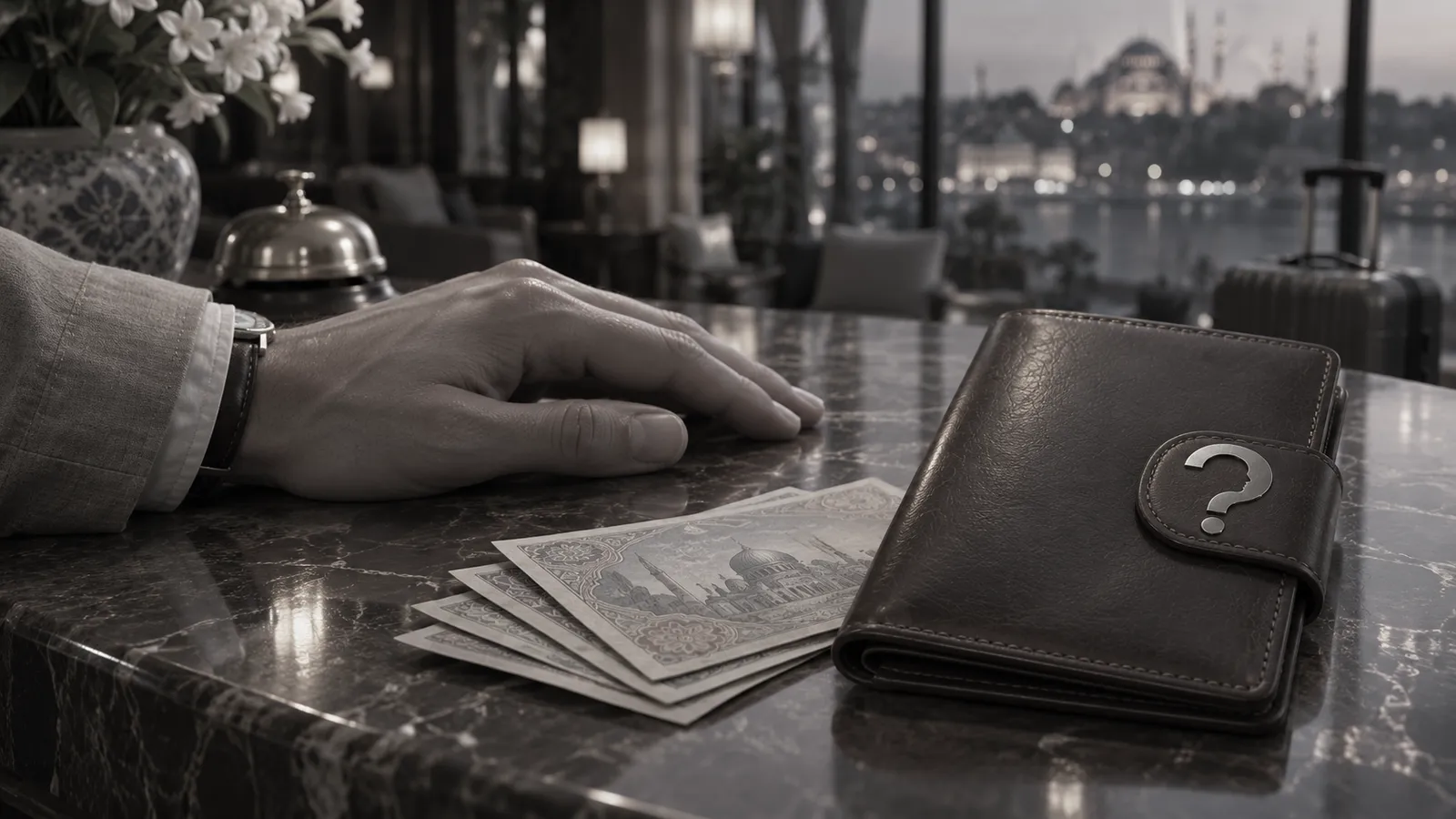
What experiments say about spending in an unfamiliar currency, from the first price seen at arrival to the total read back home.
Answer to the question
Why do we spend more in a foreign currency?
Because the number on a foreign price tag is read before the exchange rate is applied, and unfamiliar notes carry no felt value yet. In experiments, people spent more in a currency whose prices carry small numbers and less in one whose prices carry large numbers, so the pull depends on the exchange rate in play.
Key takeaways
- In a field experiment with 683 shoppers in France, Charlotte Gaston-Breton and Priya Raghubir found prices in an unfamiliar currency were recalled more accurately, though with less confidence, than prices in the familiar one.
- Priya Raghubir and Joydeep Srivastava reported in four studies that people anchor on the nominal number on a foreign price and adjust too little for the exchange rate, so spending falls with large numbers and rises with small ones.
- Klaus Wertenbroch, Dilip Soman and Amitava Chattopadhyay proposed that consumers anchor on the numerosity of the nominal gap between a price and a reference such as a budget.
- In three field studies, Raghubir and Srivastava found people less likely to spend a sum held as one large bill than the same sum in smaller bills.
- Morgan Housel's The Psychology of Money ties money beliefs to lived experience, which a new currency does not yet have.
The first prices a traveller reads in a new currency are read closely, and the spending comes after. People spend more abroad because the number on the price tag is read before the exchange rate is applied, so spending rises where prices carry small numbers.
Prices in a foreign currency draw close attention at first
A traveller who lands with a wallet of unfamiliar notes reads the first prices carefully, and the research names the effect the price knowledge paradox. Charlotte Gaston-Breton and Priya Raghubir found that shoppers shown prices in an unfamiliar currency remembered them better than prices in the familiar one, though they felt less sure of their memory.
The authors argue that unfamiliar formats get more deliberate processing, which improves how a price is stored, while familiar formats get less attention and breed confidence that runs ahead of accuracy.
The first purchases abroad are also often purchases of time. A ride from the airport buys convenience, the trade covered in Why We Pay for Convenience, and it is paid before the new price scale has been learned.
The evidence is a field experiment in France, six months before the euro was introduced, that showed shoppers prices in euros or in francs. Among the 683 shoppers, 69 per cent of those who saw euro prices said they could recall the price, against 85 per cent of those who saw franc prices, yet those who saw euro prices were almost twice as likely to recall the exact price. The memory differences carried through to the shoppers' intentions to buy.
The shoppers were looking at a unit that was about to become their own, so close attention had a lasting use. A visitor will never own the unit, which gives the early care less reason to last, a step from shoppers to travellers that the experiment did not test.
At the exchange desk the printed number outweighs the rate
When people spend in a currency they do not know, they anchor on the nominal number on the price and adjust too little for the exchange rate. Priya Raghubir and Joydeep Srivastava found this across four studies using different currencies, different ways of presenting the exchange rate and two countries. The pattern ran in both directions: spending fell when the foreign prices carried large numbers and rose when they carried small ones. Spending more in a foreign currency is therefore half of the finding. It follows when the price tags show smaller numbers than the same goods would at home, and the reverse follows when they show larger ones.
A framework from Klaus Wertenbroch, Dilip Soman and Amitava Chattopadhyay says when each direction appears. Consumers, they proposed, anchor on the numerosity of the nominal difference between a price and a salient referent such as a budget, and a series of experiments that evoked different reference standards supported the idea.
A budget is the obvious referent on a trip. Take an illustrative daily allowance of 200 units and a meal priced at 40, a gap of 160 in numbers. In home units the same allowance and meal might read 50 and 10, a gap of 40. The framework says the buyer's feeling follows the size of the gap in numbers, not the gap in value, so the same meal can look different depending on which scale carries the budget.
A holiday budget is also a mental account, and What is mental accounting sets out how such accounts are filed and watched. A foreign-unit budget gives that account a scale the buyer has not yet felt, so the number does the work that feel does at home.
Breaking a large note turns one sum into small bills
Money changed at a desk arrives as notes whose weight the traveller has not yet learned, and the first large note stays in the wallet as a reserve. People were less likely to spend a sum held as one large bill than the same sum held as many smaller bills, in three field studies reported by Raghubir and Srivastava in their paper on the denomination effect. The authors explain it through fungibility: a large denomination is less psychologically interchangeable with spending money, so it tends to stay unspent, while small bills pass more easily into everyday purchases.
The first purchase that breaks the large note turns the sum into smaller bills, and the denomination finding says those are spent more readily. The field studies were not run on holidays, but they show that the form in which money is held changes how freely it moves: a large note is handled as a unit to be kept, and a handful of small ones as money to be used.
A card removes the note altogether. Why Paying by Card Feels Cheaper covers that route, where the effect proves real but smaller than first reported and has weakened as cards became ordinary. On a trip the card adds a different gap: the till shows one number, and the converted amount in the home unit usually appears later. Neither route removes the gap between what the till shows and what the home unit records; the note simply makes the gap visible earlier.
Back home, the total meets a lifelong price sense
At home a buyer knows by experience what a coffee, a train ticket or a dinner should cost, and that background does the judging without effort. A new currency has none of it. A week of use gives the traveller a few reference prices, not a scale. Morgan Housel's The Psychology of Money rests on the same point about beliefs in general: people's beliefs about money come from what they have lived through, which is why behaviour that looks odd from outside makes sense to the person who lived it.
Conversion is where the studies and the habit meet. Adjusting for an exchange rate takes a calculation, while the number on the tag is in front of the buyer at once. That asymmetry is the setting for anchoring and adjustment, the process Wertenbroch, Soman and Chattopadhyay describe as complex, and it fits the under-adjustment seen in the face value studies. A buyer who converts one familiar price early, such as a coffee or a train fare, gets a reference point that the rate alone does not provide.
| Stage | What the research reports | Source |
|---|---|---|
| Arrival | Unfamiliar prices are recalled more accurately, with less confidence | Gaston-Breton and Raghubir |
| Exchange desk | Spending follows the number on the price more than the exchange rate | Raghubir and Srivastava; Wertenbroch, Soman and Chattopadhyay |
| First large note | A sum held in large bills is spent less readily than the same sum in small bills | Raghubir and Srivastava |
| Return | Price sense is built from lived experience, and a new unit has none yet | Housel, The Psychology of Money |
Returning home puts the total back into a currency the buyer knows well. Only now does the sum meet lifelong price experience.
Common questions
Why do we spend more in a foreign currency?
Because the number on a foreign price tag is read before the exchange rate is applied. In experiments by Raghubir and Srivastava, people spent more when the foreign prices carried small numbers and less when they carried large ones.
Do people always spend more abroad?
No. The face value research found that spending fell in currencies whose prices carry large numbers and rose where they carry small ones, so the direction depends on the exchange rate in play.
What is the denomination effect?
In three field studies reported by Raghubir and Srivastava, people were less likely to spend a sum held as one large bill than the same sum held as many smaller bills.
Does setting a budget in your home currency help?
The anchoring research suggests a budget works as a reference point, so stating it in a familiar scale gives the numbers a familiar meaning. That is a practical use of the framework, not a remedy that has been tested.
Sources
Housel, M. The Psychology of Money. Seed book; vault hub Books/The Psychology of Money.
Gaston-Breton, C., & Raghubir, P. (2014). “The price knowledge paradox: Why consumers have lower confidence in, but better recall of unfamiliar prices.” Customer Needs and Solutions, 1(3), 214-224. doi:10.1007/s40547-014-0021-0 https://doi.org/10.1007/s40547-014-0021-0
Raghubir, P., & Srivastava, J. (2002). “Effect of face value on product valuation in foreign currencies.” Journal of Consumer Research, 29(3), 335-347. doi:10.1086/344430 https://doi.org/10.1086/344430
Wertenbroch, K., Soman, D., & Chattopadhyay, A. (2007). “On the perceived value of money: The reference dependence of currency numerosity effects.” Journal of Consumer Research, 34(1), 1-10. doi:10.1086/513041 https://doi.org/10.1086/513041
Raghubir, P., & Srivastava, J. (2009). “The denomination effect.” Journal of Consumer Research, 36(4), 701-713. doi:10.1086/599222 https://doi.org/10.1086/599222