Why does buy now, pay later make us spend more?
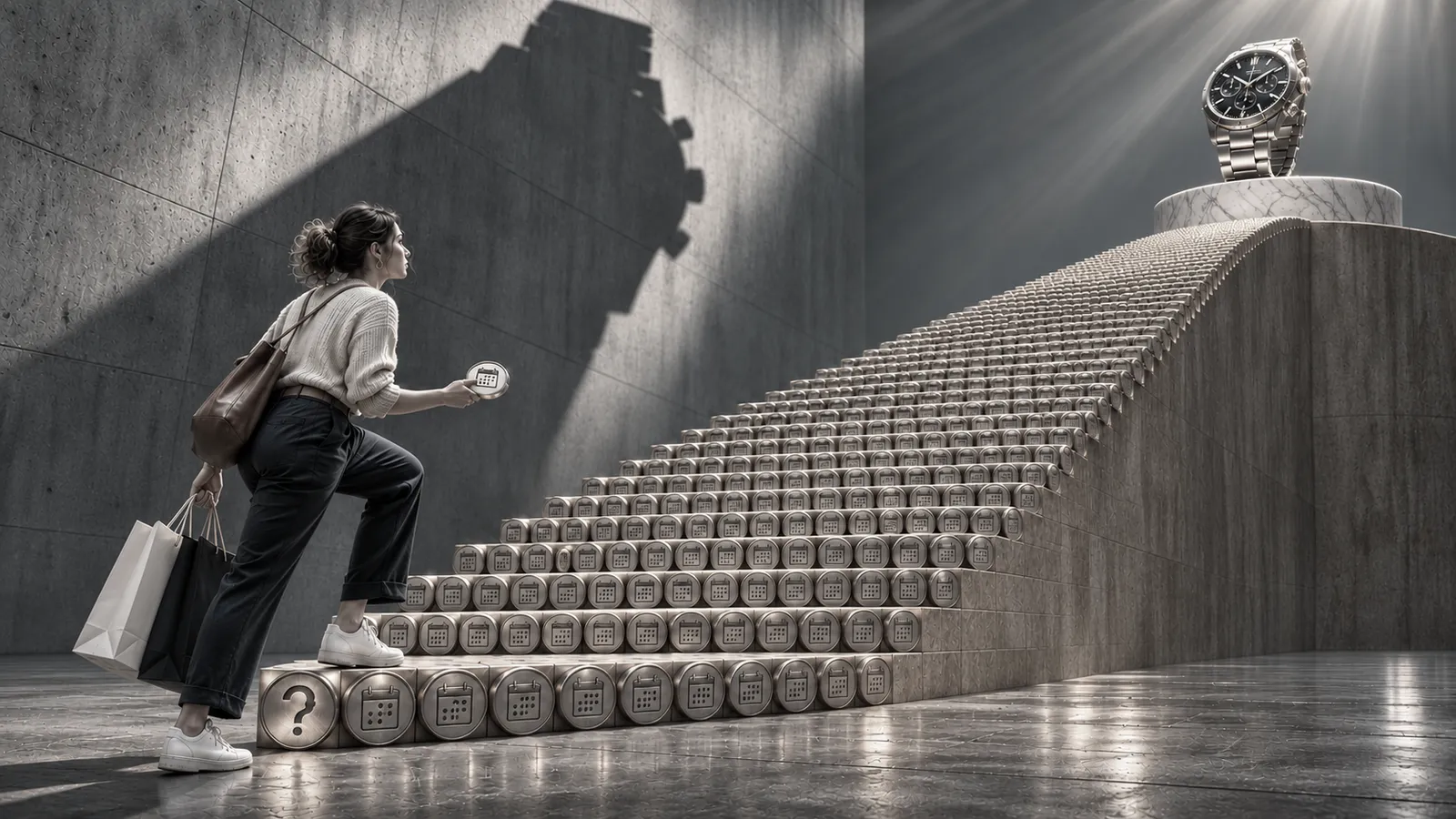
What a classic pricing study, a 2025 retailing experiment and a large transaction panel say about instalments and spending.
Answer to the question
Why does buy now, pay later make us spend more?
Buy now, pay later makes us spend more partly because instalments make a price look smaller. In a 2025 study in the Journal of Retailing, buy now, pay later raised spending more than credit cards did, and showing the price as small instalments explained the gap. A transaction-level working paper also found higher spending after access.
Key takeaways
- In John Gourville's laboratory studies, a cost framed as small recurring charges brought small, ongoing expenses to mind and improved evaluation of the transaction, with the total paid unchanged.
- A 2025 study in the Journal of Retailing found that buy now, pay later raised spending more than credit cards did, and that instalment pricing had no effect with other payment methods.
- In that study, spending rose further with more instalments or a smaller first instalment, and lower perceived expensiveness accounted for the rise.
- Dilip Soman's 2001 experiments found that past payments reduced purchase intention most when the amount was written down and when the money left the account immediately.
- A working paper using transaction-level data found that access to buy now, pay later raised total and retail spending for consumers with and without inferred liquidity constraints.
Show the same total price as a run of small recurring charges and people judge the deal more kindly than when it arrives as one sum. John Gourville found this in laboratory studies across several product categories, where a cost presented as pennies a day was evaluated more favourably though the amount paid was identical. Buy now, pay later builds that frame into the checkout.
Credit and presentation arrive together at the till, which makes them hard to pull apart. The studies below are useful because some of them manage to separate the two.
Buy now, pay later shrinks prices
A cost shown as pennies a day looks smaller because of what it brings to mind. Gourville proposed that the frame works in two steps. A person first recalls a comparison point and then judges the transaction against it. A cost shown as a small recurring charge brings to mind small, ongoing expenses, the sort that fill a week or a month. The same cost shown as one aggregate brings to mind large, infrequent expenses. Set against the first group, the charge looks modest, and set against the second it looks like a heavy purchase. Nothing about the price has changed, and the benchmark does the persuading.
Buy now, pay later is a pennies-a-day frame with a due date attached. A total is split into a few equal parts, and the first part is the figure on screen at the moment of choosing. In the terms of What is mental accounting, the purchase slides out of the account for large, occasional items and into the account for routine outlays, where one more small payment hardly registers.
| How the price appears | What comes to mind | What the research found |
|---|---|---|
| One upfront sum | Large, infrequent expenses | Less favourable evaluation than the small recurring frame |
| Small recurring charges | Small, ongoing expenses | More favourable evaluation and more compliance in laboratory studies |
| Buy now, pay later instalments | A lower sense of expense | Higher spending than with credit cards |
Buy now, pay later raised spending more than credit cards did in a 2025 study in the Journal of Retailing, and the way the price was shown explained the gap. When the price appeared as a series of small instalments, spending rose. When instalment pricing was used with other payment methods, it had no effect on spending. Spending climbed further with more instalments, or with a smaller first instalment.
Rhys Ashby, Shahin Sharifi, Jun Yao and Lawrence Ang combined purchase data with experiments. Both pointed the same way: instalment pricing lowered the perceived expensiveness of the purchase, and that lower perceived expense accounted for the rise in spending.
This bears on a common assumption. A credit card also lets someone buy now and pay later, so access to credit cannot be the whole explanation for the extra spending. The finding fits an account in which presentation does separate work. The older contrast between paying by cash and paying by card, covered in Why Paying by Card Feels Cheaper, concerns how the money moves. Instalment display is a second lever, and it acts on how large the price looks.
Later payments weigh less
A past payment holds back later buying only under some conditions. In two experiments published in 2001, Dilip Soman found that past payments reduced purchase intention most in two cases: when the buyer had to write down the amount paid, and when the money left the account immediately and not later. Writing the amount down is a form of rehearsal, and immediacy is how soon the payment is felt.
Buy now, pay later loosens both by design. Only the first part leaves at the point of sale, and the remainder is scheduled for later. By the logic of Soman's framework, a payment that is less immediate and less rehearsed should weigh less on the next purchase, which would leave more room to keep spending, though his experiments never involved instalment plans.
Dan Ariely gives the underlying tension a plain description in Predictably Irrational. He treats overspending as a self-control problem, in which people give up long-term goals for immediate gratification. His own remedy is a card that lets its owner set spending limits by category in advance. It is a proposal, offered without data. Buy now, pay later pulls the other way, since the reward arrives today and the cost is cut into pieces that arrive later, the same imbalance that drives the purchases described in Why Impulse Buys Happen Without a List.
Spending stays in retail
Transaction records tell a similar story. A working paper by Marco Di Maggio, Emily Williams and Justin Katz built a large panel of buy now, pay later users from transaction-level data, then used the roll-out of the service to see how people respond to easier access to credit. Access raised both total spending and the share of spending that went to retail. The authors report that the size of the rise is too large for standard intertemporal and static substitution effects to explain.
The result held for consumers with and without inferred liquidity constraints, which matters because a simple story says the extra spending comes from people short of cash who could now buy what they needed. The authors read the pattern as a liquidity flypaper effect, in which the extra retail liquidity from buy now, pay later sticks where it hits, and they judge that reading more consistent with the data than a standard lifecycle model of constrained consumers.
Common questions
Why does buy now, pay later make us spend more?
Splitting a price into instalments lowers how expensive a purchase seems. A 2025 study in the Journal of Retailing found that buy now, pay later raised spending more than credit cards did, and that instalment pricing had no such effect with other payment methods.
Is buy now, pay later the same as a credit card?
Both let a shopper buy now and pay later, but the research treats them differently. In the 2025 study, spending was higher with buy now, pay later than with credit cards, and the series of small instalments drove the difference.
Does the pennies-a-day idea apply to buy now, pay later?
It is closely related. In John Gourville's 1998 laboratory studies, a cost framed as small recurring charges brought small expenses to mind and improved evaluation of the transaction. Instalments use the same logic at the checkout.
Do only people short of cash spend more with it?
A working paper using transaction-level data found that access to buy now, pay later raised spending for consumers with and without inferred liquidity constraints, so the rise was not limited to one group.
Sources
Ariely, D. Predictably Irrational. Seed book; vault hub Books/Predictably Irrational.
Gourville, J. T. (1998). Pennies-a-day: The effect of temporal reframing on transaction evaluation. Journal of Consumer Research, 24(4), 395-408. doi:10.1086/209517 https://doi.org/10.1086/209517
Soman, D. (2001). Effects of payment mechanism on spending behavior: The role of rehearsal and immediacy of payments. Journal of Consumer Research, 27(4), 460-474. doi:10.1086/319621 https://doi.org/10.1086/319621
Ashby, R., Sharifi, S., Yao, J., & Ang, L. (2025). The influence of the buy-now-pay-later payment mode on consumer spending decisions. Journal of Retailing, 101(1), 103-119. doi:10.1016/j.jretai.2025.01.003 https://doi.org/10.1016/j.jretai.2025.01.003
Di Maggio, M., Williams, E. C., & Katz, J. (2022). Buy now, pay later credit: User characteristics and effects on spending patterns. NBER Working Paper 30508. doi:10.3386/w30508 https://doi.org/10.3386/w30508