Why Does One Bad Review Hurt So Much
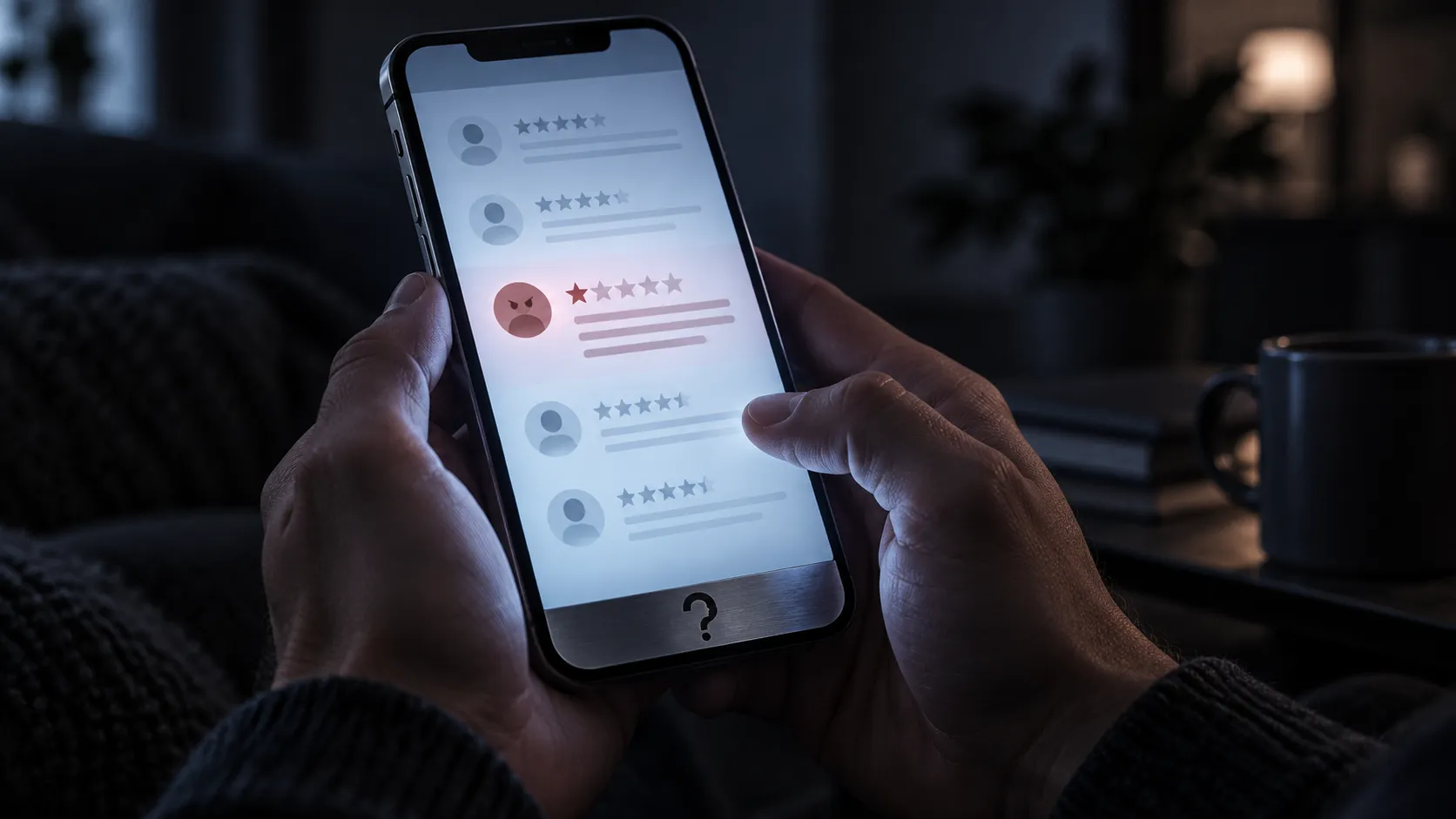
The saying that one bad review outweighs five good ones rests on a real pattern. Psychologists have documented it widely, and one study of book sales found that one-star reviews moved sales further than five-star reviews. The five is a figure of speech, and research on shoppers suggests the effect weakens when they already know the brand.
Answer to the question
Does one bad review outweigh five good ones?
Not as a measured ratio. Negativity bias is well documented, and in a 2006 study of online book reviews one-star ratings moved sales further than five-star ratings. The five in the saying is a figure of speech, and consumer research from 1991 and 2002 suggests the effect weakens when buyers already know the brand.
Key takeaways
- Baumeister and colleagues (2001) reviewed the evidence under the title "Bad Is Stronger Than Good" and wrote that hardly any exceptions can be found across the areas they covered.
- Rozin and a co-author (2001) split negativity bias into four parts. Negativity dominance, where a mixture is judged more negatively than its parts predict, is the one that matches the saying about reviews.
- Chevalier and Mayzlin (2006) found that book reviews at two retailers were overwhelmingly positive, and that one-star reviews had a larger impact on relative sales than five-star reviews.
- Herr and two co-authors (1991) found word of mouth lost force when people already held an impression of a brand, and explained the negativity effect through an accessibility-diagnosticity model.
- Ahluwalia (2002) wrote that the robustness of the negativity effect in consumer environments may be overstated, because shoppers often know the brands they judge.
The saying that one bad review outweighs five good ones is half right. Negativity bias is well documented, and one-star reviews moved book sales further than five-star ones, but the five is rhetoric.
Negativity bias, the habit of giving bad information more weight than equally strong good information, is one of the best-supported patterns in psychology, and the best-known study of online reviews and sales supports its direction. In consumer settings, though, negativity bias depends on who is reading and what they already believe about the brand.
Is the saying backed by evidence?
"Hardly any exceptions (indicating greater power of good) can be found." That line ends the abstract of a 2001 review that Roy Baumeister and three colleagues titled "Bad Is Stronger Than Good". They reported that the greater power of bad events over good ones turns up in everyday events, major life events, close relationships and learning. In the same year Paul Rozin and a co-author broke negativity bias into four parts: negative potency, steeper negative gradients, negativity dominance and negative differentiation. Negativity dominance is the part that matches the saying about a bad review, since a mixture of good and bad elements is judged more negatively than the sum of its parts would predict.
The idea has travelled into popular books. Nir Eyal's Indistractable (2019) lists negativity bias among four reasons satisfaction does not last, and it quotes "bad is stronger than good" without naming an author (pp. 30 to 31). The evidence sits in the 2001 review, and across the areas it covered the pattern held: bad outweighed good, with hardly any exceptions. That is the documented core of negativity bias. What the review does not supply is a price list for any one market.
One star against five
Reviews at Amazon.com and BarnesandNoble.com were overwhelmingly positive in a 2006 study by Chevalier and Mayzlin, which set book reviews against sales at the two sites. An improvement in a book's reviews raised its relative sales at that site, and one-star reviews had a larger impact than five-star reviews. Because the reviews skewed so positive, one-star reviews were the rarer kind, and the larger impact belonged to the rarer kind.
That is the nearest thing to the saying in sales data: a bad review costs more than a good review earns. The comparison is between the two ends of the star scale, and the abstract reports no exchange rate between them, so the "five" in the saying is rhetoric. Books sold through two retailers are also a narrow base for a kettle, a restaurant or a software subscription.
A bad rating costs more than a good rating earns, and the studies give no exchange rate.
Word of mouth was set against printed product information in a 1991 experiment by Paul Herr and two co-authors. Face-to-face word of mouth was more persuasive than print, and in a second experiment its effect weakened or disappeared when people already held an impression of the brand. The authors argue that three separate judgement effects, vividness, perseverance and negativity, can be explained by an accessibility-diagnosticity model, in which information is used when it comes easily to mind and when it seems to help the judgement at hand.
Applied to a bad review, that account suggests a reason for the asymmetry other than pain: a specific complaint can read as a better guide to how a product will fail than general praise reads as a guide to how it will succeed. The link to reviews is inference, since neither paper tested it. Rozin's negativity dominance describes the outcome of negativity bias, and diagnosticity is one candidate for the cause.
Does it hold for known brands?
Shoppers often know the brand, and that is the gap Rohini Ahluwalia's 2002 paper points to. Earlier studies, she notes, mostly had people judge unknown or hypothetical targets with the aim of forming an accurate impression, whereas shoppers may be trying to manage an impression or defend a view they already hold. Her abstract states the concern directly, that "its robustness in consumer environments may be overstated", and two experiments set out to find when negativity bias appears and when it is less likely.
Both consumer papers point to the same place to look. Herr and colleagues found word of mouth losing force when a prior impression of the brand existed, and Ahluwalia's concern is that real buyers arrive with brands they already know. Familiarity with the brand is the variable that changes the picture.
The pattern is real, but it has conditions, and the conditions are the part a seller can use. For a seller, the reading has three parts. A one-star review is the bad review shown to move sales, which makes it the one to read first. The ratio of five to one has no support, because the data compare directions and not exchange rates. And a single bad review is likeliest to carry its full weight for a product or seller the buyer does not yet know, since familiarity is where both consumer papers find the effect shrinking.
Common questions
Does one bad review outweigh five good ones?
Not as a measured ratio. Negativity bias is well documented, and one-star reviews moved book sales further than five-star reviews in a 2006 study, but no source puts a number like five to one on it.
What is negativity bias?
Negativity bias is the tendency for negative information to have more impact than positive information of equal strength. Baumeister and colleagues reviewed it in 2001, and Rozin and a co-author divided it into four parts the same year.
Does negativity bias apply to every shopper?
Probably not equally. A bad review may count for less when the buyer already knows the brand. Ahluwalia (2002) questioned how robust the negativity effect is in consumer settings, where buyers often know the brand and have goals other than accuracy.
Sources
Baumeister, R. F., Bratslavsky, E., Finkenauer, C., & Vohs, K. D. (2001). 'Bad is stronger than good.' Review of General Psychology, 5(4), 323-370. doi:10.1037/1089-2680.5.4.323.
Rozin, P., & Royzman, E. B. (2001). 'Negativity bias, negativity dominance, and contagion.' Personality and Social Psychology Review, 5(4), 296-320.
Chevalier, J. A., & Mayzlin, D. (2006). 'The Effect of Word of Mouth on Sales: Online Book Reviews.' Journal of Marketing Research, 43(3), 345-354. doi:10.1509/jmkr.43.3.345.
Herr, P. M., Kardes, F. R., & Kim, J. (1991). 'Effects of Word-of-Mouth and Product-Attribute Information on Persuasion: An Accessibility-Diagnosticity Perspective.' Journal of Consumer Research, 17(4), 454-462. doi:10.1086/208570.
Ahluwalia, R. (2002). 'How Prevalent Is the Negativity Effect in Consumer Environments?' Journal of Consumer Research, 29(2), 270-279. doi:10.1086/341576.
Eyal, N., with Li, J. (2019). Indistractable: How to Control Your Attention and Choose Your Life. Bloomsbury Publishing, Ch. 4, pp. 30-31.