Why Explaining Your Choice Spoils It
Writing down why you like something can pull you away from what you actually like. The jam study behind the idea, what followed, and when to stop explaining.
Key takeaways
- In Timothy Wilson and Jonathan Schooler's 1991 studies, students who analysed why they liked jams agreed less with expert ratings than students who simply tasted.
- In a 1993 follow-up, people who analysed their reasons chose a different poster and were less satisfied with it a few weeks later.
- The jam study has not been directly replicated at modern standards; a 1999 re-examination supported the effect but proposed a different mechanism.
- For things you will mainly experience, be wary of a long list of reasons; for things you will mainly use, make the list.
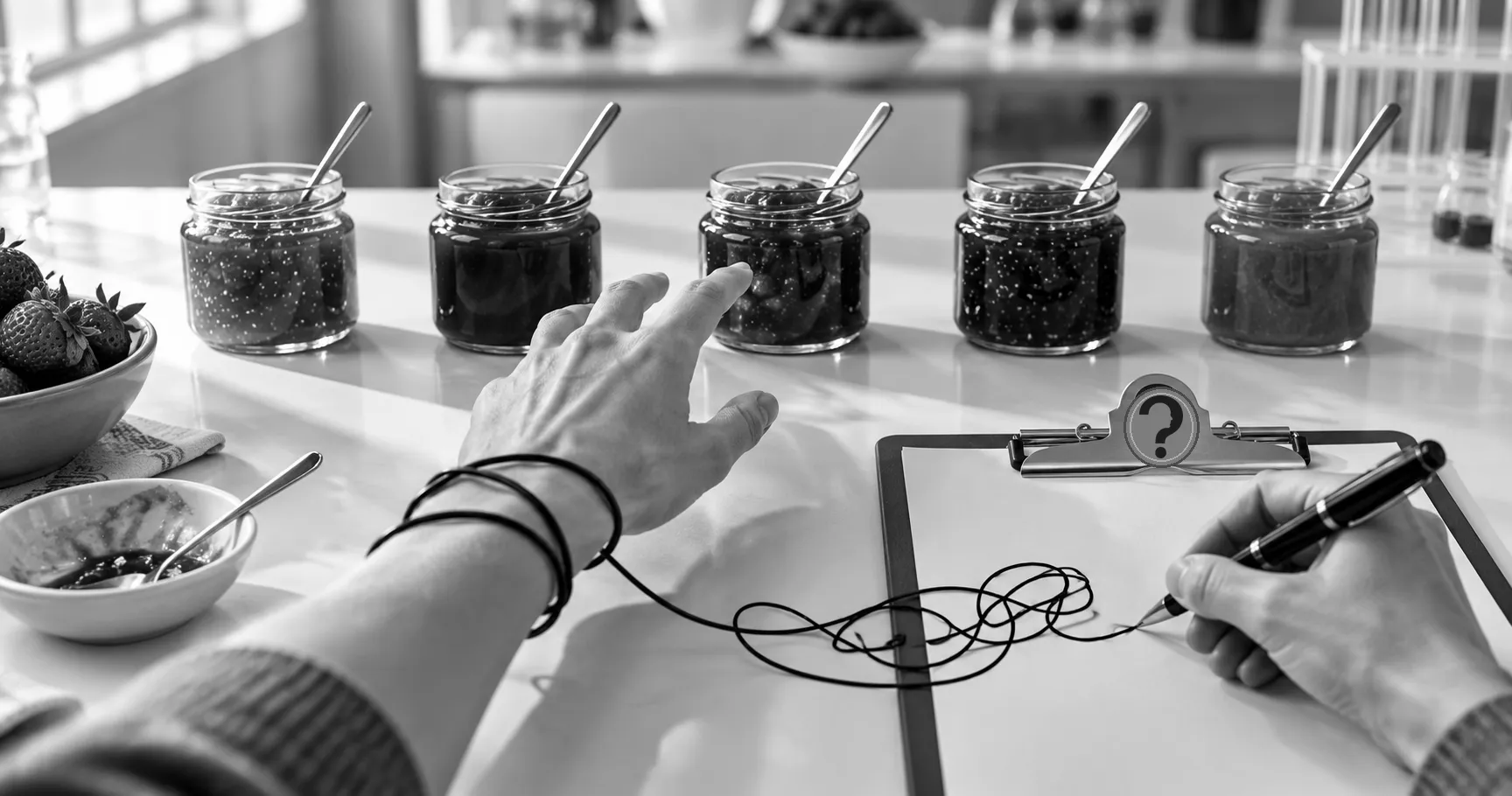
Picture several jars of strawberry jam on a table in a university laboratory. A student tastes them in turn and rates how much she likes each one. In the next room, another student does the same, with one extra instruction: before rating, write down why you feel the way you do about each jam. The second student is doing what most of us think careful choosing looks like. She is explaining her choice. And on the evidence of the experiment she is part of, her ratings are about to drift away from the experts'. Her neighbour, who simply tastes and rates, will end up closer to them.
The jam study, and what the researchers actually measured
The experiment was published in 1991 by Timothy Wilson and Jonathan Schooler in the Journal of Personality and Social Psychology, under the title "Thinking too much". Their question was whether reflecting on the reasons for a preference improves it or damages it.
They needed a yardstick, because "worse" taste is hard to define. They used experts. Students' ratings of the jams were compared with experts' ratings of the same jams. The abstract states the result plainly: students who analysed why they felt the way they did agreed less with the experts than students who did not.
Nothing about the jam changed between the two rooms. What changed was that one group had been asked to put taste into words, and the words pulled their ratings away from the experts' judgement, and away from the ratings of students who simply tasted.
A second study moved from jam to something that matters more: which college courses to take. Students who analysed their reasons, and students who were asked to evaluate every attribute of every course, both made choices that matched expert opinion less closely than students in a control group who simply chose.
The authors' explanation is about attention. Explaining a preference pushes people towards reasons that are easy to put into words, and those are not always the reasons that matter. A jam that is easy to describe is not necessarily a jam that tastes good. Evaluating every attribute had a different effect: it flattened people's judgements, so they discriminated less between good and bad options.
The target is narrow. One specific kind of thinking, explaining a gut preference in words, can replace the preference with something easier to say.
In matters of taste, that kind of thoroughness can talk you out of what you liked.
Why explaining a preference can quietly replace the preference itself
The finding fits a wider body of work on how little access people have to the causes of their own choices. Philip Graves builds a book on that idea. In Consumer.ology, a market researcher's critique of market research, he argues that the reasons people give for what they buy are constructed after the fact, and that asking consumers to explain themselves turns them into research subjects whose answers describe a situation that does not exist.
The jam study is his best evidence for a bolder claim. It is one thing to say introspection is inaccurate. It is another to say that explaining can damage the preference itself, and that is what Wilson and Schooler's results suggest.
A follow-up showed that the damage can last. In 1993 Wilson and five colleagues let people choose a poster to take home. Some first analysed their reasons for liking each poster. Those who analysed chose a different kind of poster from those who did not, and when they were contacted a few weeks later, they were less satisfied with the one they had taken home.
The authors' account is that explaining highlighted features that were easy to put into words, and that the original, harder-to-describe evaluation came back once the poster was on the wall.
That is the consumer version of the problem. The shopper who talks herself into the item with the clearest list of features may find that her own, wordless preference returns after the purchase, and that it points elsewhere.
Graves draws a practical inference for his own trade: a long interview is worse than a short one, because the longer people are asked to explain, the further the answers drift from what they would actually do. That inference is his. It follows from the evidence, but nobody has tested it directly, and it should be read as an argument rather than a finding.
What the follow-up research adds, and what it leaves open
We located no direct replication of the jam study at modern standards, and no large preregistered or multi-laboratory test of it. That does not mean it is wrong. It means its size and reliability are not settled.
What does exist is a conceptual re-examination. In 1999 R. S. Tordesillas and Shelly Chaiken re-ran the course-choice paradigm with modified procedures. They also found that introspection changed decisions, but they proposed a different reason: people who introspected processed the information less and distinguished less between important and unimportant details. That is support for the effect and a challenge to its explanation, which is still argued over.
The closest well-tested cousin is verbal overshadowing, the finding that describing a face you have seen can make you worse at recognising it later. A large registered replication published in 2014 found that effect to be real, though smaller than first reported and sensitive to timing. It is a different task, memory for faces rather than preferences among products, so it lends the jam study no direct support. It does show that putting a perception into words can interfere with it.
It is also worth stating what the research does not support. It does not support the opposite slogan, that you should stop thinking and let your unconscious decide. That claim, the so-called unconscious thought advantage, was tested in a large replication with 399 participants in 2015, which found no evidence for it. Thinking too much in one particular way can hurt. Thinking less is not a guaranteed remedy.
So the defensible position is a narrow one. A handful of studies suggest that explaining a taste-based preference can shift it, and one suggests the shift can leave people less satisfied later. There is no evidence that this applies to every decision, and no direct replication of the original.
When to stop explaining your choice and simply choose
The practical question is when explaining helps and when it gets in the way. The studies point to a distinction worth using.
For choices made mostly on taste or feel, such as food, a poster, a fragrance or a sofa that you will see every day, a long list of reasons is a risk. The things you can put into words are often not the things that will decide whether you enjoy the purchase. The jam and poster studies are both in this territory.
For choices made on criteria that can be stated and checked, such as a mortgage rate, a warranty or a car's fuel consumption, explaining is less likely to be the problem, though the course-choice study is a reminder that even practical choices carry some taste. There the words are mostly the reasons, and writing them down is how you avoid being swayed by a pleasant showroom.
A simple test follows from that distinction, though no study has tried it. Before deciding, ask whether the thing you are choosing is something you will mainly experience or mainly use. If you will mainly experience it, try it, notice your reaction, and be wary of the version of you that wants to justify the reaction in a list. If you will mainly use it, make the list.
Market researchers who ask customers why they bought something face a sharper version of the problem. The answers are real answers to a question, but they may not describe what drove the purchase, and asking may change how the customer feels about it. Watching what people choose remains a better guide than asking them to explain.
The student who wrote down her reasons for each jam was trying to be thorough. In matters of taste, that kind of thoroughness can talk you out of what you liked.
Common questions
Does thinking about your reasons make you choose worse?
For taste-based choices, it can. In Wilson and Schooler's 1991 studies, students who analysed why they liked jams agreed less with expert ratings, and students who analysed reasons for course choices matched expert opinion less closely. The effect has not been directly replicated at modern standards.
Why would explaining a preference change it?
Explaining pushes attention towards reasons that are easy to put into words, which are not always the ones that matter. In a 1993 follow-up, people who analysed their reasons chose a different poster and were less satisfied with it a few weeks later.
Should I trust my gut instead?
Not as a general rule. A large 2015 replication found no evidence that leaving decisions to unconscious thought improves them. The evidence suggests being wary of over-explaining taste-based choices, not abandoning deliberate thought.
Sources
Wilson, T. D., & Schooler, J. W. (1991). 'Thinking too much: introspection can reduce the quality of preferences and decisions.' Journal of Personality and Social Psychology, 60(2), 181-192. doi:10.1037/0022-3514.60.2.181. Abstract read 2026-10-11: students who analysed reasons agreed less with experts' ratings of jams; reasons analysis and rating all attributes both reduced correspondence with expert opinion in course choice. Sample sizes not printed because the full text was not read.
Wilson, T. D., Lisle, D. J., Schooler, J. W., Hodges, S. D., Klaaren, K. J., & LaFleur, S. J. (1993). 'Introspecting about reasons can reduce post-choice satisfaction.' Personality and Social Psychology Bulletin, 19(3), 331-339. doi:10.1177/0146167293193010.
Tordesillas, R. S., & Chaiken, S. (1999). 'Thinking too much or too little? The effects of introspection on the decision-making process.' Personality and Social Psychology Bulletin, 25(5), 625-631. doi:10.1177/0146167299025005007.
Alogna, V. K., and colleagues (2014). 'Registered replication report: Schooler and Engstler-Schooler (1990).' Perspectives on Psychological Science, 9(5), 556-578. doi:10.1177/1745691614545653. Face memory, cited only as the adjacent, better-tested paradigm.
Nieuwenstein, M. R., and colleagues (2015). 'On making the right choice: a meta-analysis and large-scale replication attempt of the unconscious thought advantage.' Judgment and Decision Making, 10(1), 1-17. doi:10.1017/s1930297500003144. 399 participants; no evidence for the advantage.
Graves, P. (2013). Consumer.ology, revised edition. Nicholas Brealey Publishing. Read in full by this publication, with a reliability audit.
A note on scope: no direct replication of the jam study was located. The experience-or-use test is this publication's suggestion.