Why is doing nothing suddenly so popular?
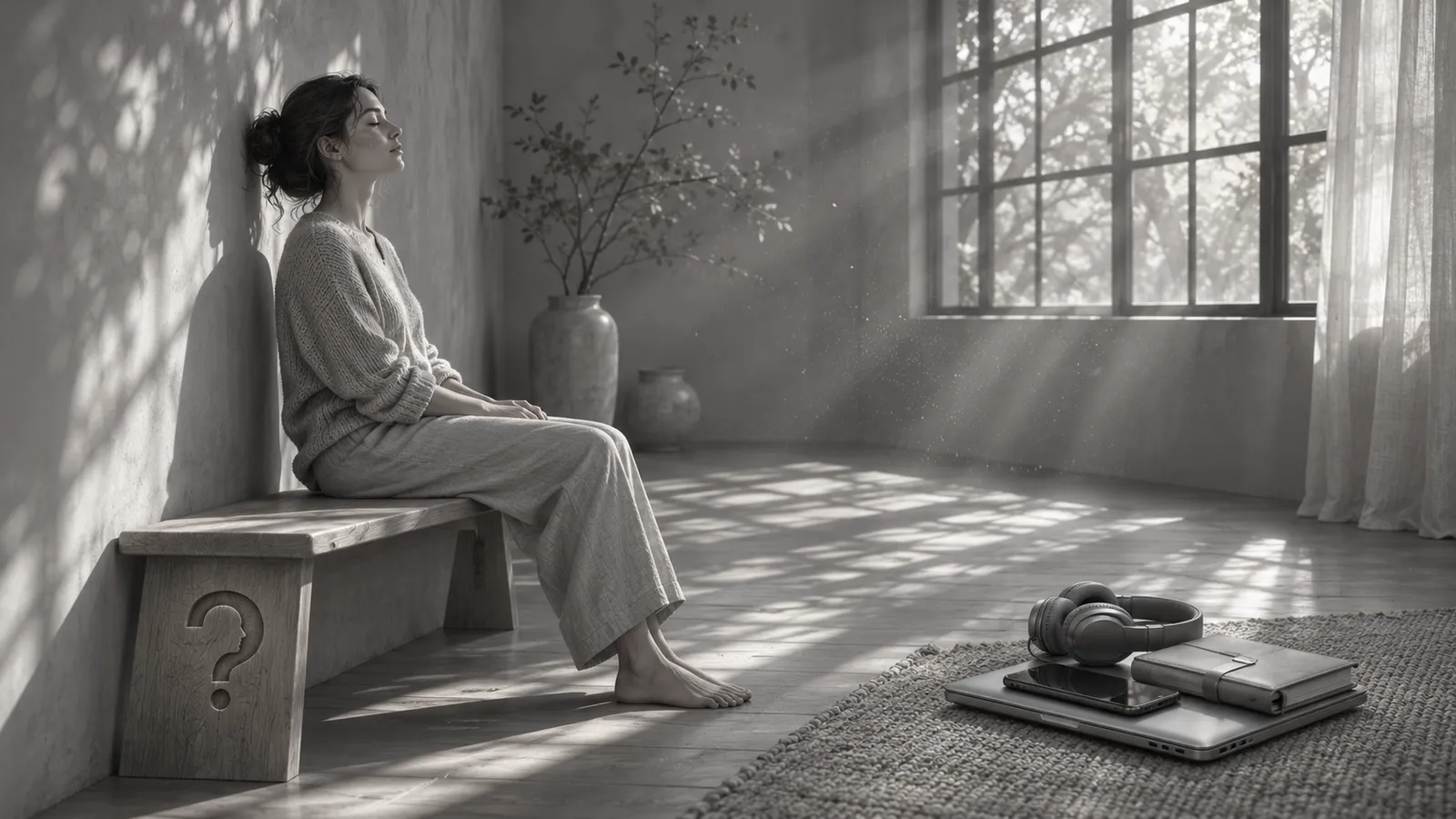
What experiments on idleness, a study of busyness as status and a seed book on boredom say about why doing nothing now has a name and an audience.
Answer to the question
Why is doing nothing suddenly so popular?
Doing nothing is popular because it has become a chosen, named practice at a time when busyness is read as status. Research shows people dislike unfilled time and need a reason to stop, so a label such as niksen supplies the permission. The studies explain both the pull and the resistance.
Key takeaways
- In one of eleven experiments reported by Wilson and colleagues in 2014, 12 of 18 men and 6 of 24 women gave themselves a mild shock rather than spend fifteen minutes alone with their thoughts, as described by the University of Virginia.
- Hsee, Yang and Wang proposed in 2010 that people dislike being idle but need a justification to be busy; in two experiments a flimsy justification was enough to keep people occupied.
- Bellezza, Paharia and Keinan found that people attribute higher status to busyness because they infer competence, ambition and demand, and the effect depended on cultural values.
- Gazzaley and Rosen, in The Distracted Mind, treat boredom as wanting to be engaged while unable to be, one of the internal forces that pull people towards their devices.
- Niksen is a Dutch word for doing nothing on purpose; a name and a reason may be what separates it from the idleness the experiments studied.
This article is general information about research on idleness and busyness. It is not wellbeing, medical or psychological advice. If you have concerns about your wellbeing, speak to a GP or another qualified professional. Medical review: Reja Batool.
Twelve of 18 men and six of 24 women gave themselves a mild electric shock rather than spend fifteen minutes doing nothing, alone with their thoughts. The figures come from one of eleven experiments reported by Timothy Wilson and colleagues in Science in 2014, as described by the University of Virginia, and every participant had first said they would pay to avoid being shocked again. Against that background, the current popularity of doing nothing looks odd. A lull that people in the laboratory filled with a shock is now being scheduled, shared and sold as a practice with its own name.
The name is niksen, a Dutch word for sitting idle, gazing out of a window or letting the mind wander without aiming at a result. News features present it as a purposeful way of doing nothing, and that is the point of the label: it turns an empty stretch of time into something a person can say they chose. The framing matters more than it looks, because the research on idleness keeps returning to permission.
Why is doing nothing so hard for so many people?
Doing nothing, in the sense of sitting with nothing to do but think, was unpleasant for many people in those experiments. Participants spent between six and fifteen minutes alone, depending on the study, and the authors concluded that being alone with one's thoughts appears to be an unpleasant experience, with the men in the sample more likely than the women to choose the shock. The studies were run in plain rooms with no phone, no book and no one to talk to, which is precisely the condition that a modern day almost never produces.
Adam Gazzaley and Larry Rosen give the pattern a working definition in The Distracted Mind. Boredom, as they use the term, is not an empty diary but the wish to be engaged combined with being unable to engage, which is why a person surrounded by content can still feel it. They treat boredom as one of the internal forces that pull people towards their devices, and they pair it with an external one, how easy the device is to reach. The room in Wilson's experiments had no exit. A train platform has one in every pocket, and the same pull sits behind the habit examined in Why You Cannot Stop Scrolling.
Doing nothing has a second difficulty, and it concerns reasons. Christopher Hsee, Adelle Yang and Liangyan Wang proposed in 2010 that people dislike being idle but need a justification to be busy. In two experiments, people who were given no justification preferred idleness, while even a flimsy justification was enough to keep them busy. The authors suggest that many of the goals people believe they are pursuing may serve mainly as justifications for staying occupied. On that account, the default is neither rest nor work but whatever comes with a reason attached, and doing nothing rarely does.
Why did busyness become a status symbol at all?
Time has carried status before. Thorstein Veblen argued in 1899 that leisure, meaning the visible non-productive use of time, was an early way of showing that a household could afford it, and that goods later took over as the main signal once people had to impress strangers. Conspicuous leisure was the older currency.
Research on the conspicuous consumption of time reports a reversal in contemporary settings. In studies published in the Journal of Consumer Research in 2017, Silvia Bellezza, Neeru Paharia and Anat Keinan found that people attribute higher status to busyness and a lack of leisure time. Observers infer that a busy person has desirable traits such as competence and ambition and is in demand in the job market. The effect depended on cultural values, including how socially mobile people perceive their society to be, so it is a pattern with conditions and not a universal rule.
When busyness is the default signal, a person who is visibly unhurried sends a signal that stands out, much as the understated cues traced in Why We Read Quiet Logos as Status do. That reading of the studies has not been tested directly, but it fits the timing: a practice built around doing nothing gains attention in a setting where nearly everyone is expected to say they are busy.
| Reading of an empty stretch of time | What it says | Where it comes from |
|---|---|---|
| Boredom | Wanting to be engaged and being unable to be | Gazzaley and Rosen, The Distracted Mind |
| Unpleasant solitude | Many chose a shock over fifteen minutes alone | Wilson and colleagues, 2014 |
| Idleness aversion | People avoid idleness unless given a reason | Hsee, Yang and Wang, 2010 |
| Busyness as status | Busyness is read as competence and demand | Bellezza, Paharia and Keinan, 2017 |
| Niksen | Chosen idleness with no goal | News descriptions of a Dutch practice |
What changes when doing nothing becomes a chosen practice?
Three things differ between the laboratory room and the practice now spreading. The first is a name. Hsee's finding that a thin reason keeps people busy suggests that a thin reason could also let them stop, and a short foreign word with a one-line description is about as thin as a reason gets. The experiments did not test that extension, which is why it is offered here as a reading and not a result.
The second is an audience. Nobody watched the participants in Wilson's rooms, whereas a chosen stretch of nothing is usually described to other people. When busyness signals demand, a person who can stop and say so shows that they control their own time, which is a modern form of the older leisure signal. Bellezza and colleagues found that the status of busyness rests on inferences about competence and demand, so any practice that sits against it borrows meaning from it.
Where does the phone fit into all of this today?
The third difference is the exit. In the laboratory the exit was removed for everyone, because the room held no phone, no book and no one to talk to. In daily life the exit is a choice made again and again, and Gazzaley and Rosen's pairing of an inner pull with an easy-to-reach device explains why doing nothing now so often means leaving the phone alone. A phone is also the quickest answer to the question of what to do next, and niksen replies by offering nothing as a legitimate answer.
The cost of switching is part of the same picture. A mind that has just changed task carries some of the last one into the next, as described in Why Attention Residue Lingers at Work, so a stretch with no switching has a different texture from one that is cut up by checks. A person who leaves the phone in another room removes the same exit the experimenters removed, and is left with the unfilled stretch of time that Hsee's findings suggest needs a reason to be worth sitting through.
Common questions
Why is doing nothing suddenly so popular?
Doing nothing has been given a name and a reason at a time when busyness is read as status. Research shows people dislike unfilled time and need a justification to stop, and a label such as niksen supplies one.
What is niksen?
Niksen is a Dutch word for doing nothing on purpose, such as sitting idle, looking out of a window or letting the mind wander without trying to achieve anything.
Why do people dislike being alone with their thoughts?
In Wilson and colleagues' 2014 experiments, many participants found fifteen minutes alone with nothing to do unpleasant, and some chose a mild shock over it. Gazzaley and Rosen describe boredom as the wish to be engaged without being able to engage.
Is busyness really a status symbol?
Studies by Bellezza, Paharia and Keinan found that people attribute higher status to busyness because they infer competence, ambition and demand. The effect depended on cultural values such as perceived social mobility.
Sources
Gazzaley, A., & Rosen, L. D. The Distracted Mind: Ancient Brains in a High-Tech World. Seed book; vault hub Books/The Distracted Mind.
Wilson, T. D., Reinhard, D. A., Westgate, E. C., Gilbert, D. T., Ellerbeck, N., Hahn, C., Brown, C. L., & Shaked, A. (2014). Just think: The challenges of the disengaged mind. Science, 345(6192), 75-77. doi:10.1126/science.1250830 https://doi.org/10.1126/science.1250830
Hsee, C. K., Yang, A. X., & Wang, L. (2010). Idleness aversion and the need for justifiable busyness. Psychological Science, 21(7), 926-930. doi:10.1177/0956797610374738 https://doi.org/10.1177/0956797610374738
Bellezza, S., Paharia, N., & Keinan, A. (2017). Conspicuous consumption of time: When busyness and lack of leisure time become a status symbol. Journal of Consumer Research, 44(1), 118-138. doi:10.1093/jcr/ucw076 https://doi.org/10.1093/jcr/ucw076
University of Virginia College of Arts and Sciences (2014). Doing something is better than doing nothing for most people, study shows. https://as.virginia.edu/node/563
Gottfried, S. (2019). What is niksen. News feature, published 12 July 2019. https://www.time.com/5622094/what-is-niksen/