Why Ten Quiet Minutes Feel So Long
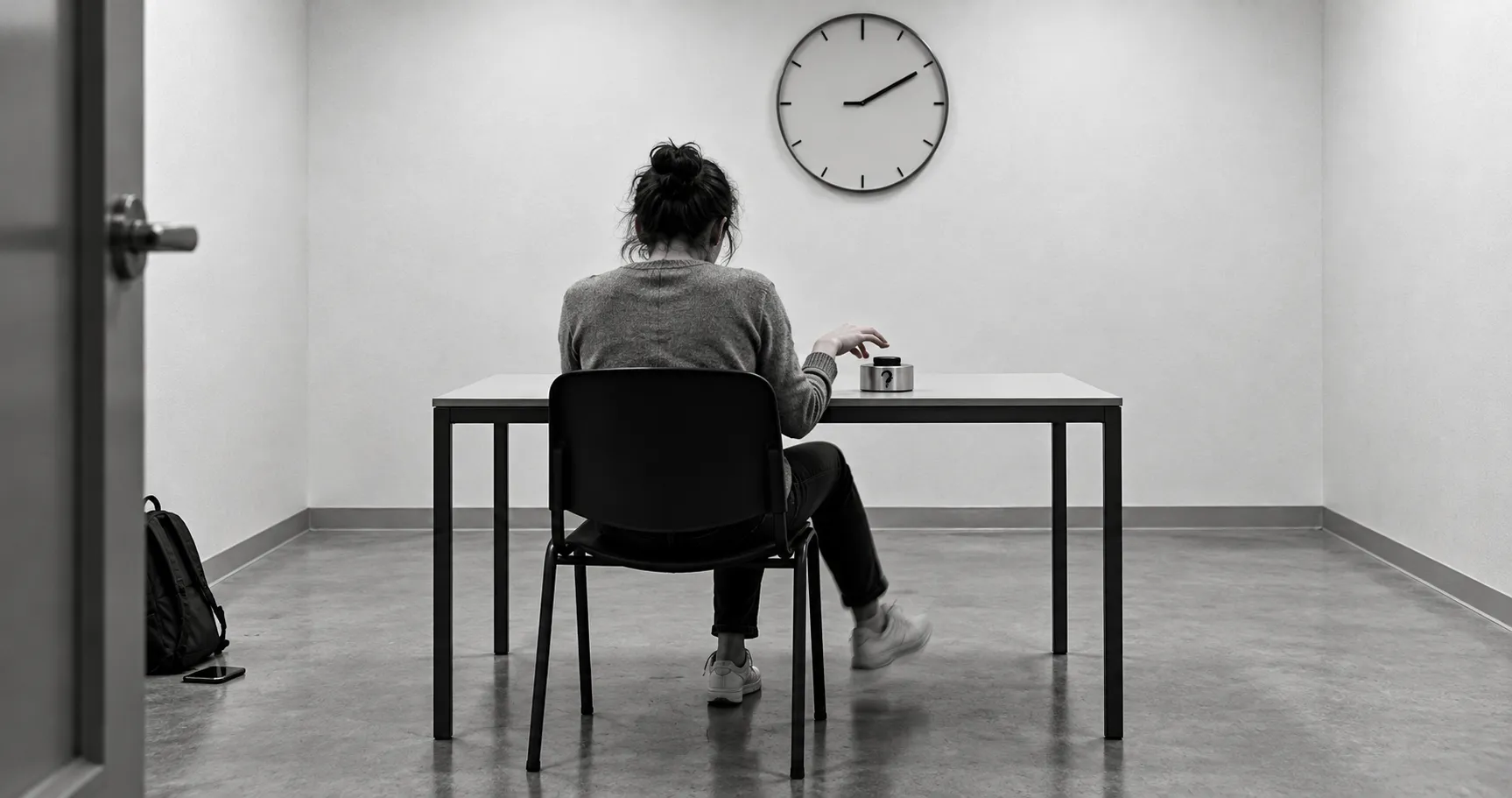
Most people find a few quiet minutes alone with their thoughts harder than they expect. The famous shock result says less than the headlines claimed.
Key takeaways
- In eleven studies published in Science in 2014, Timothy Wilson and colleagues found people did not enjoy six to fifteen minutes alone with nothing to do but think.
- In one study, 12 of 18 men and 6 of 24 women gave themselves a shock they had said they would pay to avoid.
- A 2014 commentary by Kieran Fox and colleagues noted that 57 per cent never shocked themselves, and that 14 of the 18 who did described curiosity.
- A 2019 study of 2,557 people in eleven countries, led by Nicholas Buttrick, found doing beat thinking for pleasure in every country, with the differences between countries explained by individual traits.
A student leaves her phone and bag at the door, sits down in a plain room with a chair and a table, and is told to spend the next few minutes entertaining herself with her thoughts. No reading, no writing, no getting up. Most people imagine that would be easy, even pleasant: a few quiet minutes with nothing asked of them. For most of the people who actually tried it, it was neither.
That room became one of the best-known experiments in recent psychology, mostly because of a button in it. The story of what the button meant has taken years to tell properly.
2014, eleven studies and an empty room
In July 2014 Timothy Wilson and colleagues, including Daniel Gilbert, published eleven studies in Science. The basic task was the one above. Participants spent between six and fifteen minutes alone with nothing to do but think, and then reported how it had gone.
On average they did not enjoy it. When the same people compared quiet minutes of thinking with ordinary external activities, they rated the activities as much more enjoyable, and in one study there was almost no overlap between the two sets of ratings. Many could not keep to the rules: depending on the study, between 32 and 54 per cent admitted doing something they had been asked not to, such as using their phones.
The design is worth noticing, because it avoids the usual problem with questions about how people like to spend time. Asking people whether they enjoy thinking invites a flattering answer. Putting them in a room and asking afterwards produces a report about something they have just done. That is still a self-report, but it is a report about a particular fifteen minutes rather than a general self-image.
The finding fitted a great deal of everyday experience. People reach for their phones in queues, on platforms and in lifts, in exactly the gaps the experiment recreated. Adam Alter retells the study in Irresistible, in his chapter on why devices are so hard to put down, as evidence that people will avoid being alone with their thoughts. Zelana Montminy's Finding Focus uses it to recommend scheduling time for unstructured thinking.
Those are two different uses of the same result. Alter treats the difficulty as an explanation of a habit. Montminy treats it as a reason to practise the thing that is difficult. Both are reasonable readings of eleven studies showing that quiet minutes are harder than they sound.
What made the paper famous was neither of those readings. It was one study near the end.
2014, the button that made headlines
In the tenth study, participants first received a mild electric shock and rated how unpleasant it was. Those who said they would pay money to avoid receiving it again were then left alone for fifteen quiet minutes with nothing to do but think, and with a button that would deliver the same shock if they pressed it.
Twelve of the eighteen men pressed it at least once. So did six of the twenty-four women. That is, people who had just said they would pay to avoid a shock chose to give themselves one rather than sit quietly.
The result travelled fast, usually in a sharper form than the paper gave it. Headlines said people would rather be electrocuted than be alone with their thoughts. The sentence is memorable, and it is a little more than the study shows.
Two things about the numbers are worth keeping in view. The groups were small, eighteen men and twenty-four women, so a few people either way would change the percentages a lot. And the difference between men and women was large, which the headline version almost always dropped.
A person who shocks herself once during fifteen quiet minutes has done something surprising. She has not necessarily shown that her thoughts felt worse than pain.
There is also the question of what pressing a button once tells you. A person who shocks herself once during fifteen quiet minutes has done something surprising. She has not necessarily shown that sitting with her own thoughts felt worse than pain. She may simply have wanted to know what would happen.
That last possibility is not a criticism invented after the fact. It is the argument a group of researchers made in print the same year.
2014, a commentary that asked participants why
Later in 2014, Kieran Fox and three colleagues published a commentary in Frontiers in Psychology that looked again at the shock study. Their central points were about the numbers already in the paper.
Most participants in that study, 57 per cent by their count, never shocked themselves at all. Only a small minority, 17 per cent, gave themselves more than two shocks. And when the reasons people gave were examined, curiosity dominated: of the eighteen participants who shocked themselves, fourteen described some form of curiosity about the shock, and four mentioned boredom.
Their reading was that the study had shown something about curiosity and novelty, and about boredom, but that boredom is not the same thing as finding your own thoughts unpleasant. A person can be bored during quiet minutes in a plain room and still not be suffering.
Wilson and his colleagues replied in the same journal. They accepted that some thinking is enjoyable, and that many participants were curious about how unpleasant the shock would be. But they argued that their studies examined directed, deliberate thinking rather than spontaneous daydreaming, and that the broader finding stood: people found it hard to steer their thoughts in pleasant directions and keep them there. The exchange is a good example of how a contested result should look. Neither side disputed the data. They disputed what the data meant, and both positions are on the record.
Our reading is that the commentary is right about the headline and the original paper is right about the main finding. The ten other studies did not depend on the button. They showed, repeatedly and in different settings, that people find a stretch of unstructured thinking harder and less enjoyable than they expect. The shock study added a vivid illustration whose meaning is genuinely open.
2019, the same test in eleven countries
A finding from American participants could still have been a local one. In 2019 Nicholas Buttrick led a team, which included Wilson and Gilbert, that ran the thinking task with 2,557 participants at twelve sites in eleven countries, and published the results in the Journal of Personality and Social Psychology.
The consistent half came first. In every country, people randomly assigned to do something on their own, such as reading or watching television, enjoyed it more than people assigned to sit and think for pleasure. The countries did differ in how much people enjoyed thinking, and that is the relative half of the title. But the differences were fully explained by five traits that varied from country to country. People higher in need for cognition, the taste for effortful thinking, and in openness to experience enjoyed thinking more. So did people with meditation experience and people who started the session in a good mood. People who reported heavier phone use enjoyed it less.
Read that last list carefully, because it is correlation, not instruction. It does not show that meditating or putting the phone away makes thinking more pleasant. It shows that the people who already enjoy thinking more tend to look like that, wherever they live.
It is worth being clear about what kind of evidence this is. The original team was involved, so it is a large extension of the work rather than an independent attempt to overturn it. That makes it strong evidence that the basic pattern is real across cultures, and weaker evidence on whether outsiders with different assumptions would find the same thing.
Taken together, the run of studies from 2014 to 2019 tells a fairly consistent story. A few quiet minutes alone to think, with nothing else to do, is not most people's idea of a good time, in many countries and in many settings. The shock result is the part that remains open, and it was always the least representative part of the work.
What none of the studies measured is whether the difficulty changes with practice. They captured a single session, usually with people who had not chosen to be there.
What ten quiet minutes ask of you
If you want to try this yourself, the research suggests what to expect, and it is not serenity. Expect the first few quiet minutes to be restless. Expect your mind to wander, and expect to want your phone. None of that is a sign of failure. It is what most participants in eleven studies and eleven countries reported.
A few things follow from the evidence, held as our reading rather than as findings the studies tested:
- Expect it to be harder than it sounds. Most participants did not enjoy it, whatever they expected going in.
- Do not expect a topic to fix it. In the original studies, giving people time to prepare and choose pleasant things to think about did not make the thinking much more enjoyable, which surprised the researchers themselves.
- Treat curiosity as a good sign. If the commentary is right, the urge to press a button was often an urge to find out, not an urge to escape.
The second point is the least quoted finding in the set and probably the most useful. In their reply, Wilson and his colleagues wrote that they "were surprised that participants did not enjoy deliberative thought very much", even when they had chosen what to think about. The difficulty seems to lie in steering the mind, not in finding something for it to do.
Quiet minutes are not a test you pass. They are an unfamiliar task, and unfamiliar tasks are uncomfortable before they are anything else.
Common questions
Would people really rather shock themselves than think?
Some would, in one study. In Timothy Wilson's 2014 experiment, 12 of 18 men and 6 of 24 women shocked themselves at least once during fifteen quiet minutes. But 57 per cent of participants never did, and most who did described curiosity as the reason.
Has the thinking study been replicated?
The basic finding, that people find unstructured thinking less enjoyable than doing something, was extended to 2,557 people in eleven countries in 2019 by a team that included the original authors. The shock study has not, to our knowledge, been repeated at scale.
How can I make quiet time easier?
The evidence does not offer an easy fix. In the original studies, choosing pleasant topics in advance did not make thinking much more enjoyable. What helps most, on our reading, is expecting the first few minutes to be restless rather than treating restlessness as failure.
Sources
Wilson, T. D., Reinhard, D. A., Westgate, E. C., Gilbert, D. T., Ellerbeck, N., Hahn, C., Brown, C. L., & Shaked, A. (2014). 'Just think: the challenges of the disengaged mind.' Science, 345(6192), 75-77. doi:10.1126/science.1250830. Eleven studies, six to fifteen minutes; study 10, 12 of 18 men and 6 of 24 women self-administered at least one shock, among participants who said they would pay to avoid it.
Fox, K. C. R., Thompson, E., Andrews-Hanna, J. R., & Christoff, K. (2014). “Is thinking really aversive? A commentary on Wilson et al.'s 'Just think: the challenges of the disengaged mind'.” Frontiers in Psychology, 5, 1427. doi:10.3389/fpsyg.2014.01427. Read at the publisher, 2026-10-08: 57 per cent never shocked themselves; 17 per cent gave more than two shocks; of 18 who shocked themselves, 14 described curiosity and 4 mentioned boredom.
Wilson, T. D., and colleagues (2014). 'Would you fund this movie? A reply to Fox et al. (2014).' Frontiers in Psychology, 5, 1428. doi:10.3389/fpsyg.2014.01428. Read at the publisher, 2026-10-08: between 32 and 54 per cent admitted banned activities; time to prepare or choose topics did not make thinking much more enjoyable; the shock analysis included only those who said they would pay to avoid another shock.
Buttrick, N., Choi, H., Wilson, T. D., Oishi, S., Boker, S. M., Gilbert, D. T., and 24 others (2019). 'Cross-cultural consistency and relativity in the enjoyment of thinking versus doing.' Journal of Personality and Social Psychology, 117(5), e71-e83. doi:10.1037/pspp0000198. 2,557 participants, twelve sites, eleven countries. Abstract read 9 October 2026.
Alter, A. (2017). Irresistible. Penguin Press. Read in full by this publication. Ch. 7. Our audit marks the shock headline as contested.
Montminy, Z. (2025). Finding Focus. Read in full by this publication, 2026-09-04. Uses the shock studies to recommend scheduled unstructured thinking time.