Adam Alter
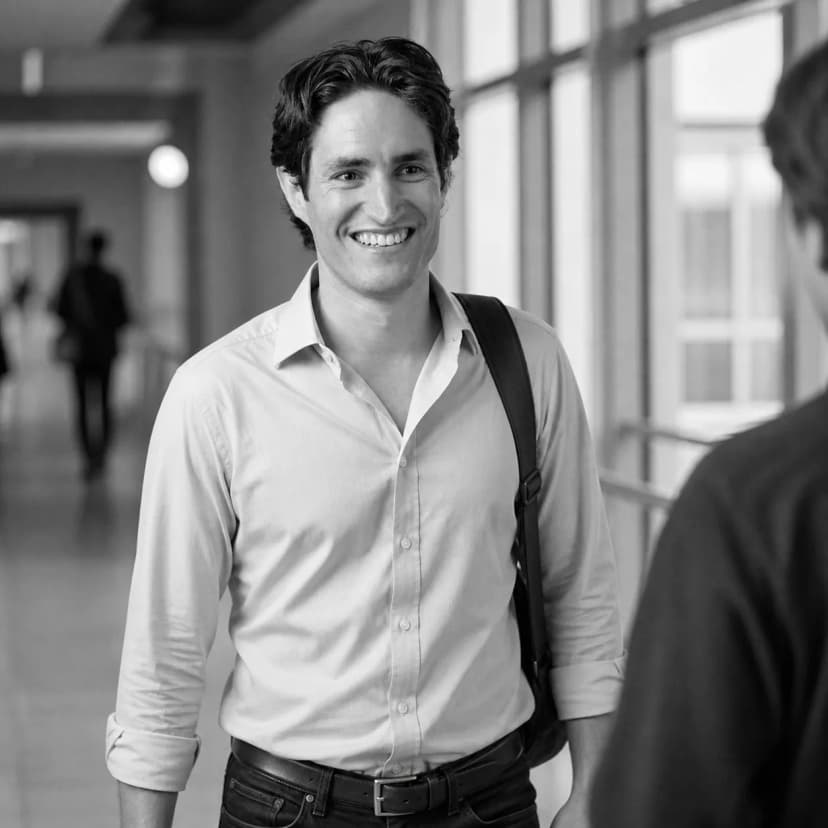
Adam Alter is a professor of marketing and psychology at NYU Stern School of Business who writes trade books about how design and environment shape behaviour without people noticing. His three books trace an arc worth reading in order: Drunk Tank Pink (2013) leaned on social-priming research that mostly failed to replicate, Irresistible (2017) leaned on sturdier behavioural and industry evidence instead, and Anatomy of a Breakthrough (2023) moved on to creative problem-solving. The middle book, on behavioural addiction, is the one this site cites most.
Who they are
Adam Alter teaches marketing and psychology at NYU Stern School of Business, where his research sits at the boundary between social psychology and consumer behaviour: how names, colours, labels and interface design steer decisions that people experience as freely made. He has written three trade books for a general audience, each aimed at a different piece of that territory.
The most useful thing about Alter's body of work is not any single finding but the shape of it over time. Drunk Tank Pink (2013) leaned heavily on the social-priming literature that was dominant in social psychology at the time, citing studies on physical warmth, money priming and colour effects that would go on to fail large-scale replication attempts within a few years of publication. He flagged the weaker evidence in his own endnotes, including the mixed record of the Baker-Miller pink effect the book takes its title from. But the book is, in retrospect, a snapshot of a field taken just before a large part of it collapsed under scrutiny.
Irresistible (2017), published four years later, argues a related case, that technology products are engineered to be habit-forming, using a different kind of evidence: behavioural data, industry practice and interviews rather than priming studies. Read next to Drunk Tank Pink, it reads as a researcher adjusting his standards of evidence in real time, without ever announcing the correction. Anatomy of a Breakthrough (2023) moves away from addiction and persuasion entirely, toward the psychology of getting unstuck on hard problems.
Books
Key papers
Alter, A. (2013). Drunk Tank Pink: And Other Unexpected Forces That Shape How We Think, Feel, and Behave. Penguin Press.
Alter, A. (2017). Irresistible: The Rise of Addictive Technology and the Business of Keeping Us Hooked. Penguin Press.
Alter, A. (2023). Anatomy of a Breakthrough: How to Get Unstuck When It Matters Most. Simon & Schuster.
Bibliography verified against publisher listings, 2026-09-01.
Key ideas
The correction arc. Alter is the clearest case in this vault of a popular-science author visibly adjusting to the replication crisis between two books. Drunk Tank Pink built its case on studies such as Williams and Bargh's coffee-cup warmth priming and Vohs's money priming, most of which did not hold up in high-powered replication attempts in the years after publication. Irresistible does not repeat that mistake, resting instead on behavioural evidence and industry practice. Alter never states the shift as a correction, but the pattern is there for anyone reading the two books in order. See the replication crisis.
The six-ingredient model of behavioural addiction. Irresistible's central contribution is a diagnostic checklist for whether a product has been engineered to hook its users, covering goals, feedback, progress, escalating difficulty, unresolved tension and social interaction. It functions less as a theory than as an audit tool, and it is the piece of Alter's work most directly useful to anyone assessing a product's design. See behavioural addiction and behavioural architecture.
Variable rewards and operant conditioning. Alter draws the same line from B. F. Skinner's operant conditioning experiments to app design that Nir Eyal draws, treating unpredictable reward schedules as the engine behind compulsive checking. See variable rewards.
What held up and what did not. Alter's own research on processing fluency, how easily a name or a piece of text is parsed, has replicated well and remains one of the more durable findings in Drunk Tank Pink. The material that did not hold up was largely other researchers' priming work he was reporting on in good faith, not his own experiments, a distinction worth keeping in mind before treating the book as a cautionary tale about the author rather than about a field.
Concepts on this site
Behavioural addiction, the six-ingredient model Alter proposed in Irresistible
Behavioural architecture, the design logic behind engineered habit loops
Persuasive design, the wider design tradition his work sits inside
Variable rewards, the reward-schedule mechanism his six-ingredient model leans on
Operant conditioning, the behaviourist foundation beneath both
The replication crisis, the context that separates his two main books
Wanting vs liking, the neuroscience distinction his engagement research is read against on this site
Find them elsewhere
X handle is linked from his own site, adamalterauthor.com, and the matching Bluesky account states his NYU Stern professorship and his books. A separate adamalter.bsky.social belongs to a sportscaster and was rejected
Checked 2026-09-10. Handles and affiliations go out of date, so treat this block as a snapshot rather than a standing fact.
Sources
- Alter, A. (2013). Drunk Tank Pink: And Other Unexpected Forces That Shape How We Think, Feel, and Behave. Penguin Press.
- Alter, A. (2017). Irresistible: The Rise of Addictive Technology and the Business of Keeping Us Hooked. Penguin Press.
- Alter, A. (2023). Anatomy of a Breakthrough: How to Get Unstuck When It Matters Most. Simon & Schuster.
- Bibliography verified against publisher listings, 2026-09-01.