Why the Odd One Out Gets Remembered
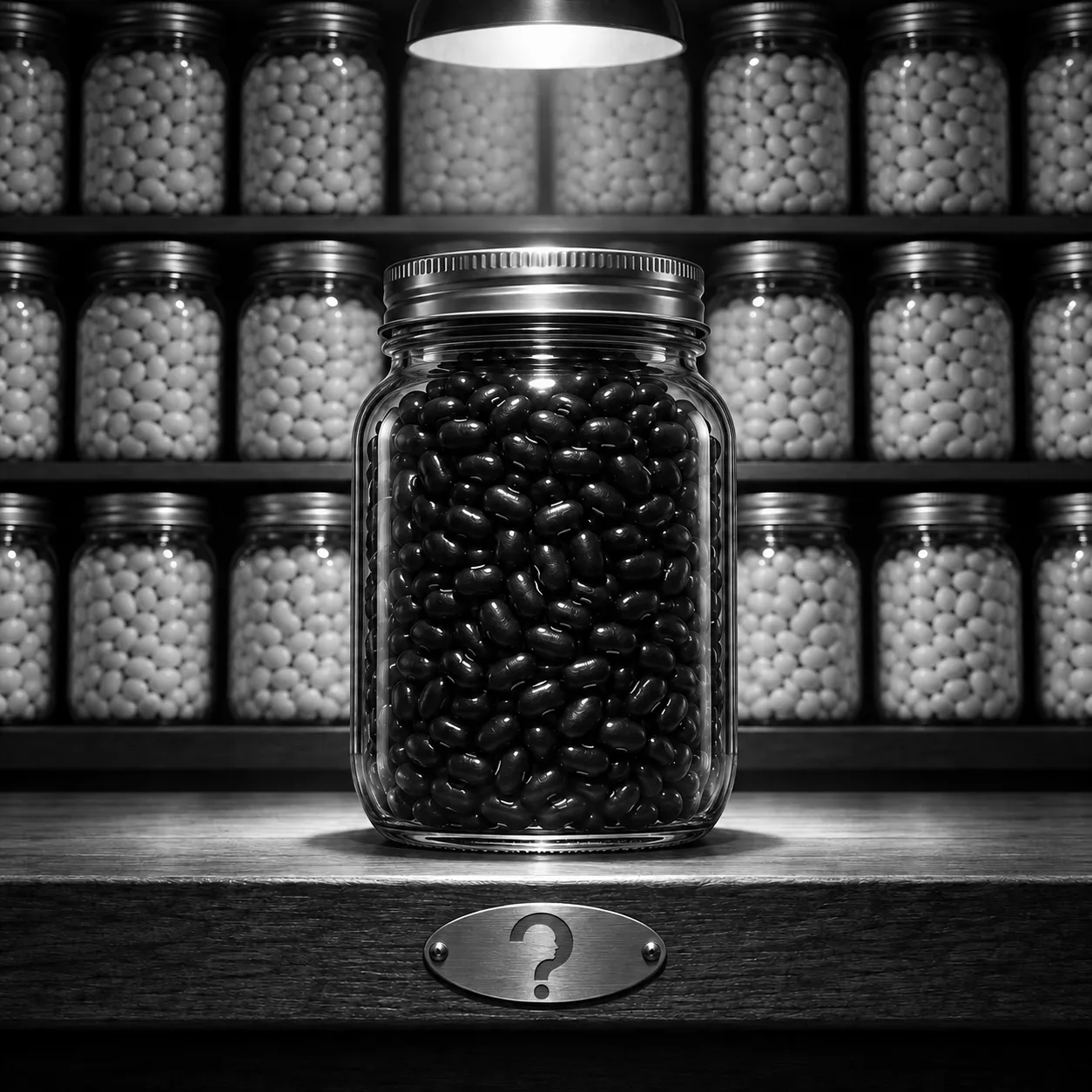
In a list of similar things, the item that breaks the pattern is the one we keep. The research shows it depends on what surrounds it, and that the same pull can steer a hurried choice away from what we prefer.
Key takeaways
- In Hedwig von Restorff's 1933 experiment, 70 per cent of volunteers recalled the odd item in a list of similar ones, against 40 per cent when every item in the list was different.
- R. Reed Hunt's 1995 replication with 40 undergraduates found the effect even when the odd item came second in the list, before it could look unusual.
- In data from a 2007 paper by Jenni Romaniuk and colleagues, only about 17 per cent of buyers saw their own brand as different or unique, so most bought a brand they did not see as different.
- A 2012 Caltech study found that in rapid food choices, visual saliency influenced decisions more than preferences did, especially under cognitive load.
The isolation effect is a plain idea with a formal name: in a run of similar things, the odd one out gets remembered. A number among nonsense syllables, a red word in a list of black ones, a single circle among squares. Psychologists credit it to Hedwig von Restorff, who published her experiments in German.
What von Restorff actually tested
Modern accounts tell the story as one about attention. The strange item catches the eye, gets a second look and so lodges in memory. That account is tidy, and it is not quite what the original paper showed. Von Restorff wrote in German. In 1995 the memory researcher R. Reed Hunt set out what she did in Psychonomic Bulletin and Review, describing it as a "widely cited but little read piece".
Her lists were ten items long. Some held nine nonsense syllables and one number, others nine numbers and one syllable. The detail that matters is where she put the misfit: second or third in the list, before her volunteers could know what the rest would contain. At that point nothing about it looked unusual. The position was chosen on purpose, so that the odd one out would not stand out to the eye, and it was still recalled far better than the same kind of item in a control list.
Hunt repeated the experiment with 40 undergraduates, placing the odd item second every time, and got a similar pattern.
| Study | Odd item among similar items | Same item in an all-different list |
|---|---|---|
| von Restorff, 1933, 15 volunteers | 70 per cent | 40 per cent |
| Hunt, 1995, odd syllable | 70 per cent | 40 per cent |
| Hunt, 1995, odd digit | 80 per cent | 30 per cent |
The figures are the share of people who recalled the item after ten minutes spent reading something else.
Context decides what stands out
The control list carries the result. In it, all ten items differed from one another: a number, a syllable, a colour patch, a letter, a word, a photograph, a symbol, a real button, a punctuation mark and the name of a chemical. A syllable in that list is just as different from its neighbours as a syllable among numbers. Yet it was remembered less well. Von Restorff's reading, which Hunt endorses, is that difference alone does not produce the effect. What makes the odd one out memorable is that everything around it is alike.
Hunt draws a line between difference, which is a property of the items, and distinctiveness, which is what the mind makes of that difference. A difference only becomes distinctive against a background of similarity.
A difference only becomes distinctive against a background of similarity.
Carry that from a word list to a supermarket aisle and it predicts something specific, though nobody in these studies tested it on a shelf. A row of packs that each shout in a different colour looks more like the all-different list than the isolation list. The pack most likely to be remembered is the one that breaks a pattern the eye has already settled into.
The advertising strategist Richard Shotton reports in The Choice Factory (Bias 4, pages 27 to 28) that he reran a version of the test with 500 people, including a list of eleven car logos and one fast-food logo. The fast-food brand was mentioned four times as often as the average car brand. The data are unpublished, so we report it without leaning on it.
Telling brands apart on shelves
Byron Sharp's How Brands Grow turns this memory effect into a brand strategy. Chapter 8, co-written with Jenni Romaniuk and opening at page 112, argues that brands should build distinctiveness rather than differentiation. Differentiation means giving buyers a meaningful reason to see a brand as different or better. Distinctiveness means being easy to recognise through colours, logos, characters, taglines and advertising styles that identify the brand without claiming anything for it. The book calls these distinctive assets and notes that they can be trademarked, while a meaningful difference usually cannot.
Much of the evidence comes from a 2007 paper by Romaniuk and colleagues in the Australasian Marketing Journal. Customers across many categories in Australia and the UK were asked whether the brand they bought was different or unique. On the averages the book prints from that paper in its Table 8.3, about 11 per cent of buyers called their brand different, 10 per cent called it unique and 17 per cent said either. Most did not describe their own brand as different or unique, and they bought it anyway. The paper's answer is to place distinctiveness at the centre of brand strategy.
The chapter tests its own measure with care. Brands that genuinely are unusual do score highly on it: Aldi reached 67 per cent on "different" among its customers and Subway 50 per cent on "unique". Rerun on a five-point rating scale (page 124), the question returned an average of 2.5, with no brand averaging as high as 4. In this account the typical brand is bought without being seen as the odd one out in any meaningful way, and is found because it is easy to recognise.
The same table has a column the book leaves without comment. Asked about the category as a whole, an average of 54 per cent of customers could point to at least one brand they saw as different or unique, and 76 per cent in soft drinks. Our review of the book also found that its tables measure perception and never carry a price, a margin or a return. The conclusion at page 126, that perceived differentiation "plays little part in the success of brands", reaches further than the tables beneath it.
Bright packs and real taste
Being easy to spot is also a way of being picked for the wrong reason. In a 2012 study in the Journal of Consumer Psychology, Milica Milosavljevic and colleagues at Caltech ran three real food-choice experiments. People chose between options that differed in how much they liked them and in visual saliency, meaning how bright and eye-catching each one looked. When choices had to be made quickly, saliency influenced them more than preferences did. The bias grew under cognitive load, when people's minds were busy with something else, and it was strongest when they had no firm favourite among the options.
The bias was measured for rapid decisions, and the paper does not claim the same pull over slow, deliberate ones. But a shelf in a busy shop comes close to those conditions: many options, little time and a mind on the rest of the list. The odd one out on that shelf has an advantage that says nothing about whether it is any good. Before the basket, ask whether you reached for a pack because you prefer what is inside or because it was the brightest thing in view.
When strange stops sticking
The bizarreness effect looks like the strongest version of the odd one out. Picture a dog riding a bicycle rather than chasing one, and the stranger image seems the easier to keep. Mark McDaniel and Gilles Einstein tested this across five experiments in 1986. Bizarre images helped recall when bizarre and ordinary items were mixed in the same list. The advantage held across different presentation speeds, which counts against a simple story about extra attention, and the authors concluded that distinctiveness may underlie it.
A 1995 follow-up by the same pair and three co-authors found that the mixing itself produced the effect. A strange image needs ordinary ones beside it, which is von Restorff's point arriving by a different route.
On that reasoning, an advert that is strange in a break of ordinary ones has the background it needs. A break in which every advert strains to be strange begins to resemble the all-different list, where nothing is isolated because nothing is alike. The same goes for a feed in which every post has been designed to stop the thumb.
On this evidence, the odd one out is remembered, the effect is more than ninety years old and has held up, and it depends on its surroundings as much as on the item. Whether being remembered leads people to choose well, or only to choose what they noticed, the research here does not settle. Distinctive assets help a buyer find a brand; the Caltech results show that the same visibility can pull a hurried choice away from what that buyer actually prefers.
If every brand on a shelf learns the same lesson and works to become the odd one out, which of them will still look odd to a tired shopper, and will the pack that wins that contest be the one the shopper would have chosen with a minute to think?
Common questions
What is the von Restorff effect?
It is the finding that the odd one out in a list of similar items is remembered better. Hedwig von Restorff reported it in 1933, with 70 per cent recall for an isolated item against 40 per cent in a control list, and R. Reed Hunt replicated it in 1995.
Why do we remember the odd one out?
Not only because it grabs attention. Von Restorff placed the odd item second or third, before it could look unusual, and it was still better remembered. Hunt argued in 1995 that the effect depends on the similarity of the surrounding items, not on difference alone.
Does standing out on a shelf make people buy a product?
It can sway fast choices. Milica Milosavljevic and colleagues found in 2012 that at rapid decision speeds visual saliency influenced food choices more than preferences did, especially under cognitive load and when people had no strong favourite.
Is distinctiveness better than differentiation for brands?
How Brands Grow argues so, citing a 2007 paper in which only 17 per cent of buyers saw their brand as different or unique. The same data show 54 per cent of customers could name at least one differentiated brand, so the question remains open.
Sources
von Restorff, H. (1933). “Über die Wirkung von Bereichsbildungen im Spurenfeld.” Psychologische Forschung, 18(1), 299-342. doi:10.1007/BF02409636. Abstract read: German abstract on the Springer page, paraphrased; the paper itself is in German and was read through Hunt (1995).
Hunt, R. R. (1995). “The subtlety of distinctiveness: what von Restorff really did.” Psychonomic Bulletin and Review, 2(1), 105-112. doi:10.3758/BF03214414. Full text read: von Restorff's 15 subjects, isolate in second or third position, ten-item lists, ten minutes of prose reading before free recall, recall .70 isolated against .40 control; Hunt's replication with 40 undergraduates, isolate always second, .70 (syllable) and .80 (digit) against .40 and .30; the all-different control list and the similarity argument; 'widely cited but little read piece'.
McDaniel, M. A., & Einstein, G. O. (1986). “Bizarre imagery as an effective memory aid: the importance of distinctiveness.” Journal of Experimental Psychology: Learning, Memory, and Cognition, 12(1), 54-65. doi:10.1037/0278-7393.12.1.54. Abstract read: five experiments; bizarre imagery aided recall in mixed lists; effect persisted across presentation timings; distinctiveness proposed as the explanation.
McDaniel, M. A., Einstein, G. O., DeLosh, E. L., May, C. P., & Brady, P. (1995). “The bizarreness effect: it’s not surprising, it’s complex.” Journal of Experimental Psychology: Learning, Memory, and Cognition, 21(2), 422-435. doi:10.1037/0278-7393.21.2.422. Abstract read: Experiment 1 found that mixing, rather than the small number of bizarre items, produced the effect.
Romaniuk, J., Sharp, B., & Ehrenberg, A. (2007). “Evidence concerning the importance of perceived brand differentiation.” Australasian Marketing Journal, 15(2), 42-54. doi:10.1016/S1441-3582(07)70042-3. Abstract read: low perceived differentiation across many categories and two countries; customers still buy; distinctiveness placed at the centre of brand strategy. Category averages of 11, 10 and 17 per cent and the 54 per cent column taken from the book's Table 8.3, which reproduces this paper.
Milosavljevic, M., Navalpakkam, V., Koch, C., & Rangel, A. (2012). “Relative visual saliency differences induce sizable bias in consumer choice.” Journal of Consumer Psychology, 22(1), 67-74. doi:10.1016/j.jcps.2011.10.002. Abstract read: three real food choice experiments; at rapid decision speeds saliency influences choices more than preferences; bias increases with cognitive load and is strongest without strong preferences.
Sharp, B. (2010). How Brands Grow: What Marketers Don't Know. Oxford University Press Australia and New Zealand. Read in full by this publication, with a reliability audit. Ch. 8 (co-written with Jenni Romaniuk), p. 112 onwards; Table 8.3; the rating-scale check at p. 124; the conclusion at p. 126.
Shotton, R. (2018). The Choice Factory: 25 Behavioural Biases That Influence What We Buy. Harriman House. Read in full by this publication, with a reliability audit. Bias 4, Distinctiveness, pp. 27-28: the author's own unpublished replication with 500 people and a logo list.