Irresistible
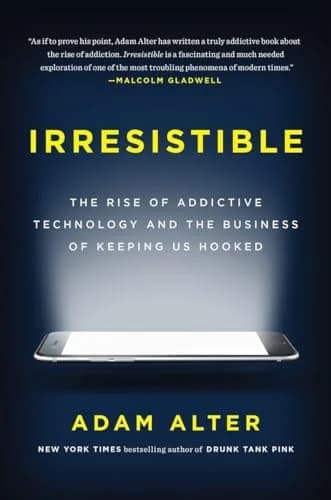
Adam Alter's 2017 book argues that behavioural addiction is now engineered at scale, and that the people building the products know it. Its evidence base is industry reporting, clinical work and behavioural research rather than the social-priming studies that carried *Drunk Tank Pink* four years earlier. That change is not announced anywhere in the book, and it is the most interesting thing about it.
What it covers
Alter opens on the observation that gets quoted most: some of the technology leaders who build these products limit the use of those products at home. The people closest to the machinery behave like people who understand it.
The book then sets out six ingredients Alter argues make an experience behaviourally addictive: compelling goals just out of reach, irresistible and unpredictable feedback, incremental progress, escalating difficulty, unresolved tension, and strong social connections. Each gets a chapter and a set of cases, from World of Warcraft to Instagram to fitness trackers.
Its most-quoted passage for this site is Kent Berridge's, on the asymmetry between the two reward systems: wanting is "much more robust and big and broad and powerful. Liking is anatomically tiny and fragile."
The last section is about designing distance, which is where Alter is at his most practical and least alarmed.
Main topics
- Behavioural addiction as engineered rather than incidental, and the insiders who restrict their own use.
- Compelling goals, and why a target just out of reach outperforms a target met.
- Variable feedback, the same variable-ratio machinery Eyal builds on in *Hooked*.
- Incremental progress and escalation, difficulty curves that keep competence just ahead of comfort.
- Unresolved tension, cliffhangers and the Zeigarnik effect, and why autoplay works.
- Social hooks, validation as a reward category.
- Children and screens, the section where the book is most contested.
- Designing distance, environmental architecture rather than willpower.
Concepts drawn from it
- behavioral addiction, the book's spine
- wanting versus liking, via the Berridge quotation
- variable rewards
- behavioural architecture, the practical response
- the disenchantment effect and digital loneliness
Reliability
More reliable than the same author's earlier book, and the difference is deliberate. Where *Drunk Tank Pink* leans on social priming, a literature that largely failed to replicate, Irresistible leans on industry reporting, clinical accounts and behavioural evidence. Alter never announces the change. He simply stops using the studies.
Two cautions when citing it.
The children-and-screens chapters take a more alarmed line than the current evidence supports. Andrew Przybylski's large-sample work finds wellbeing rising with moderate use, with harm at the heaviest use "about a third as bad as missing breakfast or not getting eight hours' sleep", and Christopher Ferguson finds only a negligible screen-time and depression relationship. The vault treats this as a live dispute with small effect sizes. Where Irresistible and *Indistractable* disagree on how alarmed to be, the disagreement itself is the honest thing to report.
And the addiction framing is broader than the clinical literature. DSM-5 recognises gambling disorder; internet gaming disorder sits in the section reserved for conditions needing further study. Eyal's counter-line is worth holding alongside Alter's: almost nobody is pathologically addicted to the internet.